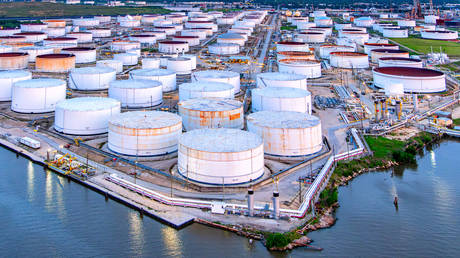
The desert near Dhahran doesn't just hold heat; it holds a silence that feels heavy, like the air before a lightning strike. If you stand near the massive infrastructure of the world’s most profitable company, you don’t see the spreadsheets or the geopolitical maps that dominate news cycles in London or New York. You see steel. You see the shimmering haze of heat rising off pipelines that stretch toward a horizon currently clouded by the smoke of distant, and not-so-distant, fires.
Saudi Aramco recently reported a net income of $121.3 billion for the past year. To the average person, that number is an abstraction, a figure so large it loses its meaning. It is roughly the GDP of a mid-sized nation. But this isn't a story about a windfall. It is a story about the strange, high-stakes physics of keeping a global engine running while the world around it threatens to tear itself apart. Meanwhile, you can read similar stories here: Madrid Plays a Dangerous Game of Economic Diplomacy with Beijing.
The Mathematics of Chaos
Oil is often called the lifeblood of the modern world, but it behaves more like its nervous system. When a drone strikes a tanker in the Red Sea or tensions boil over in the Levant, the system twitches. Usually, conflict sends prices screaming toward the ceiling. Uncertainty is the market's greatest stimulant. Yet, looking at the recent $121 billion profit—a slight dip from the record-shattering $161 billion of the previous year—we see a paradox.
The world is on edge. The Middle East is facing its most volatile period in decades. Ships are diverting around the Cape of Good Hope to avoid missiles. And yet, the price of Brent crude has remained stubbornly, almost eerily, disciplined. To explore the bigger picture, we recommend the excellent article by Investopedia.
Consider a hypothetical trader named Elias. He sits in a glass-walled office in Singapore, watching the ticker. In 1990 or 2003, the headlines he sees today would have caused him to buy every futures contract in sight. But today, Elias is hesitant. He knows that while the drums of war are beating, the global economy is catching a cold. High interest rates in the West and a sputtering industrial engine in China act as a wet blanket on the fire.
Aramco’s profits are the result of this grueling tug-of-war. The company is making billions not because the world is at peace, but because it has mastered the art of standing still in a hurricane.
The Weight of the Crown
To understand why these profits matter, we have to look past the corporate headquarters and into the heart of a kingdom’s transformation. For Saudi Arabia, Aramco is more than a company. It is a bridge. On one side of that bridge is a past defined entirely by the extraction of ancient carbon. On the other side is "Vision 2030," a sprawling, ambitious, and wildly expensive attempt to build a future where the country doesn't need oil at all.
Think of it as a captain trying to rebuild the ship while sailing through a storm.
The $121 billion isn't just sitting in a vault. It is being funneled into neon-lit cities rising from the sand, into massive solar farms, and into global sports leagues. The stakes are deeply human. For a young Saudi professional in Riyadh, those profits represent the possibility of a career in tech or tourism rather than the oil fields. If the profits falter, the bridge collapses.
The pressure is immense. The Saudi government owns the vast majority of the company, and it relies on Aramco's massive dividends—which were actually increased to nearly $98 billion despite the dip in profit—to keep the lights on and the dreams funded. It is a high-wire act. To keep the dividend high while prices are suppressed by global economic gloom, the company has to be ruthlessly efficient.
The Invisible Infrastructure of Risk
There is a specific kind of tension that comes with managing assets that the whole world wants, and half the world wants to disrupt.
Imagine a technician on a platform in the Arabian Gulf. We can call him Omar. Omar’s job is boring until the moment it isn't. He knows that his workplace is a geopolitical chessboard. When the news talks about "production cuts" or "supply chain resilience," Omar sees it in the increased security patrols and the redundant systems he has to check twice.
Aramco recently paused plans to expand its maximum sustainable capacity. The world media treated this as a dry shift in corporate strategy. In reality, it was a profound admission of uncertainty. It was the giant saying, "The future is too blurry to keep building at this speed."
The company is currently producing about 9 million barrels a day. It has the capacity for 12 million. That gap—that unused potential—is the only thing keeping the global economy from a total cardiac arrest every time a new headline breaks. It is a buffer. A cushion made of oil.
The Ghost of the Energy Transition
While the conflict in the Middle East provides the immediate drama, a much slower, more existential drama is unfolding in the background. The world is trying to quit oil. It’s a messy, inconsistent breakup.
Western oil majors like Shell and BP are being pulled in two directions by activists and shareholders. They are cutting investments in long-term projects. Aramco, conversely, is doubling down on the belief that the world’s hunger for energy will outlast the current wave of optimism for a purely green transition.
They are betting that even if we all drive electric cars, the world will still need the chemicals, the plastics, and the heavy industrial heat that only hydrocarbons can provide. Their profit isn't just a reward for today’s production; it is a war chest for a long, slow siege against the end of the oil age.
They are investing heavily in "blue hydrogen" and carbon capture. These aren't just buzzwords. They are survival strategies. If you can make oil "cleaner," you can stay in business longer.
The Ripple Effect in the Grocery Aisle
It is easy to think that the multibillion-dollar movements of a state-owned oil giant have nothing to do with the price of bread in a London suburb or the cost of a commute in Ohio. That is an illusion.
Everything we touch is moved by oil. The fertilizer that grows the wheat is made from natural gas. The plastic wrapping is a petroleum product. The ship, the truck, and the delivery van all pay the "Aramco tax" in one way or another.
When Aramco decides to pay out a massive dividend to the Saudi state instead of reinvesting it in new drilling, they are signaling that they believe prices need to stay high to justify their existence. They aren't just price takers; they are the floor beneath the global economy's feet. If that floor sags, everyone feels the vibration.
The Sound of the Sand
We often talk about these entities as if they are cold, calculating machines. But they are run by people who are looking at the same maps we are. They see the instability. They feel the shift in the wind.
The record profits of the last two years were an anomaly, a spike caused by the sudden vacuum left by Russian sanctions. The current $121 billion is a return to a "new normal"—a world where conflict is constant, but demand is fragile. It is a more dangerous world for a business to navigate because there is no margin for error.
In the corporate offices, the talk is of "reliability" and "operational excellence." In the desert, the reality is a constant battle against the elements and the encroaching chaos of a region in flux.
The sun sets over the Ghawar field, casting long, thin shadows over the pipes and the pumps. The machinery hums, a low-frequency vibration that you can feel in your teeth if you stand still long enough. It is the sound of $121 billion being pulled from the earth, one stroke at a time, while the rest of the world wonders how much longer the ground can hold.
The money is real. The steel is real. But the security it buys is as shimmering and elusive as a mirage on the summer road. Every barrel pumped is a heartbeat in a body that is running a fever. We watch the numbers because we have to, but the real story isn't the profit. It's the cost of keeping the world's eyes open in the dark.
The desert remains, indifferent to the dividends and the drones alike. It has seen empires rise on the strength of what lies beneath its surface, and it has seen them fade when the well runs dry or the fire gets too close. For now, the pumps keep moving. The money keeps flowing. The bridge to the future is still standing, but the toll to cross it has never been higher.