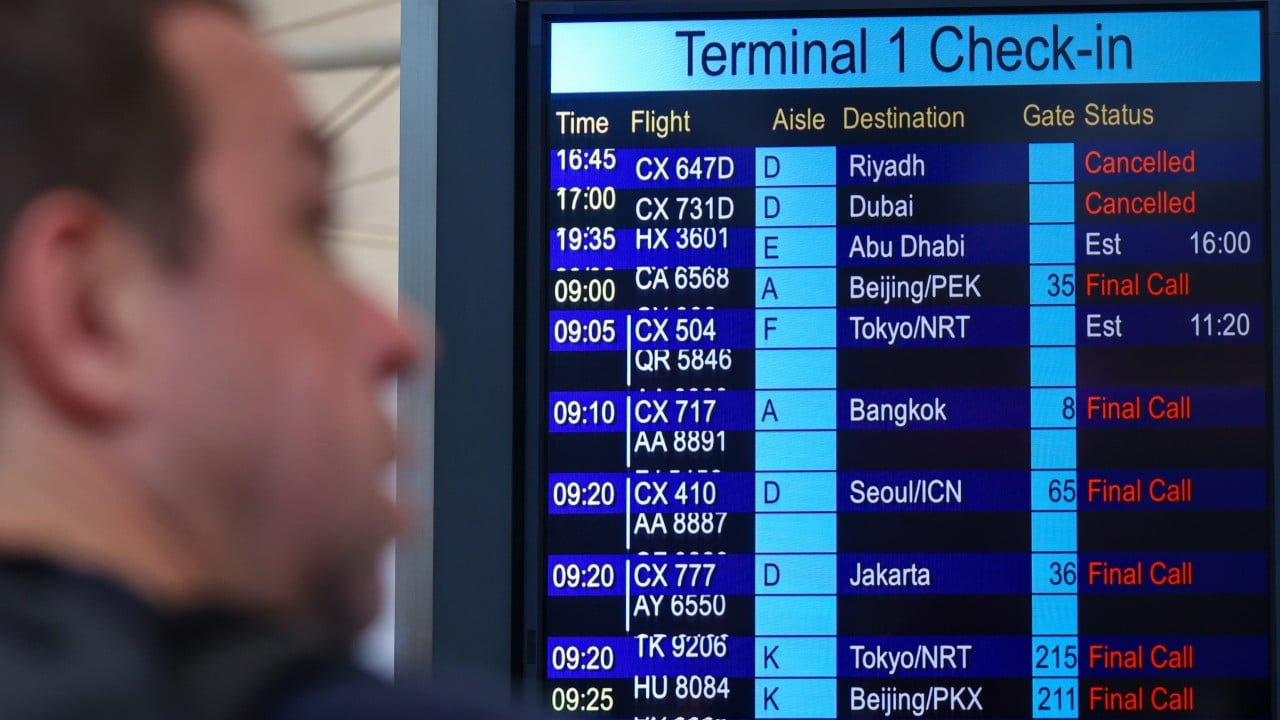
The blue light of a smartphone screen is a cruel companion at three in the morning. For Sarah, a freelance graphic designer sitting on the floor of a terminal in Hong Kong, that light was a countdown. Every few minutes, she refreshed a news feed that pulsed with the rhythm of a heartbeat in crisis. Reports of missiles streaking across the dark over Isfahan. GPS jamming in the Eastern Mediterranean. A sudden, jagged closure of Jordanian airspace.
Sarah wasn't a diplomat. She wasn't a military strategist. She was just a woman trying to get to her sister’s wedding in London with a Cathay Pacific ticket that was rapidly becoming a digital ghost.
When global powers exchange fire, we talk about the macro. We analyze Brent crude prices. We map out the "no-fly" corridors that now jaggedly avoid Iranian and Israeli airspace like a child dodging cracks on a sidewalk. But the micro is where the real wreckage sits. The micro is Sarah, and thousands like her, trapped in a bureaucratic no-man’s-land where a carrier’s "force majeure" clause becomes a brick wall.
The Geography of Anxiety
Modern aviation is a miracle of thin margins. A flight from Hong Kong to Europe traditionally skirts the edges of the Middle East, slicing through airspace that, until recently, was merely a backdrop for a mid-flight movie. Now, that sky is a minefield of shifting geopolitics. When Israel and Iran move from a shadow war to direct strikes, the invisible highways of the sky vanish.
For a passenger, the first sign of a geopolitical shift isn't a headline; it's a notification. Flight CX251 is cancelled.
The ripple effect is instantaneous. When Cathay Pacific or any major carrier pulls a flight due to "operational reasons" tied to security, they aren't just moving a plane. They are shattering a sequence of human events. Sarah’s sister’s wedding. A business deal in Milan. A final goodbye to a sick relative in New York.
The frustration boiling over in airport lounges and on social media isn't just about the delay. It is about the money. Specifically, it is about the "refund gap."
The Terms and Conditions of Terror
Consider the math of a stranded traveler. You paid $1,800 for a round-trip ticket. The airline cancels because the sky over Tehran is glowing with anti-aircraft fire. You ask for your money back. The airline offers a "travel credit" valid for twelve months, or perhaps a refund that will take sixty days to process, minus "administrative fees."
But you need to get home now.
Because the entire industry is scrambling to reroute, the remaining seats on other carriers—the ones willing to fly the long way around Africa—have tripled in price. You are staring at a $4,000 one-way ticket. The airline’s credit is useless because they have no flights left to sell you that week. You are, for all intents and purposes, being asked to subsidize the airline’s risk management with your own savings.
This is the "Middle East surcharge" that no one puts on a brochure.
Critics and consumer advocates are pointing to a growing divide in how passengers are treated based on where their journey began. If Sarah were flying out of an EU airport, or even certain US hubs, she would be protected by robust passenger rights laws like EC 261. These laws don't care if a war started; they care that the passenger is made whole.
But for those flying through Asian hubs like Hong Kong, the protections are as thin as the oxygen at thirty thousand feet. Cathay’s policies, like many of its regional peers, often leave the burden of "Extraordinary Circumstances" squarely on the shoulders of the person in seat 42C.
The Invisible Stakes of a Reroute
When an airline decides to fly around a conflict zone rather than through it, the cost is staggering. A detour around Iranian airspace can add two hours to a flight. That means twenty tons of extra fuel. It means crew shifts that suddenly exceed legal limits, requiring expensive mid-route stops.
Airlines are businesses. They are currently caught between a desire to maintain safety and a desperate need to protect a bottom line that was already decimated by years of pandemic-era lockdowns. Every time a missile is launched, a spreadsheet in a corporate office in Lantau vibrates.
But the human cost doesn't fit in a cell on a spreadsheet.
Imagine a hypothetical traveler named David. David saved for two years to take his family on a trip to the Holy Land. He is caught in the crossfire of a cancellation. The airline tells him they can’t fly him back because the insurance premiums for the route have spiked. They offer him a refund, but only for the "unused portion" of the ticket. Because he already flew the first leg, the airline calculates the value of the return leg at a fraction of the total cost. David is left in a hotel room in Tel Aviv, watching the sky, with $300 in refund credit and a $5,000 credit card bill for the emergency flights he just had to book on a different carrier.
This isn't just a policy dispute. It is a crisis of trust.
The Myth of the "Seamless" Journey
We have been sold a version of the world where borders are invisible and travel is a right. We use words like "global village" and "seamless connectivity." But the moment a drone enters another country's airspace, those illusions evaporate. Suddenly, the "global village" has high walls and the "seamless" journey is full of jagged edges.
The anger directed at Cathay Pacific in recent weeks isn't just about the money. It’s about the feeling of being discarded. When a passenger pays for a premium service, they believe they are buying more than a seat; they are buying a promise of transit. When that promise is broken by "the hand of God" or the hand of a general, the passenger expects the airline to act as a partner, not a debt collector.
The current friction points—the long wait times on customer service lines, the opaque refund portals, the refusal to cover hotel costs during "war-related" delays—reveal a fundamental truth about modern travel: You are on your own.
A New Architecture of Risk
If this is the new normal—a world where regional conflicts can blink on and off like a faulty neon sign—the way we buy travel has to change. The "standard" ticket is a gamble.
Travel insurance used to be an afterthought, a $50 box you checked to feel safe. Now, it is the only thing standing between a traveler and financial ruin. But even insurance has "acts of war" exclusions. We are entering an era where the fine print is more important than the destination.
We are seeing a shift in the power dynamic. Travelers are starting to vote with their wallets, looking for carriers that offer "flexibility" as a core feature rather than a paid upgrade. They are looking for airlines that have the logistical depth to reroute without leaving thousands stranded in the dark.
The industry is at a crossroads. It can continue to hide behind the legal jargon of "extraordinary circumstances," or it can recognize that in a volatile world, empathy is a competitive advantage.
The Cost of the Long Way Home
Sarah eventually got a flight. It wasn't with Cathay. It was a multi-stop odyssey that took her through Singapore and then over the southern tip of India, avoiding the Middle East entirely. It cost her double her original fare. She missed the rehearsal dinner. She arrived with red eyes and a sense of profound exhaustion.
As she sat at the wedding, watching her sister laugh, she felt a strange sense of disconnection. The world was celebrating, but she was still vibrating with the stress of the terminal. She kept thinking about the money. Not because she was greedy, but because that money represented her labor, her time, and her trust.
The missiles in the Middle East didn't just hit their targets. They hit a freelance designer's bank account in Hong Kong. They hit a family's vacation fund in Sydney. They hit the very idea that we can move freely across this planet without being held hostage by the whims of men in bunkers.
The sky is no longer just a place of transit. It is a ledger where the debts of nations are settled using the currency of our convenience and our safety. We look up and see a beautiful, empty blue. But for those waiting on a refund that may never come, that blue is the color of a very expensive, very lonely cage.
The silence from the airline's customer service line is the loudest sound in the world when you are five thousand miles from home. It is the sound of a system that knows exactly how much you are worth—and exactly how much it can afford to lose you.
As the sun sets over the terminal, the departures board flickers. Another flight is diverted. Another route is redrawn. Another thousand stories are interrupted, mid-sentence, by a conflict they did not choose and a policy they cannot change.
The true price of a ticket isn't found on a website. It is found in the moment you realize that the airline's "unforeseen circumstances" are, in fact, your life.
Would you like me to analyze the specific passenger rights of a different region to see how they compare to these circumstances?


