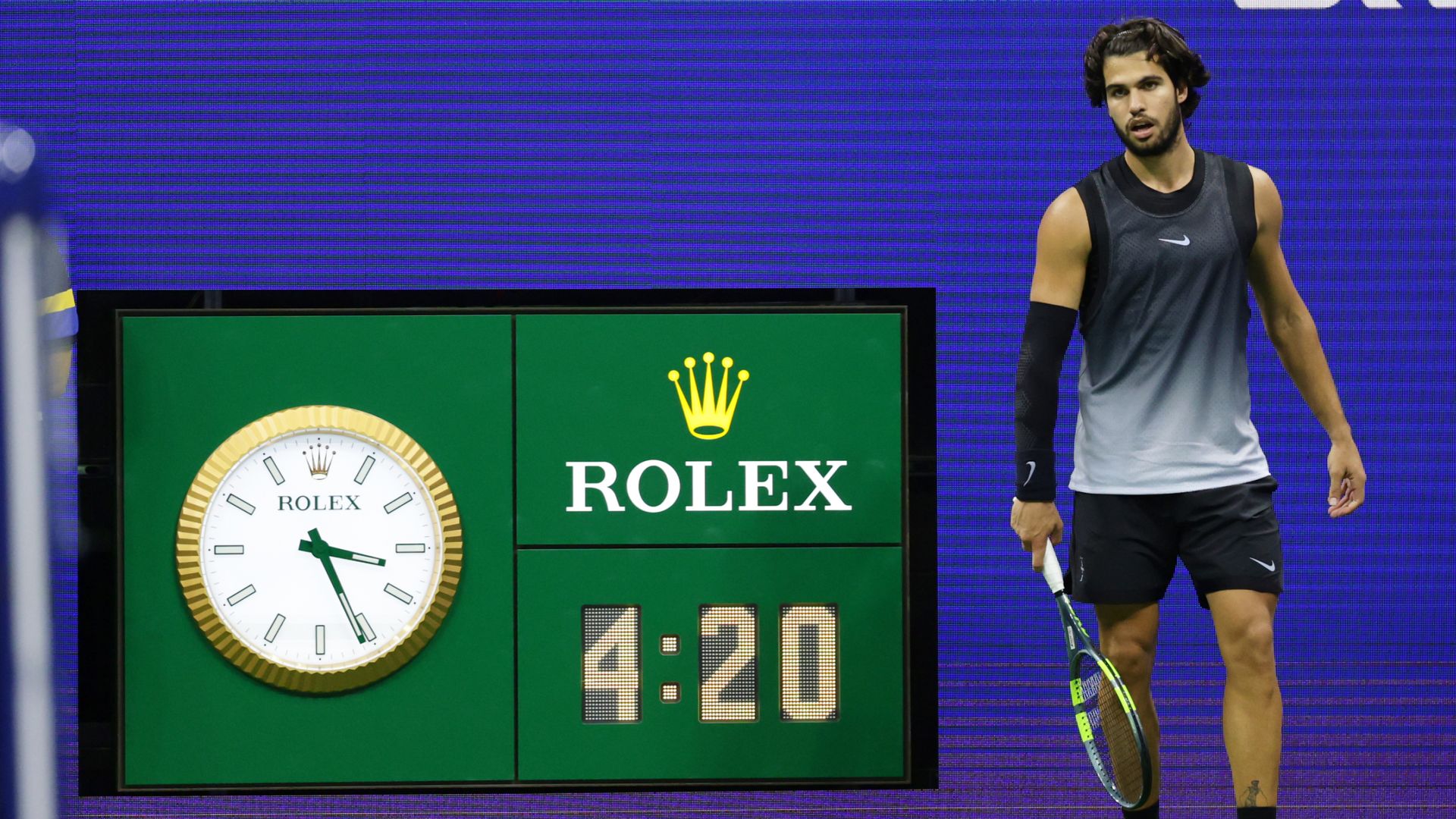
The scoreboard inside Arthur Ashe Stadium flashed 3:33 AM on a humid New York morning when Ben Shelton drove a 146 mph ace past a physically broken Carlos Alcaraz.
The final point of this US Open quarterfinal did not just seal a 6-7(5), 6-1, 6-3, 1-6, 7-6(10-7) upset. It shattered the tournament's previous record for its latest-ever finish, plunging professional tennis deeper into an avoidable scheduling crisis. Alcaraz, the defending champion fighting his way back from a five-month wrist layoff, spent the changeovers vomiting into a towel before succumbing to the suffocating exhaustion of a 4-hour and 28-minute war.
Fans streaming out into the concrete abyss of Flushing Meadows cheered the spectacle. Broadcasters celebrated the historic drama. But beneath the romanticized narratives of grit and late-night theater lies an institutional failure that puts athlete health at severe risk while treating the sport's core audience with outright contempt.
The Cost of Midnight Tennis
Tennis has a calendar problem, and its governing bodies refuse to fix it. When matches begin deep into the evening session due to bloated day-to-day programming blocks and lucrative television window demands, players become collateral damage.
Consider the logistical reality of a 3:33 AM conclusion. By the time a player finishes mandatory post-match press conferences, undergoes physical treatment for torn muscles and blisters, and attempts to wind down an adrenaline-spiked nervous system, dawn is breaking. Circadian rhythms are entirely demolished. Recovery windows shrink to hours instead of days.
This is not an isolated anomaly. It is the logical endpoint of a tournament model that prioritizes prime-time broadcast slots over human biology. Grand Slam organizers routinely cram high-profile matches into single-session night blocks, betting that young bodies can defy basic physiology. When players break down—visibly, publicly, on national television—the response is often a shrug and a promotional clip highlighting the grit of the survivor.
The Physical Toll Behind the Spectacle
Alcaraz did not lose simply because Shelton served out of his mind during the final-set tiebreak. He lost because human musculature has a breaking point.
The human body operates on strict metabolic and neurological reserves. At 2:00 AM, cognitive processing speeds drop, reaction times slow, and micro-tears in muscle fibers heal at a drastically reduced rate. Forcing elite athletes to execute high-velocity biomechanical movements at a time when the body is biologically programmed for deep sleep invites catastrophic injury.
- Neurological Fatigue: Hand-eye coordination degrades exponentially after midnight, turning precision sports into coin flips.
- Metabolic Depletion: Core body temperatures and glycogen storage cycles fall out of sync, leading to acute gastrointestinal distress—manifested painfully by Alcaraz on court.
- Recovery Deficit: A player competing past 3:00 AM cannot possibly reset for a subsequent round under fair competitive conditions.
The tournament draws a false equivalence between mental toughness and sheer sleep deprivation. Pushing through pain is woven into the DNA of professional sports. Pushing through metabolic collapse in the dead of night is simply negligent.
The Broadcasting Trap
Television rights dictate the heartbeat of modern tennis. Networks pay billions for exclusive windows, demanding matches that fit neatly into prime-time evening slots for domestic viewers.
This financial structure creates an immovable object. Afternoon sessions routinely run long due to competitive parity and tiebreaks, pushing the start time of the night session backward. By the time the marquee match of the evening walks onto the court, it is already past 9:30 PM. Add a couple of competitive sets, and a standard best-of-five Grand Slam encounter becomes a midnight marathon.
Organizers possess the administrative power to alter this trajectory. They choose not to use it.
Splitting sessions earlier, introducing strict cut-off times, or moving matches to secondary indoor courts when main-draw schedules fall catastrophically behind remain entirely viable solutions. Yet, tournament directors cling to the theater of the night session, treating the midnight hour not as a systemic failure, but as a marketing hook.
Where the Sport Goes From Here
Shelton moves forward to face Frances Tiafoe in an all-American semifinal that promises electric energy, while Alcaraz packs his bags to nurse a battered body.
The headlines will focus on the American's ascent and the dethroning of the champion. They will replay the 146 mph ace and marvel at the resilience required to survive a five-set tiebreak under a waning moon.
Those highlights obscure a darker truth. Until tournament organizers decouple prestige from sleep deprivation, tennis will continue to sacrifice its athletes on the altar of late-night television ratings. The record for the latest finish in US Open history was broken tonight. Unless the sport radically restructures its scheduling priorities, that grim milestone has an expiration date.