Imagine finding a library book in your late father's estate that was checked out during the middle of World War II. Then, realize it is 82 years overdue. That is exactly what happened when an Oregon resident mailed a package back to the San Antonio Public Library.
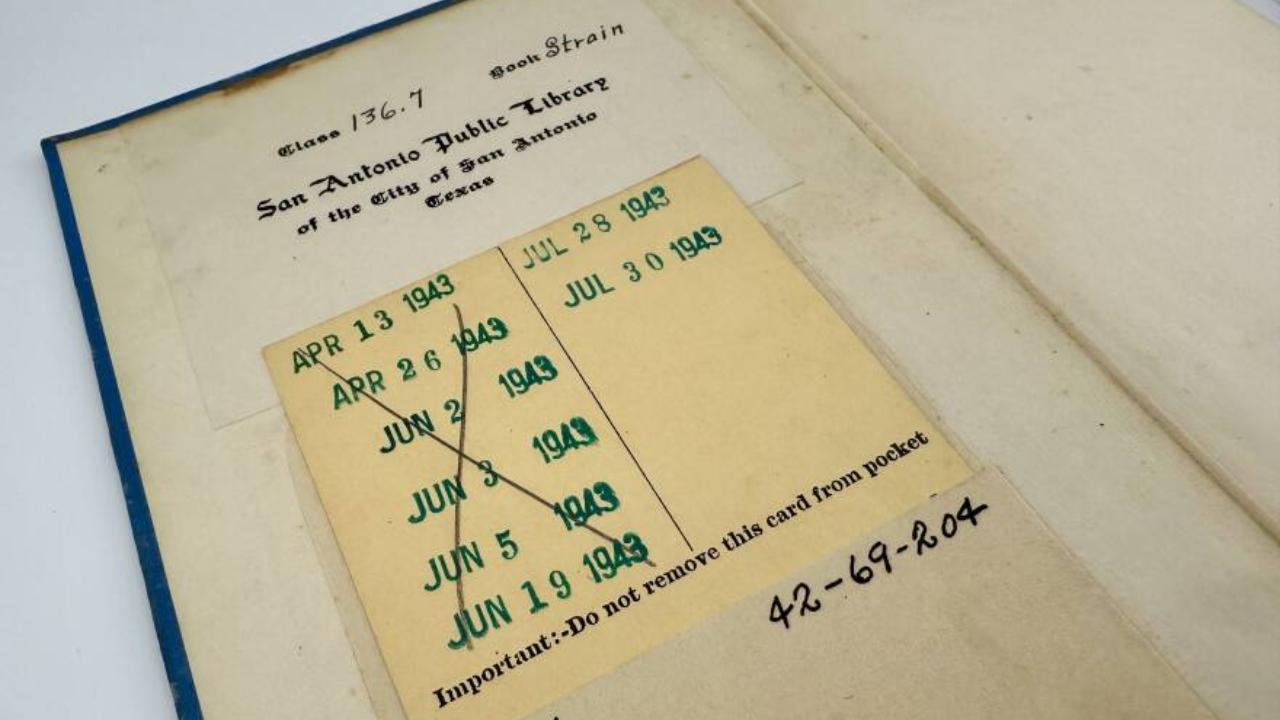
The book, Your Child, His Family, and Friends by Frances Bruce Strain, was originally checked out in July 1943. Back then, the world was consumed by global conflict, rationing was a daily reality, and a 28-day checkout window meant you actually had to walk down to the branch to renew your items. Instead of staying in Texas, the parenting guide packed its bags. It moved internationally to Mexico City when the borrower—the reader's grandmother—was transferred for work with the U.S. Embassy. From there, it crossed generations before turning up in Oregon.
When the parcel finally landed on library desks, it came with a humorous note. The sender worried aloud whether Grandma would be able to settle the balance.
The Math Behind a Century-Old Fine
If you look closely at the stamped rules inside the cover, old lending policies carried teeth. The daily fine printed in the front was three cents.
Three cents sounds trivial. Multiply that across 82 years, though, and the numbers escalate quickly. A strict daily tally comes out to roughly $900. Adjust that for inflation over eight decades, and you are looking at a bill exceeding $16,000.
Libraries used to treat lost materials harshly. If an item vanished for long enough, institutions automatically slapped replacement costs onto accounts, sometimes sending collections agencies after unsuspecting patrons. Families have occasionally panicked over minor book mishaps because of these historical precedents.
Fortunately, the sender caught a massive break.
Why Modern Libraries Are Dropping Late Fees
The San Antonio Public Library didn't charge a single penny for the 82-year delay. Why? Because the system abolished overdue fines entirely back in 2021.
Libraries across the country are ditching punitive fees for a simple reason. Fines do not actually make people return books faster. Instead, they scare low-income patrons away from utilizing public resources. When a modest fee turns into an unpayable debt, users simply stop coming back. They abandon their cards, keep the materials, and avoid the building out of sheer embarrassment.
By wiping the slate clean, institutions see higher return rates. People stop hiding overdue property under their beds. They feel safe walking back through the front doors.
Where the WWII Survivor Ended Up
Despite spending over eight decades packed in boxes and traveling across international borders, the vintage parenting manual arrived in remarkably good shape.
Library staff placed the antique volume on display in the Central Library lobby, letting visitors inspect a tangible slice of 1940s history. Afterward, the institution sent the book to the Friends of the San Antonio Public Library to be sold in their basement bookstore, turning an 82-year-old logistical anomaly into direct funding for modern community programs.
Check your shelves. You might just have a piece of history waiting to go home.