The smell hits you before the water does.
It is the heavy, mineral scent of damp earth mixed with old iron and decaying oak leaves—a scent that has settled over two thousand miles of British waterways for more than two centuries. Stand on the towpath of the Rochdale Canal just outside Manchester on a quiet Tuesday morning, and you are standing on top of a ghost machine. Meanwhile, you can read similar stories here: Code Red in the Aegean: Why Mediterranean Tourism is Standing on Shifting Ashes.
To understand why these narrow strips of water matter today, you have to picture the soot.
In 1761, when the Duke of Bridgewater opened his famous canal to haul coal directly from his mines at Worsley straight into the heart of Manchester, no one was thinking about kingfishers. Nobody gave a damn about water voles. The goal was brutal, raw efficiency: move heavy, dirty stuff faster than a horse pulling a wagon through knee-deep mud could ever manage. To understand the bigger picture, check out the excellent article by Lonely Planet.
Engineers like James Brindley cut through rock, sculpted embankments, and lined ditch after ditch with puddled clay—a simple mixture of clay and water trodden down until it became virtually waterproof. They engineered a veins-and-arteries system that fired up the Industrial Revolution. Millions of tons of coal, pottery, steel, and cotton moved along these murky liquid highways. The water was toxic, choked with industrial runoff, chemical dye, and raw sewage. It was a utilitarian sacrifice zone.
Then, the trains arrived. Then, the lorries. By the mid-twentieth century, the commercial traffic faded into silence. The iron lock gates began to rot. The brickwork crumbled. The grand arterial system of British industry was left to die.
Except it didn't die. It transformed into something entirely unplanned.
The Liquid Corridors
Consider a hypothetical traveler named Thomas, walking a five-mile stretch of the Grand Union Canal today. If Thomas had taken this walk in 1840, he would have heard the cracking of whips, the shouts of boatmen, and the heavy thud of wooden hulls slamming into lock walls. He would have smelled sulfur and wet mule fur.
Walk that same path now, and the silence is almost unsettling.
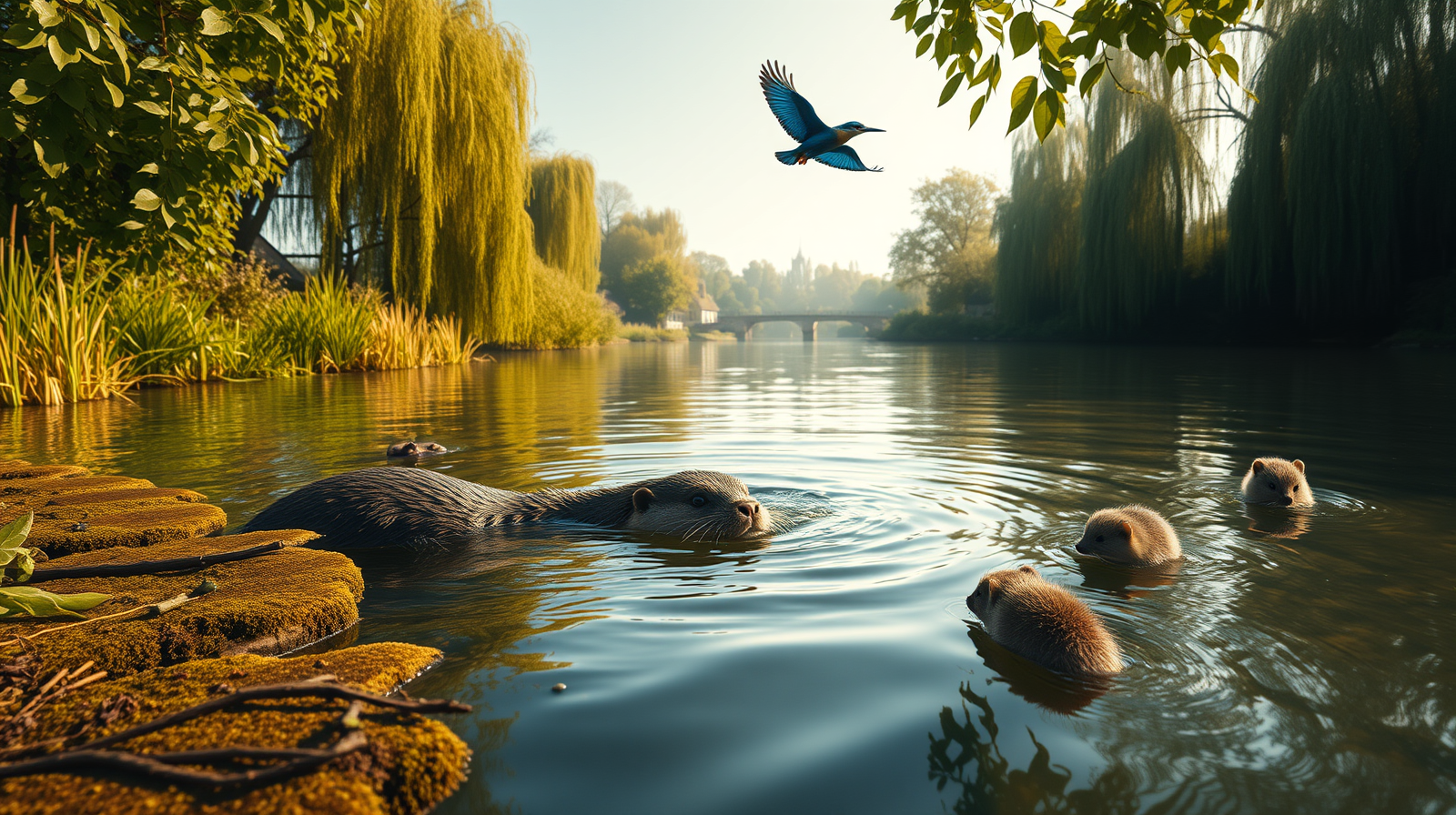
Where coal barges once scraped against stone, thick beds of yellow flag iris and reed sweet-grass bend in the gentle wake of a lone kayak. Bright flashes of electric blue cut across the shadows—a kingfisher hunting small fry in water that was once thick with coal dust.
What the original engineers created without knowing it was a massive, interconnected network of artificial wetlands.
In a modern countryside carved up by six-lane motorways, sprawling suburban housing developments, and high-intensity agricultural fields slathered in chemical fertilizers, wildlife faces a silent crisis: isolation. A population of hedgehogs or water voles trapped in a five-acre patch of isolated woodland is a population on a timer. Without room to roam, interbreed, and escape localized threats, species slowly fade out.
The canals solved this problem by accident.
Stretching across 2,000 miles, the canal network operated by the Canal & River Trust forms an unbroken web of green and blue corridors. They slice directly through dense urban centers, connect fractured suburban green spaces, and bridge the gap between distant national parks.
They are, in every practical sense, ecological bypasses.
Life on the Margins
The transformation didn't happen overnight, nor was it clean. When industrial traffic ceased in the 1950s and 60s, many canals turned into stagnant, shallow ditches filled with discarded shopping trolleys, rusted bicycles, and dead weeds.
Then something quiet began to happen beneath the murk.
Because canal water flows at a crawl—rarely exceeding a gentle trickle except near locks—sediment settles to the bottom. Submerged plants like hornwort and shining pondweed took root in the soft bed. These plants act as natural filtration systems, absorbing pollutants and pumping oxygen back into the water column.
As the water cleared, small aquatic invertebrates moved in. Water boatmen, caddisfly larvae, and rare freshwater snails populated the muddy margins. Fish followed. Perch, roach, bream, and pike found ideal breeding grounds among the submerged roots and artificial stonework of old canal banks.
Then came the mammals.
Britain's water vole population has suffered one of the most catastrophic declines of any native species, dropping by roughly 90 percent over the past few decades due to habitat destruction and predation by invasive American mink. Yet along the vegetated banks of rural canals, these small, furry creatures have found a crucial refuge. The soft mud banks beneath old towpaths allow them to dig complex burrow systems, while the dense overhanging hawthorn and bramble give them cover from birds of prey.
Even top predators have returned. Otters, once nearly extinct across vast swaths of England due to pesticide contamination in major rivers, now regularly hunt along urban canal stretches in cities like Birmingham and Leeds. They use the quiet night hours to navigate through city centers completely unseen by human residents sleeping just fifty yards away.
"A canal is a ironclad monument to human ambition that nature quietly conquered and claimed as her own."
The Science of the Slow Stream
To appreciate how a man-made ditch supports high biodiversity, you have to look at the geometry of the canal itself.
Unlike natural rivers, which flood dramatically in winter and dry to a trickle in summer, canals are engineered to maintain a remarkably stable water level. Locks, weirs, and reservoirs keep the depth predictable.
This stability creates distinct ecological zones within a space only twenty or thirty feet wide:
- The Deep Channel: The central line where narrowboats pass. Though disturbed by propellor wash, it provides winter refuge for larger fish species below the frost line.
- The Shallow Shelf: The sloped edge along the bank. Sunbeams penetrate easily here, fueling dense plant growth that shelters dragonflies and amphibian larvae.
- The Towpath Fringe: The unpaved strip of grass, wildflowers, and hedgerows running alongside the path. This edge habitat is a haven for pollinators, including native bumblebees and rare butterflies like the dingy skipper.
- The Built Environment: The historic brick masonry of lock chambers, bridges, and aqueducts. The lime mortar in two-hundred-year-old brickwork slowly breaks down, creating tiny crevices where ferns take root and bats find roosting spots.
There is a stark paradox here: nature thrives on these routes precisely because humans built them so rigidly.
The Human Cost of Keeping It Alive
Nothing this artificial stays alive on its own forever. Left entirely to itself, a canal does not remain a clean, thriving aquatic corridor. It turns into a bog, then a marsh, and eventually a dry woodland.
The water would dry up. The locks would collapse. The shallow shelves would choke on silt and rot.
Maintaining this delicate balance requires constant, unglamorous human labor. Every year, dredging crews remove thousands of tons of accumulated silt from the canal beds to keep the water deep enough for both fish and boats. Volunteers spend cold November weekends clearing invasive plants like floating pennywort—a smothering aquatic weed that can cover an entire canal stretch in days, blocking sunlight and stripping oxygen from the water.
There is also an intense cultural shift underway. The people who live along these waterways are no longer industrial workers hauling coal. They are a diverse mix of live-aboard boaters, local walkers, urban anglers, and conservationists.
Take Sarah, a live-aboard boater who has spent six years navigating the Kennet and Avon Canal. On a cold autumn dusk, as smoke drifts from her small wood-burning stove, she points to a patch of reeds near her stern mooring.
"People think boaters damage the environment," she says, watching a moorhen dodge through the reeds. "And sure, if you run a dirty diesel engine, you aren't doing the air any favors. But the movement of the boats actually keeps the channels open. It stops the weeds from choking the whole ditch. We are part of the ecosystem now whether we like it or not."
Her observation aligns with research. Moderate boat traffic actually stirs up nutrients and prevents aggressive aquatic weeds from completely dominating the surface, allowing a wider variety of plant species to coexist. But it is a fragile balance. Too much traffic turns the water into a muddy smoothie, killing off delicate aquatic plants; too little traffic causes the corridor to silt up and die.
The Unspoken Crisis Beneath the Surface
It would be a mistake to pretend this is an unmitigated fairytale victory. The modern canal network faces structural threats that make its future deeply uncertain.
First, climate change is battering two-hundred-year-old engineering. Extreme drought events dry up feeder reservoirs, forcing navigation authorities to close locks and leaving aquatic life stranded in warm, low-oxygen pools. Conversely, heavy rainfall and flash flooding rupture ancient clay embankments, causing catastrophic canal breaches that dump millions of gallons of water—and thousands of fish—into surrounding fields.
Second, funding is shrinking. Keeping 2,000 miles of crumbling Georgian and Victorian infrastructure intact costs hundreds of millions of pounds every year. When budgets are cut, maintenance drops. When maintenance drops, the canal banks collapse, historic locks fall into disrepair, and the water turns foul.
If we lose the canals, we don't just lose historic brickwork and charming leisure spots for weekend strollers.
We lose the main biological artery stitching together the fragmented English landscape.
The Final Horizon
Stand on a canal bridge at twilight, right when the evening streetlights start to hum against the darkening sky.
Below you, the water stretches out—a dark, still ribbon cutting through concrete, brick, and asphalt. A pipistrelle bat darts out from a gap in the ancient brickwork of the bridge abutment, swooping low across the surface to catch midges. A heron stands motionless in the shadows of an old cotton mill, waiting for the flash of a silvery belly beneath the surface.
Human hands dug every inch of this trench with spades and pickaxes. Human muscle moved the stone. Human greed paid for the labor.
Yet as you watch the heron strike, swift and precise in the quiet dark, you realize something profound about resilience. Nature does not demand perfection. It does not require a pristine, untouched wilderness to recover. Given half a chance, a bit of clean water, and a narrow strip of muddy bank, life will colonize even our forgotten industrial scars.
The canals were built to feed the roaring furnaces of an empire. Today, they do something far more important: they give the wild world a way home.