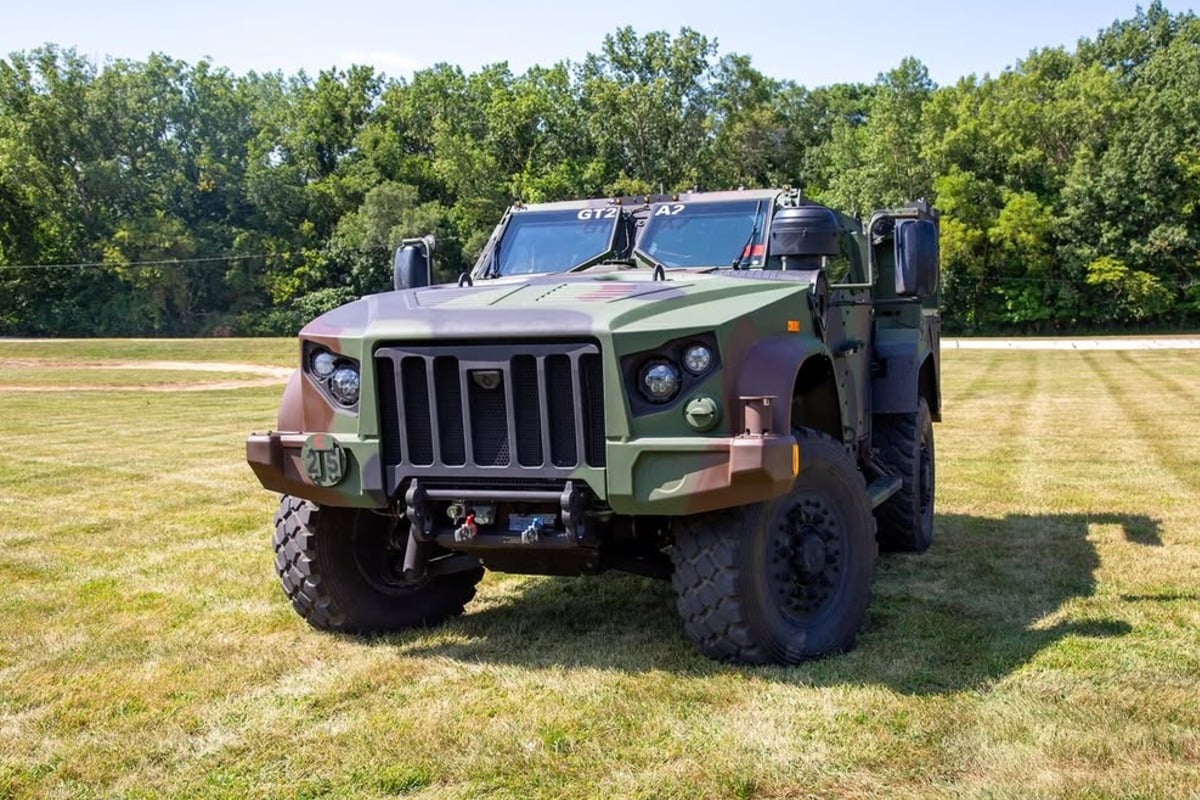
The defense procurement echo chamber is panicking over AM General’s desperate scramble to salvage its $8.6 billion Joint Light Tactical Vehicle (JLTV) A2 contract. Mainstream defense analysts are treating this like a standard corporate rescue mission. They look at the production delays, the supply chain bottlenecks, and the looming threat of Oshkosh Defense clawing back the turf, and they ask: "How can AM General fix its manufacturing line?"
They are asking the wrong question.
The real question is why the Pentagon is still sinking billions into heavy, armored, internal-combustion-engine trucks designed for a counter-insurgency paradigm that died a decade ago. AM General shouldn't be fighting to save the JLTV A2 contract. They should be trying to escape it. And the U.S. Army should let them.
The Incumbent Fallacy: Bigger Production Lines Are Just Bigger Targets
The lazy consensus in defense journalism suggests that winning a massive production contract is the ultimate victory. It isn’t. In modern manufacturing, locking yourself into an $8.6 billion hardware delivery schedule for a legacy platform is a gilded cage.
When AM General underbid Oshkosh in 2023 to snatch the JLTV Follow-On Contract, the industry cheered. It was hailed as a triumphant return for the creators of the Humvee. But I have watched defense primes choke on these exact types of low-margin, high-volume contracts for twenty years. The margins are razor-thin because the bidding process forces companies to price everything to absolute perfection.
Then reality hits.
- Microchip shortages hit the specialized vetronics suites.
- High-grade steel prices fluctuate.
- Labor markets tighten in manufacturing hubs like Mishawaka, Indiana.
Suddenly, that $8.6 billion headline figure becomes a liability. Every vehicle rolling off the line represents a diminishing return on capital. Oshkosh Defense didn't lose when they lost the re-compete; they escaped a margin-crushing operational bottleneck. They were freed up to focus on high-margin autonomy integration and next-generation hybrid power plants. AM General won the right to build thousands of heavy steel boxes at a discount.
The Tactical Delusion: The JLTV is Already Obsolete
Let's dismantle the premise that the JLTV A2 is even the right vehicle for the next conflict. The JLTV was conceived to solve a specific problem: the vulnerability of the Humvee to Improvised Explosive Devices (IEDs) in Iraq and Afghanistan. It is a masterpiece of blast protection, featuring a V-shaped hull, heavy fragmentation armor, and a massive suspension system designed to absorb catastrophic vertical energy.
But the strategic priority has shifted to the Indo-Pacific and high-intensity peer conflict.
Imagine a scenario where a marine littoral regiment is deployed across the First Island Chain. They need to move fast, stay hidden, and maintain a minimal logistical footprint. Now try to stuff a 22,000-pound, diesel-guzzling JLTV onto a Light Amphibious Warship or a dynamic transport aircraft.
The Brutal Reality: In a theater dominated by long-range precision fires, loitering munitions, and ubiquitous drone surveillance, mass is a liability. Mobility and signature management are the only survival metrics that matter.
The JLTV A2 is too heavy for agile expeditionary warfare and too light to survive an anti-tank guided missile (ATGM) or a dual-purpose improved conventional munition (DPICM) swarm. It sits in a tactical no-man's-land. It is an exquisite solution to yesterday's war.
The Software-Defined Vehicle Misunderstanding
The defense department talks constantly about modular open systems architecture (MOSA). The JLTV A2 promises better integration of modern command, control, communications, computers, cyber, intelligence, surveillance, and reconnaissance (C4ISR) systems.
But adding modern vetronics to a traditional truck chassis is not innovation. It is just putting an iPad on a tractor.
True modernization requires software-defined vehicles where the computational architecture is baked into the drivetrain and power management systems from day one. If you want to run high-energy lasers, active protection systems (APS), and localized drone-jamming pods, you cannot rely on a traditional 24-volt alternator system hacked onto a diesel engine. You need hybrid-electric or fully electric architectures capable of exporting massive amounts of kilowatt power.
AM General is burning executive bandwidth trying to source physical components for a mechanical assembly line when they should be hiring software engineers and power-electronics specialists. The value in military hardware has permanently shifted from the steel hull to the digital stack. By focusing on the physical delivery metrics of the A2 contract to appease Pentagon auditors, AM General is starving its own research and development for what comes next.
How to Actually Fix the Tactical Wheeled Vehicle Fleet
If the Pentagon wants to stop burning capital on platforms that will be targets for cheap loitering munitions, it needs to shift its acquisition strategy immediately.
| Metric | The Legacy Approach (JLTV A2) | The Disrupted Approach (Attritable Autonomy) |
|---|---|---|
| Unit Cost | $400,000+ | $75,000 - $120,000 |
| Weight | 10+ Tons | Under 3 Tons |
| * Crew Requirements* | 2-4 Human Operators | Optionally Manned / Unmanned |
| Logistical Footprint | Heavy Diesel, Specialized Parts | Hybrid-Electric, Commercial Off-The-Shelf |
Instead of doubling down on the JLTV production line, the Army should pivot to an attritable, modular platform strategy.
First, cap the JLTV procurement at current baseline requirements. Stop treating the A2 variant as a multi-decade program of record. Use the remaining funds to purchase lighter, optionally manned vehicles with hybrid powertrains.
Second, decouple the software suite from the vehicle manufacturer. The Pentagon should buy bare-chassis platforms from automotive manufacturers who understand scale, then contract specialized software firms to integrate autonomous driving and threat-detection systems. Forcing a traditional defense prime to act as both a heavy metal stamper and a cutting-edge software house is a structural design flaw that leads directly to the delays AM General is experiencing.
The Downside of Disruption
Admittedly, abandoning the JLTV A2 contract structure has severe institutional consequences. The defense procurement system is built on predictability. Congressional districts rely on the steady manufacturing jobs provided by multi-year vehicle builds. If the Army curtails the JLTV program, manufacturing lines pause, supply chains fracture, and industrial capacity is lost.
Furthermore, autonomous, lighter platforms do not offer the same level of passive crew protection. If an unarmored, autonomous logistics vehicle hits a mine, the vehicle is destroyed. The institutional risk aversion of the military bureaucracy prefers a $500,000 armored truck that keeps soldiers safe in a low-intensity conflict, even if that same truck is entirely useless in a high-intensity peer environment where it cannot even be transported to the theater of operations.
But keeping a broken industrial paradigm on life support just to preserve legacy manufacturing capabilities is a strategic failure.
AM General’s leadership shouldn't be staying up at night wondering how to optimize their factory floor to meet the original delivery schedule of the JLTV A2. They should be drafting the proposal that renders their own contract obsolete. They need to show the Pentagon how to transition those Indiana factories from building heavily armored anchors into assembling agile, autonomous power-generation platforms.
If they choose to keep fighting the bureaucracy to save an outdated contract, they might win the battle against Oshkosh only to find they have manufactured their own corporate irrelevance. Stop trying to optimize the production of the past. Let the contract break, absorb the short-term market hit, and build the autonomous manufacturing base that the next decade explicitly demands.