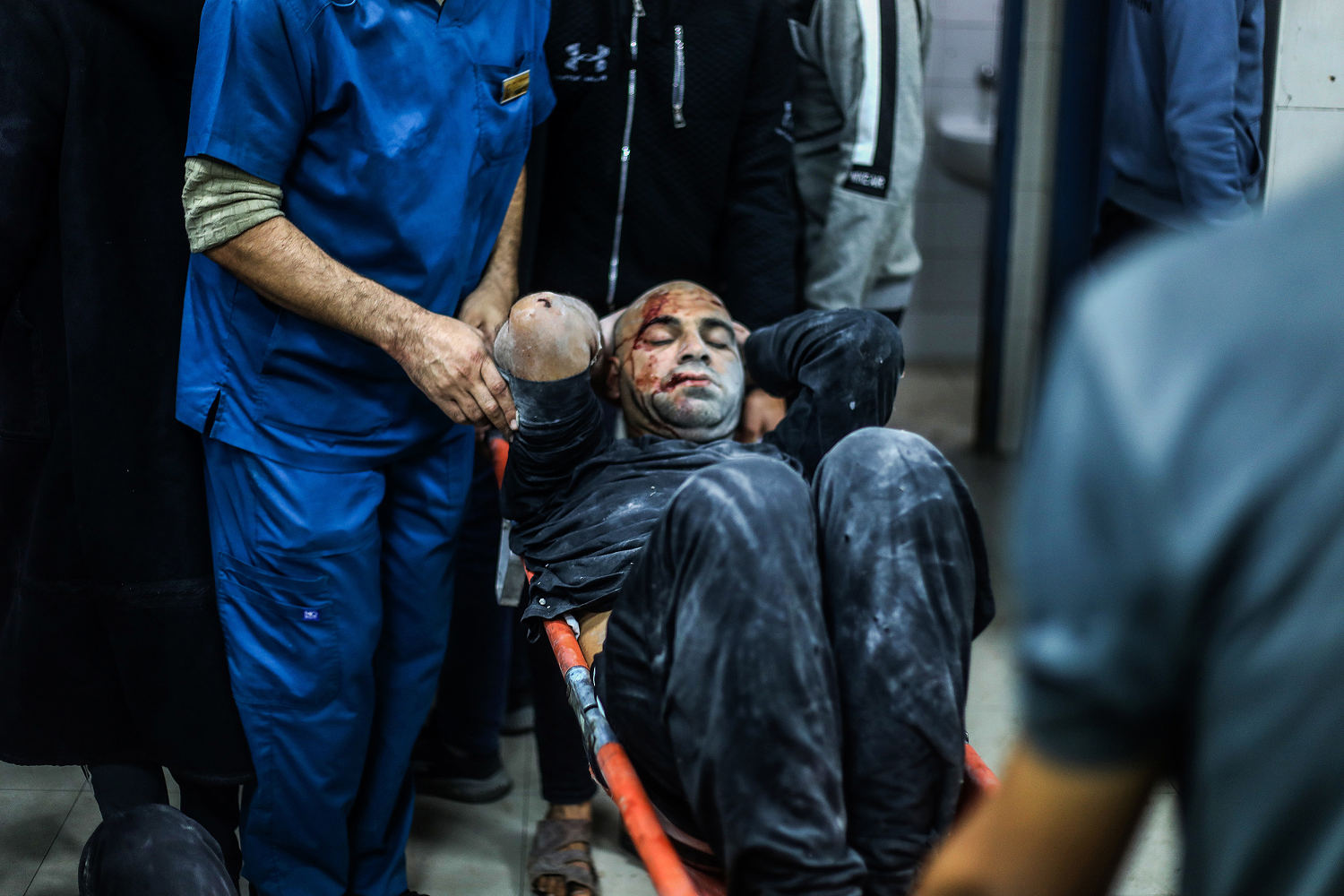
Kinetic strikes on medical facilities in dense urban combat zones represent the sharpest friction point between modern military doctrine and International Humanitarian Law. Standard wire reporting—exemplified by headlines noting that an Israeli strike on a Gaza hospital killed at least six people according to local officials—reduces a complex operational, legal, and informational event into a single casualty metric. This surface-level framing obscures the structural mechanisms driving target selection, the evidentiary standards required to strip a facility of its protected status, and the asymmetric verification bottlenecks that prevent independent confirmation in active conflict theaters. Analyzing these events requires moving past raw casualty counts to examine the operational logic governing urban warfare, the legal thresholds of dual-use infrastructure, and the systemic degradation of healthcare capacity under sustained siege conditions.
The Structural Framework of Protected Infrastructure
Under the Geneva Conventions, specifically Article 18 of the Fourth Geneva Convention and Article 12 of Additional Protocol I, civilian hospitals are granted special protected status. They cannot be the object of attack under any circumstances, provided they are not used to commit, outside their humanitarian duties, acts harmful to the enemy. This legal architecture rests on a binary distinction between combatant and non-combatant spaces. Modern asymmetric urban warfare systematically erodes this binary. For a different look, read: this related article.
When non-state actors embed command-and-control nodes, weapons caches, or staging areas beneath or adjacent to medical complexes, they exploit the protective shield of International Humanitarian Law. This creates an acute operational dilemma for conventional militaries. A state actor faces two competing imperatives: neutralizing an active tactical threat originating from a protected site, or preserving the integrity of civilian infrastructure to maintain strategic legitimacy and legal compliance.
To resolve this, military legal advisors apply a three-part analytical framework before authorizing kinetic action near or against a medical facility: Related insight on this trend has been provided by The New York Times.
- Loss of Protection: The attacking force must establish with high-confidence intelligence that the facility is actively being used for military purposes—such as housing combatants, storing munitions, or launching projectiles—rather than merely treating wounded fighters, which remains protected under humanitarian law.
- Duty to Warn: Even when a hospital loses its protected status due to military misuse, the attacking force is legally obligated to issue an effective advance warning, setting a reasonable time limit for the cessation of hostile acts and the evacuation of patients and medical staff.
- Proportionality Assessment: The anticipated concrete and direct military advantage gained from the strike must outweigh the expected incidental loss of civilian life, injury to civilians, and damage to civilian objects.
In the case of a strike resulting in six fatalities, the operational signature suggests a precision-guided munition aimed at a specific structural sub-unit—such as an upper floor, an adjacent courtyard, or a peripheral vehicle—rather than a broad-spectrum bombardment intended to level the entire complex. However, precision in ordnance delivery does not automatically translate to precision in proportionality. In an overcrowded medical facility operating beyond capacity, even a localized kinetic impact generates secondary lethal effects through structural collapse, shrapnel dispersion, and the destruction of critical life-support systems.
Verification Bottlenecks in Active Conflict Zones
A critical failure in standard news reporting is the uncritical juxtaposition of competing claims without explaining the structural mechanisms of verification. When local health authorities report a specific death toll—such as six fatalities—and military spokespeople either deny involvement, attribute the blast to a misfired insurgent rocket, or claim a targeted strike on a militant operative, the information environment enters a state of epistemological deadlock.
This deadlock is driven by four primary operational constraints:
- Absence of Independent Observers: Active combat zones with restricted border access prevent international forensic teams, independent journalists, and neutral UN investigators from reaching the blast site within the golden window required to preserve physical evidence.
- Rapid Site Alteration: First responders and hospital staff prioritize casualty extraction and debris clearance over forensic preservation. Removing shrapnel, washing away blast residue, and burying the dead within hours—often necessitated by religious custom and the lack of refrigerated morgue capacity—eliminates the physical markers needed to determine munition type, trajectory, and yield.
- Dual-Use Ambiguity: Distinguishing between civilian casualties and non-uniformed militants is nearly impossible from post-strike hospital intake logs. In asymmetric conflicts, fighters rarely wear standardized uniforms, and local authorities categorize all fatalities admitted to medical facilities under a single civilian casualty ledger.
- Signal Intelligence Asymmetry: State militaries possess aerial surveillance, drone telemetry, and intercepted communications that they frequently classify to protect sources and methods. Without releasing raw telemetry, military assertions of "terrorist infrastructure" remain unverifiable to external auditors, creating a credibility deficit that favors immediate on-the-ground visual documentation from local sources.
Consequently, public understanding of a hospital strike is shaped less by objective forensic reconstruction and more by the speed and emotional resonance of initial media distribution. A smartphone video showing wounded patients in a smoke-filled corridor establishes an immediate visual reality that a subsequent military briefing featuring annotated aerial photographs cannot easily displace.
The Cascading Failure Model of Urban Healthcare
Evaluating a strike on a hospital solely by its immediate kinetic fatalities miscalculates the true cost function of the event. A functioning hospital in a conflict zone is not merely a building; it is a tightly coupled, interdependent technical system. Damaging a single node triggers a cascading failure across the entire facility and the surrounding medical network.
Consider the operational mechanics of a hospital operating under blockade conditions. The facility relies on uninterrupted electrical power to run ventilators, incubators, surgical suites, and water purification pumps. When a kinetic strike—even a limited one that kills six people—impacts a hospital compound, the shockwave and shrapnel frequently sever external power lines, rupture fuel storage tanks for backup generators, or damage oxygen distribution manifolds.
The second limitation of focusing strictly on immediate deaths is the erasure of indirect mortality. If a strike forces the evacuation of an intensive care unit or destroys the sterile surgical theater, patients requiring emergency trauma care, dialysis, or neonatal support face rapid physiological deterioration. The mortality curve extends outward in time and space:
- Immediate Kinetic Mortality: Individuals killed directly by blast overpressure, fragmentation, or localized structural collapse at the moment of impact.
- Operational Attrition: Patients who die within 24 to 72 hours due to interrupted critical care, lack of oxygen, or inability to perform emergency surgeries during facility shutdowns.
- Systemic Overload: Adjacent hospitals, already operating at 200 to 300 percent capacity, absorb the displaced patient load, degrading their own triage efficiency and increasing mortality rates across unrelated trauma cases.
- Infrastructure Abandonment: Fear of subsequent strikes causes medical personnel and displaced civilians sheltering on hospital grounds to flee, effectively neutralizing the facility's operational capacity without requiring its physical destruction.
In Gaza, where the healthcare system has experienced cumulative degradation over prolonged hostilities, each individual strike acts as a force multiplier on systemic collapse. Losing a single ward or a handful of specialized medical personnel—such as trauma surgeons or anesthesiologists—creates an irreplaceable bottleneck. Unlike physical equipment, which can theoretically be resupplied if humanitarian corridors open, specialized medical human capital cannot be regenerated within the timeframe of an active conflict.
Tactical Mechanics of Precision Strikes vs. Collateral Dispersion
To understand how a military strike on a hospital kills six people rather than sixty, one must examine the munition physics and targeting protocols employed in modern urban warfare. When state forces execute targeted strikes inside sensitive areas, they typically deploy low-yield, precision-guided munitions (PGMs) designed to minimize the blast radius.
These munitions utilize delayed-action fuses and specialized warhead casings—such as focused fragmentation warheads or kinetic energy penetrators—to confine lethal effects to a specific room, vehicle, or courtyard wall. The operational objective is to neutralize a high-value target or a specific tactical threat while preserving the structural integrity of the surrounding building.
However, three physical variables routinely subvert this intended containment in dense medical environments:
Overcrowding Density: Hospitals in war zones function simultaneously as medical centers and de facto internally displaced person (IDP) camps. Courtyards, hallways, and stairwells are packed with civilians seeking perceived safety under the Red Cross or Red Crescent emblem. A munition with a lethal radius of ten meters, which might cause zero civilian casualties in an evacuated urban block, will inevitably strike multiple non-combatants when detonated in a congested hospital courtyard.
Secondary Explosions: Medical facilities house volatile materials, including pressurized oxygen cylinders, anesthetic gases, and diesel fuel reserves for emergency generators. If kinetic fragmentation breaches an oxygen storage bank or a fuel line, the resulting secondary deflagration amplifies the blast overpressure and thermal radiation far beyond the munition's designed yield.
Structural Fragility: Buildings subjected to months of nearby concussive blasts suffer from accumulated micro-fractures in load-bearing concrete columns and masonry. A localized impact that would normally damage a single room can trigger partial progressive collapse in structurally compromised older wings, trapping occupants beneath heavy debris.
Information Warfare and the Strategic Cost Function
Every kinetic operation against protected infrastructure generates an immediate strategic liability in the international arena. In modern hybrid warfare, tactical victories on the ground can produce strategic defeats if they erode diplomatic support, trigger arms embargoes, or invite judicial intervention from international courts.
When an incident occurs, both belligerents engage in immediate narrative framing to manage this strategic cost function. The attacking force seeks to shift the burden of responsibility onto the defending irregular force, arguing that the embedding of military assets within civilian infrastructure constitutes a war crime of human shielding. This framing aims to establish that the legal and moral culpability for civilian deaths rests with the party that militarized the protected space, rather than the party that executed the kinetic strike.
Conversely, local authorities and sympathetic international observers frame the strike as an indiscriminate attack on non-combatants and a systematic dismantling of the civilian life-support system. By highlighting the exact casualty count—such as six dead—alongside the protected status of the venue, this narrative emphasizes the disproportionality of the military response and seeks to compel external diplomatic intervention to halt ongoing military operations.
The effectiveness of these competing narratives depends entirely on evidentiary transparency. When a military force conducts a strike on a hospital and provides only generalized statements of intent without releasing granular intelligence—such as video evidence of weapons firing from the site or specific identification of targeted operatives—it cedes the informational terrain. International observers, conditioned by prior instances of disputed military claims, default to skepticism.
Operational Imperatives for Conflict Analysts and Decision-Makers
Evaluating reports of strikes on medical facilities requires disciplined analytical hygiene to avoid being misled by incomplete initial data or partisan framing. Analysts, policymakers, and humanitarian coordinators must apply a structured verification protocol before drawing strategic conclusions from breaking casualty reports.
First, separate the kinetic event from the systemic impact. Track not only the immediate fatalities reported in the first six hours, but also the operational status of the hospital's core departments—emergency triage, surgical theaters, intensive care, and power generation—at the 24-hour and 72-hour marks. A strike with low initial casualties that knocks out a hospital's main oxygen plant represents a far greater humanitarian crisis than a higher-casualty strike confined to an external perimeter wall.
Second, demand granular forensic indicators to evaluate competing claims of attribution and proportionality. Cross-reference satellite imagery of structural damage patterns against known munition crater signatures. Large, deep craters with widespread thermal scorching indicate heavy aerial ordnance, whereas shallow surface pitting, localized shrapnel dispersion, and intact surrounding walls point toward mortars, drone-launched micro-munitions, or misfired short-range rockets.
Third, enforce strict evidentiary thresholds when assessing claims of dual-use militarization. Military forces must be held to a standard of demonstrable proof—requiring post-strike release of declassified drone telemetry, weapons recovery documentation, or clear tactical identification—to justify the revocation of a hospital's protected status. Without enforced transparency, the legal protections afforded to medical infrastructure under the Geneva Conventions will continue to degrade into a dead letter across future urban battlefields.