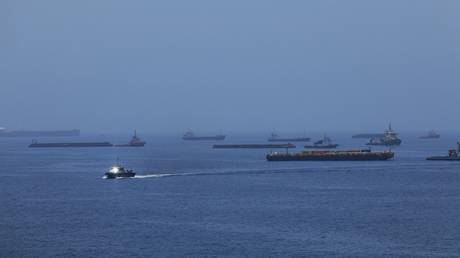
Geopolitical agreements operating under structural asymmetry inevitably collapse when the underlying mechanism shifts from cooperative compliance to kinetic leverage. The public declarations by Iranian Parliament Speaker and top negotiator Mohammad Bagher Ghalibaf regarding the Islamabad Memorandum of Understanding (MoU) signal this shift precisely. By publicizing a clause that bound Tehran to guarantee safe commercial passage through the Strait of Hormuz "for 60 days only," Iran exposed the foundational flaw of the agreement: it was a time-bound operational concession, not a permanent strategic settlement.
When the United States revoked the license authorizing the sale of Iranian crude following regional tanker targeting, it triggered a predictable cascade. The subsequent cycle of tit-for-tat military engagement—culminating in U.S. Central Command (CENTCOM) striking roughly 140 targets across southern Iran—unveils the strategic friction of a conflict where neither economic sanctions nor conventional deterrence achieves its stated end. To evaluate why the framework fractured, the crisis must be analyzed through the mechanical trade-offs of maritime leverage, cost-imposition strategies, and domestic political constraints.
The Asymmetrical Cost Function of Maritime Interdiction
The fundamental flaw in Western containment models is the miscalculation of the cost-to-benefit ratio in asymmetric maritime warfare. The Strait of Hormuz functions as a critical choke point where geographic vulnerability dictates global economic exposure. By threatening or executing blockades, Iran exploits a cost function that works heavily in its favor.
- Cost of Execution vs. Cost of Defense: Deploying low-cost loitering munitions, anti-ship missiles, and fast-attack craft requires minimal capital expenditure from state forces or proxy networks. Conversely, defensive operations conducted by carrier strike groups and allied navies demand massive resource allocation, including the expenditure of multi-million dollar air defense interceptors to neutralize low-cost threats.
- Economic Leverage Multiplication: Even minor disruptions to commercial shipping drive up maritime insurance premiums, trigger cargo diversions, and introduce volatility into the Brent and WTI crude markets. For Iran, this economic disruption serves as an external lever to offset its internal economic pain.
The primary structural bottleneck stems from the legal interpretation of passage. While international maritime law prioritizes transit passage through strategic straits, Tehran exploits the older doctrine of innocent passage, asserting the authority to regulate or halt shipping if it deems the transit detrimental to its national security. This creates a permanent structural friction point that can be weaponized whenever diplomacy stalls.
The Failure Modes of Kinetic Deterrence
CENTCOM's operational execution—degrading radar, missile, and drone infrastructure—rests on classical deterrence theory: imposing a high enough military cost to alter the adversary's calculus. However, this model breaks down under two distinct structural conditions.
Strategic Internal Utility
Military strikes fail to deter when the target regime derives domestic or regional utility from the confrontation. For the Islamic Revolutionary Guard Corps (IRGC) and the hardline political faction led by Ghalibaf, resisting external pressure validates their internal governance model. Demonstrating the capacity to disrupt international shipping routes signals regional authority, directly challenging the narrative of Western dominance.
Irreversible Economic Transition
Sanctions function as an effective policy lever only if the targeted nation believes compliance will restore economic stability. Within Iran's administrative planning, the priority has shifted away from securing immediate sanctions relief—viewed by hardline factions as a failed strategy—toward adapting the domestic economy to absorb long-term isolation. When an economy transitions to a structured, sanction-resistant framework, the threat of continued economic penalties loses its coercive power.
The Sixty-Day Trap
The collapse of the Islamabad MoU highlights the danger of ambiguous, short-term diplomatic instruments. The 60-day clause exposed by Ghalibaf reveals that the agreement lacked a self-sustaining compliance mechanism. Instead, it functioned as a countdown clock.
[MoU Signed] ➔ [60-Day Safe Passage Window Opens] ➔ [Sanctions/Licensing Disagreement] ➔ [Ceasefire Fractures] ➔ [Maritime Interdiction Recommences] ➔ [Kinetic Escalation]
This structural loop demonstrates that temporary concessions without explicit, phased reciprocity create a strategic vacuum. Once the initial timeline expires, both parties are incentivized to return to hostile posturing to establish a stronger bargaining position for the next round of negotiations.
The Immediate Strategic Play
De-escalating the crisis in the Strait of Hormuz requires abandoning the illusion that conventional air strikes can permanently secure an open-ended maritime corridor without a broader diplomatic architecture.
The immediate requirement is the establishment of a restricted, transactional framework focused exclusively on maritime security, completely separated from broader geopolitical disputes like regional proxy networks or long-term nuclear enrichment portfolios. Policymakers must engineer an explicit mechanism where verified maritime non-interference is tied directly to automated, incremental licensing adjustments for specific commercial energy volumes. This structure must replace arbitrary time limits with performance-based triggers, ensuring that any deviation from compliance results in an immediate, proportional economic lock rather than an unpredictable cascade into full-scale kinetic warfare.