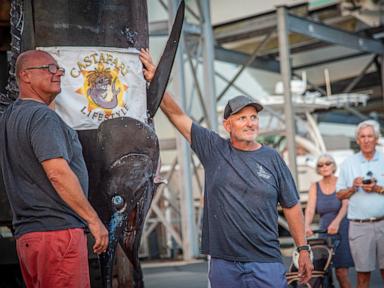
When a fish crosses the threshold into grander status, tipping the scales at 1,000 pounds or more, the geography of the catch usually points toward the Pacific or the remote waters of the Cape Verdes. New England has never been ground zero for prehistoric-sized billfish. That changed on August 19, when Captain Damon Sacco and the crew of the Castafari hauled a staggering 1,260-pound blue marlin into Falmouth Harbor after a grueling three-hour battle in Atlantis Canyon.
This single specimen didn't just break the Massachusetts state record by nearly 400 pounds; it established a new benchmark for the entire United States East Coast, eclipsing previous heavyweights out of North Carolina. More remarkably, it landed just 142 pounds shy of the all-tackle world record set off Brazil decades ago. Also making waves in this space: Coventry City Promotion Economics and Roster Architecture.
Understanding why this event matters requires looking past the dockside spectacle. It demands a closer examination of offshore dynamics, marine biology, and the shifting thermodynamic realities of the North Atlantic.
The Canyons of Change
Atlantis Canyon is not a casual destination. Located roughly 100 miles south of Nantucket, it sits on the edge of the continental shelf where the ocean floor drops into absolute dark. Upwellings collide here, pushing nutrient-rich water against the shelf break. This creates a hyper-productive ecosystem where squid, tuna, and pelagic predators congregate. More insights on this are detailed by FOX Sports.
Captain Sacco knew the water was right, but catching a fish of this magnitude is a statistical anomaly. Most blue marlin encountered by recreational trollers in the Northeast range between 200 and 400 pounds. These are younger, highly active fish. A specimen scaling 1,260 pounds is an apex predator that has spent decades dodging commercial longlines, avoiding killer whales, and foraging across vast pelagic corridors.
When angler Walter Chapman hooked the beast on a trolled bait, the physics of the fight immediately shifted. A fish of that mass does not simply sprint on the surface; it utilizes its sheer hydrodynamic weight to sound deep, forcing the angler into a mechanical stalemate. Three hours on the rod translates to an extreme test of physical endurance and tackle integrity. The drag system must remain calibrated down to the ounce to prevent the line from snapping under the dead weight of a creature that could easily tow a small skiff.
Rewriting Regional Boundaries
For generations, offshore anglers looked to the Gulf Stream off Hatteras or the islands of the Caribbean when dreaming of a grander. Massachusetts was viewed as a striped bass and bluefin tuna fishery, with billfish treated as an occasional summer bonus brought north by stray warm-water rings spinning off the Gulf Stream.
The 1,260-pound specimen alters that mental map entirely. Ocean temperatures in the Northwest Atlantic have trended upward over the past decade, recording marine heatwaves that alter the traditional migration paths of pelagic species. While scientists hesitate to link a single record fish directly to broad climate trends, the presence of a multi-decadal mega-marlin in New England waters underscores how fluid marine habitats have become.
When the Castafari backed into MacDougall’s Cape Cod Marine Service, the physical scale of the animal became immediately apparent. The fish was so wide and long that it barely cleared the vessel's tuna door. Hoisting it via crane required careful rigging to prevent the heavy straps from tearing through the flesh, a testament to the sheer bulk that local dockworkers had never witnessed firsthand.
The Science After the Scale
The celebration at the dock was matched by a subsequent scientific pivot. Modern sports fisheries have evolved past the purely extractive mindset of the mid-20th century, even when dealing with historic specimens. While portions of the meat were distributed to the crew and local crowds—as is customary in traditional coastal ports—the critical piece of biological data was preserved.
The head of the marlin was destined for the Pelagic Fisheries Laboratory at the University of Maine. Researchers will extract and examine the otoliths—the ear stones containing calcium carbonate layers that function much like tree rings. These microscopic rings will reveal the exact age of the animal.
A blue marlin scaling 1,260 pounds is estimated to be anywhere from 20 to upwards of 30 years old, having survived decades of commercial fishing pressure that systematically removes larger breeding-age fish from the global population. Understanding the growth rate and longevity of an outlier of this size provides marine biologists with vital data points for international management frameworks.
The International Commission for the Conservation of Atlantic Tunas monitors stock levels, but reliable data on fish at the absolute upper limit of the growth curve remains scarce. Every grander brought to a dock represents a rare window into the longevity of a species that spends most of its existence hidden beneath the open horizon.
As the scales settled in Falmouth and the record books were redrawn, the narrative shifted from a local fishing triumph to a broader reflection on the ocean's capacity to still produce the unimaginable. The sea off New England remains capable of keeping heavy secrets in the deep canyons, waiting for the precise convergence of skill, heavy gear, and raw chance.