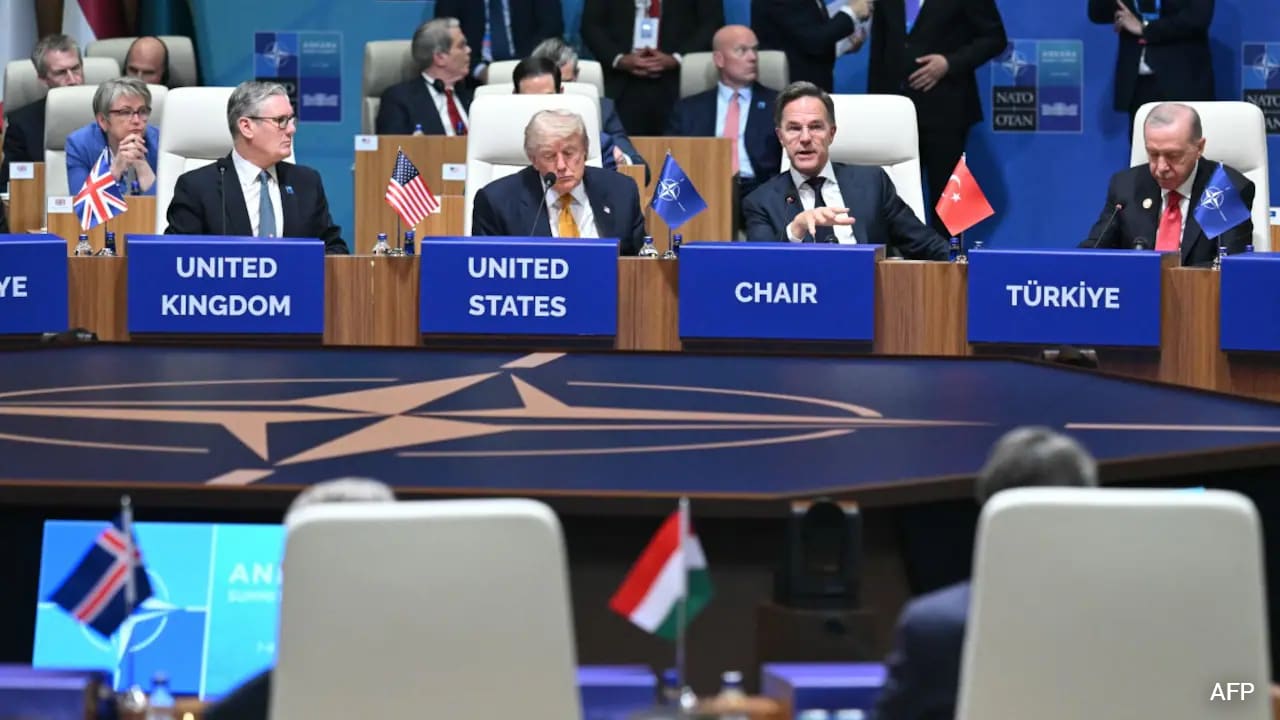
Statecraft operates on a dual-track mechanism: formal treaty negotiations and symbolic coercion. Turkish President Recep Tayyip Erdogan's presentation of personalized, engraved firearms and live ammunition to every NATO head of state at the Ankara summit offers an analytical blueprint for how mid-tier powers project asymmetric strategic weight within a multi-lateral alliance. This was not a breach of protocol; it was a calibrated calculation designed to test domestic legal boundaries, assert domestic defense manufacturing capability, and establish a transactional baseline with Western allies.
Understanding the mechanics of this move requires looking past the sensationalism of the gift itself and examining the structural friction it generated across G7 domestic legal frameworks.
The Domestic Legal Friction Engine
The strategic brilliance of the hard-power gift lies in the structural friction it induces within the recipient nation's domestic legal apparatus. By accompanying each engraved pistol with a signed note waiving Turkish export controls, the host nation transferred 100% of the regulatory compliance burden to the visiting heads of state. This created an immediate operational bottleneck.
UK Prime Minister Keir Starmer and Canadian Prime Minister Mark Carney faced distinct statutory constraints upon receiving the weapons:
- The UK Import Deadlock: Under the UK Firearms Act 1968 (as amended), handguns are classified as prohibited Section 5 weapons. Because a sitting Prime Minister cannot bypass border force protocols or introduce live firearms into the jurisdiction without explicit Home Office authorization—which carries immense political risk regarding "two-tier" enforcement narratives—Starmer was forced to leave the asset under the custody of British officials in Turkey for permanent decommissioning.
- The Canadian Enforcement Pivot: Canadian law dictates that official state gifts must comply with strict federal asset management guidelines. Carney's office diverted the physical asset to the Royal Canadian Mounted Police (RCMP) for processing and potential museum placement, while abandoning the live ammunition entirely within Turkish borders to avoid complex international transit violations.
This friction proves that sovereign security protocols are inherently rigid, even when facing an allied state's explicit waiver of international trade barriers.
The Defense Industrial Capability Statement
Beyond the immediate psychological impact, the distribution of personalized firearms serves a precise commercial purpose: the physical manifestation of Turkey's defense-industrial base. The global arms trade relies heavily on signaling reliability and domestic manufacturing independence. By delivering custom, combat-ready hardware directly to G7 commanders-in-chief, Turkey achieved several micro-economic objectives.
Vertical Integration Demonstration
The presentation of both the weapon and the matching ammunition demonstrates complete domestic supply chain resilience. It signals to NATO allies that Turkey maintains uncoupling capability from Western defense supply chains.
Regulatory Defiance
The inclusion of an explicit export control waiver is a calculated display of unilateral regulatory authority. It establishes that Ankara views its domestic defense output as a tool of sovereign diplomacy, unimpeded by standard multilateral arms tracking norms.
This assertion of industrial autonomy occurred alongside high-stakes negotiations regarding heavy military hardware. While leaders wrestled with the logistical realities of custom handguns, Turkey secured massive industrial concessions. The structural relationship between this symbolic gifting and major defense acquisitions became clear as the summit concluded:
[Custom Handgun Gifting] -> Signals Sovereign Industrial Autonomy
                                    |
                                    v
[Sanction Relief / F-35 Program Pivot] -> Re-entry into High-Tier NATO Hardware Supply Chains
                                    |
                                    v
[Naval Defense Cooperation Agreements] -> Expansion into Joint Frigate/Submarine Production
The second structural linkage of this industrial signaling was the immediate breakthrough in high-tier aerospace procurement. Following the weapon distribution, the US administration signaled a softening stance on the F-35 fighter jet program, following the 2019 suspension caused by Ankara’s purchase of Russian S-400 missile systems.
Simultaneously, Turkey leveraged the summit to advance naval defense partnerships, outlining joint frigate and submarine construction initiatives to be executed inside Turkish shipyards. The pistols served as a tactile calling card for a nation demanding to be treated as a tier-one defense exporter rather than a secondary buyer.
The Cost Function of Allied Compliance
When a state leader accepts, conditions, or rejects a highly politicized gift, they reveal their internal risk-reward calculus. The strategic options available to NATO leaders can be broken down into three distinct operational pathways, each carrying a specific geopolitical cost.
Path 1: Absolute Rejection / Immediate Abandonment
Leaving the asset entirely within the host nation's jurisdiction minimizes domestic political blowback but yields a diplomatic deficit, signaling a refusal to engage in the host’s transactional framework. This was the route necessitated by the UK's domestic legal framework.
Path 2: Delayed Decommissioning / Institutional Absorption
Routing the asset through federal law enforcement or state museums (the Canadian model) balances regulatory compliance with diplomatic politeness. The cost here is administrative delay and potential public scrutiny over the ethics of retaining weapons of war as state property.
Path 3: Full Integration
Importing the asset directly into the home country under state security exemptions signals deep alignment with the donor state’s political culture. However, for Western democracies, the domestic political cost function of this path is prohibitively high due to stringent domestic gun control narratives.
Strategic Asset Allocation Shift
The Ankara summit demonstrated that European defense strategy is undergoing a permanent structural reorganization. The push by NATO leadership to enforce a 5% GDP defense spending target by 2035—divided into a 3.5% core defense allocation and a 1.5% resilience infrastructure fund—reflects a growing acknowledgment that continental defense can no longer rely solely on external security guarantees.
Starmer’s concurrent unveiling of a $50 billion deep precision strike missile initiative with European allies underlines a critical pivot. Western European powers are focusing their capital allocations on long-range, high-altitude strategic deterrence (up to 2,000km ranges), leaving mid-tier powers like Turkey to dominate the manufacturing and supply of localized, tactical combat hardware and naval production.
The optimal play for European defense ministries moving forward is to separate symbolic statecraft from industrial reality. While Turkey uses bespoke small arms to project an image of sovereign independence, the real leverage remains anchored in high-technology consortiums, long-range missile defense networks, and joint maritime transport production.
Allies should systematically accept the administrative friction of processing these hard-power diplomatic gestures, redirecting the asset volume to state archives while tightening the joint economic parameters governing high-tier defense procurement and aerospace supply chains.