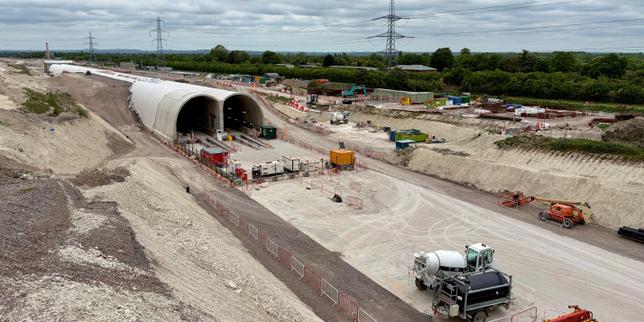
The collapse of the High Speed 2 (HS2) rail project into a truncated, hyper-expensive trunk line is not a failure of engineering; it is a failure of economic governance and structural design. When the United Kingdom set out to build a high-speed rail network linking London to Birmingham, Manchester, and Leeds, the initial budget sat at roughly £30 billion. Current projections estimate the cost of a severely diminished network will exceed £100 billion. This geometric escalation reveals a fundamental reality of modern infrastructure: the final cost of a mega-project is inversely proportional to the rigor of its initial scope containment and institutional design.
By evaluating HS2 through the lens of capital asset pricing, structural risk misallocation, and bureaucratic drift, we can map the precise mechanisms that transformed a transformative transport initiative into a sovereign liability. The core issue lies in three distinct structural compounding factors: the inflation of the baseline cost function, the misvaluation of spatial-economic benefits, and a fatal political risk-sharing model. For another perspective, consider: this related article.
The Cost Function Architecture: Why Escalation Was Structural
Mega-project cost escalation is rarely linear. In the case of HS2, the budget ballooned through a compounding loop of scope creep, geological uncertainty, and regulatory gold-plating. To understand why the cost per kilometer of HS2 outstripped comparable European projects (such as France’s LGV or Italy’s Alta Velocità) by orders of magnitude, we must dissect the project's cost function into three variables: civil engineering premiums, political mitigation overhead, and procurement design.
1. The Subterranean Premium and Geological Risk
The decision to route significant portions of the London-to-Birmingham phase through tunnels rather than surface alignments was driven by environmental and political lobbying, particularly through the Chiltern Hills. This fundamentally altered the project's engineering profile. Similar analysis on the subject has been provided by NPR.
Surface rail construction requires earthworks, track laying, and systems integration. Subsurface construction introduces exponential compounding risks:
- Tunnelling Speed and Geotechnical Variances: Boring through complex, variable strata requires bespoke Tunnel Boring Machines (TBMs) operating at high capital intensity. Any unexpected geological fault or hydrological anomaly halts progress while fixed asset costs accumulate.
- Ventilation and Safety Shafts: Long stretches of continuous underground rail require deep vertical shafts for intervention and ventilation, multiplying the real estate footprint and structural engineering requirements at the surface.
2. Regulatory Gold-Plating and Design Symmetry
UK rail infrastructure operates under a highly risk-averse regulatory framework that mandates extreme safety and environmental margins. For HS2, this manifested as bespoke design specifications rather than off-the-shelf procurement. The project demanded high operating speeds (up to 400 km/h design speed), which dictated wider track spacing, larger tunnel diameters to mitigate aerodynamic slap, and gentler curves. This optimization for marginal speed gains exponentially expanded the physical footprint and material volume required for construction, driving up concrete and steel consumption per kilometer.
3. The Optimism Bias and Appraisal Lag
Large-scale public infrastructure suffers from systemic appraisal optimism. Early-stage cost-benefit analyses routinely underestimate the Reference Class Forecasting metrics—meaning planners evaluate the project as a unique, ideal case rather than benchmarking it against historical global peers. When inflation hit the supply chain, the highly leveraged, multi-decade contract structures amplified input cost volatility. The project lacked a dynamic hedging mechanism for raw materials, leaving the taxpayer to absorb the downside of macro-inflationary cycles.
The Spatial-Economic Paradox
The primary strategic justification for HS2 was the rebalancing of the British economy, specifically bridging the productivity gap between London and the North of England. However, the economic model underpinning the project contained a fundamental logical error regarding agglomeration economies.
Economic theory dictates that high-speed rail generates value via two mechanisms: reducing transaction costs through faster business travel, and expanding labor market catchments. The HS2 appraisal model over-indexed on the monetary value of travel time savings ($VTT$). The core calculation assumed that time spent on a train was economically dead time, meaning a 30-minute reduction in travel time yielded a direct productivity dividend equal to the traveler's wage rate.
The widespread adoption of digital connectivity and remote productivity suites invalidated this assumption. When business travelers can execute high-density cognitive work from a laptop at 300 km/h, the marginal economic utility of saving 20 or 30 minutes drops significantly.
Furthermore, high-speed rail links do not inherently distribute wealth from a dominant economic hub to peripheral regions. Instead, they frequently trigger a "pump effect," where economic activity is sucked more efficiently into the primary metropolis. London’s deep capital markets, specialized service sectors, and talent density mean that reducing friction between Birmingham or Manchester and the capital often makes it easier for northern firms to source services from London, rather than vice versa. By cancelling the northern legs (Phase 2b to Manchester and the eastern leg to Leeds) while keeping the southern trunk, the project transformed from a national network into an expensive commuter line for the West Midlands, destroying the network effects required to amortize the fixed capital cost.
Procurement Vulnerabilities and Risk Misallocation
The institutional framework managing HS2 failed to resolve the classic Principal-Agent problem. The government (the Principal) delegated execution to HS2 Ltd (the Agent), which in turn leased operational execution to massive consortia of tier-one civil engineering firms.
[UK Government / HM Treasury]
          │
          ▼  (Principal-Agent Friction)
     [HS2 Ltd]
          │
          ▼  (Cost-Plus Delivery Structures)
[Tier 1 Construction Consortia]
This delivery chain suffered from structural misalignments in risk allocation:
- Cost-Plus vs. Fixed-Price Incentives: Given the scale and duration of the works, major contracts were structured around target cost models with pain/gain share mechanisms. While designed to align interests, in practice, once a project breaches its upper cost threshold due to systemic scope changes, the incentive for private contractors to control costs diminishes. The government becomes a captive buyer; it cannot easily fire a consortium mid-tunnel without incurring catastrophic litigation and delay costs.
- Asymmetric Information: Tier-one contractors possess deep technical execution data that the state-owned delivery vehicle cannot effectively audit in real-time. This information asymmetry leads to variation orders—constant alterations to design specifications post-contract award—which represent the single largest driver of marginal cost inflation in public works.
- Sunk Cost Fallacy and Political Horizon Alignment: The multi-decade timeline of HS2 means the political actors who greenlight the project are rarely the ones held accountable for its delivery or budgetary breaches. This creates an incentive to suppress initial cost estimates to achieve political approval, knowing that future administrations will face the politically unpalatable choice of either cancelling a partially built line (and writing off billions in sunk capital) or funding the deficit.
The Operational Bottleneck: The Euston Dilemma
The compounding effect of these structural flaws is crystallized in the termination strategy at London Euston. The original design demanded an expansive, multi-platform underground station reconfiguration to handle the throughput of a national high-speed network. As costs spiraled, the management response was to defer, de-scope, and decouple the Euston development from the core rail line construction, temporarily terminating the line at Old Oak Common in west London.
This decision introduces a severe systemic bottleneck. Old Oak Common is a highly connected interchange, but forcing thousands of high-speed rail passengers to disembark outside the central business district and transfer onto local transit networks (such as the Elizabeth Line) fundamentally destroys the end-to-end journey time advantages that justified the high-speed infrastructure in the first place.
[High-Speed Trunk Line] ──> [Old Oak Common Interchange] ──(Local Transit Bottleneck)──> [Central London]
A high-speed rail system must be evaluated as an integrated network, not a collection of isolated track segments. The economic utility of the infrastructure is non-linear; it depends entirely on seamless access to final destinations. Truncating the line while leaving the terminus dependent on private sector investment to complete the final miles shifts the financial burden from the capital budget to the operational risk register, degrading the long-term asset value.
Strategic Playbook for Infrastructure Capital Recovery
To salvage value from the current position and prevent future capital destruction of this magnitude, sovereign infrastructure procurement must undergo a structural re-engineering.
First, the remaining phase of HS2 must be stripped of bespoke design parameters. Infrastructure delivery agencies must adopt a philosophy of radical standardization. Future rail projects must utilize standardized tunnel diameters, rolling stock, and signalling systems matched to existing European or global reference classes rather than inventing custom engineering solutions. Speed targets should be dynamically optimized against cost curves; reducing a design speed from 400 km/h to 300 km/h yields non-linear savings in land acquisition, energy consumption, and structural wear.
Second, contract structures must shift from target-cost models to strictly bounded design-and-build contracts where geological and inflationary risks are balanced via public-private risk pools rather than open-ended state guarantees. The state must build internal technical capability to match the engineering expertise of tier-one contractors, eliminating the information asymmetry that drives expensive variation orders.
Finally, infrastructure planning must replace the flawed Value of Travel Time Savings metric with a comprehensive Economic Complexity and Connectivity Index. Projects must be appraised based on their ability to create functional, contiguous labor markets and supply-chain resilience, rather than arbitrary minutes saved on a clock. If the UK is to build major infrastructure in the coming decades, it must treat megaprojects not as political symbols or Keynesian jobs programs, but as highly disciplined capital allocations that demand strict adherence to global cost-per-kilometer benchmarks. Failing to implement these structural reforms ensures that future sovereign capital deployments will suffer the exact same compounding degradation observed across the HS2 footprint.