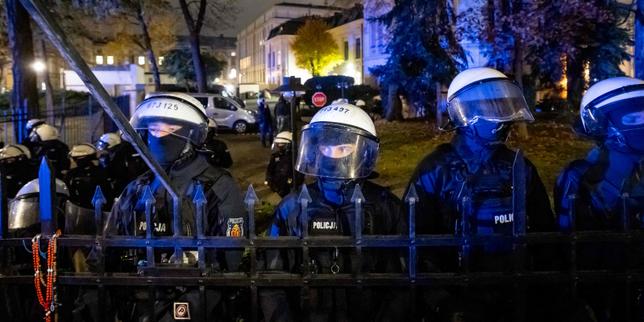
When physical force enters a constitutional court, legal theory has already failed. The removal of the President of Poland’s Constitutional Tribunal and the simultaneous deployment of police units in Warsaw mark the terminal phase of a multi-year institutional breakdown. Standard news coverage treats this event as a dramatic political clash between rival factions. That framing misses the structural reality. What occurred in Warsaw is the predictable execution of an institutional override mechanism triggered when two incompatible legal orders occupy the same sovereign territory without a shared arbiter.
To understand the mechanics of this crisis, one must separate political rhetoric from administrative execution. A constitutional court possesses no divisions, no budget enforcement arms, and no police apparatus. Its authority rests entirely on voluntary compliance by the executive and legislative branches, anchored in shared recognition of procedural legitimacy. Once that recognition evaporates, a high court ceases to function as a judicial body and becomes a physical building occupied by contested officeholders. The deployment of state security forces in Warsaw represents the executive branch enforcing its definition of statutory validity over a recalcitrant judicial holdout.
The Architecture of Dual Legitimacy
Every constitutional crisis of this magnitude stems from a divergence between formal legality and substantive legitimacy. In Poland, the dispute over the Constitutional Tribunal’s leadership—centered on the tenure and authority of its presiding judge—exposed a fatal flaw in how judicial appointments and term limits are codified and enforced.
The Statutory Contradiction
The core dispute revolves around the expiration of the Tribunal President’s mandate and the validity of the judges who participated in the selection process. Under Polish constitutional law, the President of the Tribunal is appointed by the President of the Republic from among candidates presented by the General Assembly of the Judges of the Constitutional Tribunal. When disputes arise over whether specific judges were validly elected by the Sejm (the lower house of parliament) or whether the internal quorum rules of the General Assembly were met, the resulting leadership sits on a fractured foundation. One camp treats the presiding official as the legitimate head of an independent constitutional organ. The opposing camp classifies the same individual as an unauthorized occupant holding office past a statutory deadline, presiding over a body tainted by irregular judicial appointments.The Enforcement Vacuum
In functional democracies, disputes over judicial eligibility are resolved internally or through established appellate mechanisms. When the highest court itself is the site of the dispute, no superior domestic tribunal exists to issue a binding ruling. This creates an enforcement vacuum. Legal opinions issued by the contested Tribunal are dismissed as non-existent acts (sententia non existens) by the executive branch, while legislative resolutions attempting to invalidate those acts are declared unconstitutional by the Tribunal. Both sides operate within closed, self-validating legal loops.The Administrative Chokepoint
Because neither side recognizes the legal validity of the other's decrees, the conflict inevitably migrates from courtrooms to administrative chokepoints. Control over physical access, official state gazettes (where laws and rulings must be published to take legal effect), budgetary disbursements, and security details becomes the true measure of power. Removing a court president in this environment is not merely a personnel change; it is the seizure of an institutional node to break a legislative veto.
Mechanics of the Warsaw Police Deployment
The presence of law enforcement around judicial premises in Warsaw serves specific operational functions beyond crowd control. In institutional transitions where legitimacy is contested, police deployment operates as a physical audit of chain-of-command loyalty.
First, security forces establish a perimeter to prevent parallel governance. When a high-ranking judicial official is sidelined or removed from leadership, the immediate risk to the executive branch is the creation of a "court-in-exile" or a rival administrative center operating out of the same facility. Securing the perimeter ensures that access credentials, official seals, and case files remain under the custody of the incoming or interim administrative authority.
Second, police presence manages the escalation of political theater into physical obstruction. Parliamentarians from the opposition frequently invoke parliamentary immunity to enter state buildings, stage sit-ins, or physically block administrative transitions. Law enforcement units act as a buffer, separating political actors from civil servants and judicial staff tasked with executing administrative handovers. Without this physical separation, routine administrative procedures—such as changing locks, revoking IT access, or transferring administrative registries—grind to a halt.
Third, the deployment signals finality to the broader civil service. Bureaucracies are inherently risk-averse; mid-level administrators in ministries, state banks, and lower courts watch crises at the top to determine whose orders carry legal protection and whose carry future criminal liability. The visible deployment of state police under the direction of the Interior Ministry demonstrates which faction holds the monopoly on legitimate force, compelling the broader administrative apparatus to align with the executive’s legal interpretation.
The Cost Function of Institutional Override
Executing a forceful administrative reset of a constitutional court imposes severe, quantifiable costs on state governance. Policymakers must weigh immediate legislative throughput against long-term systemic friction.
Sovereign Risk and Capital Allocation
Institutional investors and credit rating agencies price legal predictability directly into sovereign debt yields. When the composition and leadership of a country’s supreme constitutional arbiter are determined through police perimeters rather than uncontested jurisprudence, contract enforcement risk rises. Multinational enterprises operating under Polish jurisdiction face a dual-track legal hazard: a regulatory ruling upheld by one judicial faction may be invalidated by another, creating contingent liabilities that cannot be hedged through standard commercial insurance.European Union Jurisdictional Friction
Poland’s domestic judicial architecture does not exist in isolation; it is integrated into the legal order of the European Union. The Court of Justice of the European Union (CJEU) relies on mutual trust among member states' courts to execute European Arrest Warrants and recognize commercial judgments. While removing disputed judicial leadership may satisfy Brussels' demands for restoring judicial independence in the long run, the method of removal—if perceived as an executive infringement on the irremovability of judges—triggers immediate scrutiny under Article 19 of the Treaty on European Union. The state risks trading one set of infringement proceedings for another.Precedent Inversion
The most dangerous cost is structural precedent. By demonstrating that a parliamentary majority and executive cabinet can use administrative and police mechanisms to dislodge entrenched judicial leadership, the governing coalition lowers the barrier for future reversals. Once the norm of absolute judicial security of tenure is breached for corrective purposes, any subsequent government can invoke the exact same administrative playbook to purge the judiciary anew. The constitutional court ceases to be a counter-majoritarian check and degrades into a spoils system subject to electoral cycles.
Separating Known Facts from Strategic Hypotheses
Analyzing a live institutional crisis requires strict discipline regarding what is verified versus what is projected.
Verified Operational Facts:
- The leadership of the Constitutional Tribunal has been formally contested based on disputes over term expirations and the legality of prior judicial appointments.
- The executive branch and parliamentary majority have refused to recognize the legal validity of rulings issued by panels containing disputed judges.
- Police forces were deployed in Warsaw to secure premises and manage public order around key state and judicial institutions during the leadership transition.
- Administrative measures have been utilized to bypass or neutralize the Tribunal's ability to block legislative initiatives.
Analytical Hypotheses (Unverified Projections):
- Hypothesis A: Rapid Judicial Normalization. The removal of the contested leadership will allow newly appointed, uncontested judges to form a majority, leading to the rapid dismissal of pending political challenges and the unlocking of frozen EU cohesion funds. This assumes the opposition lacks the procedural tools to paralyze the Tribunal's internal voting mechanisms.
- Hypothesis B: Prolonged Judicial Schism. Rather than resolving the crisis, the sidelining of the Tribunal President will result in two parallel judicial tracks. Lower courts will selectively apply rulings based on the political alignment of individual judges, creating a patchwork of conflicting legal precedents across Polish appellate districts that will take a decade to untangle.
Tactical Constraints on the Executive Playbook
An executive branch attempting to reclaim a captured or contested court operates under tight operational constraints. There is no clean legal exit from an unconstitutional status quo; every available pathway carries inherent defects.
If the government waits for the natural expiration of all contested judicial terms, its legislative agenda remains hostage to vetoes from a body it deems illegitimate. A constitutional tribunal can strike down tax reforms, media restructuring, and budgetary allocations within weeks, effectively neutralizing a parliamentary mandate.
Conversely, if the government uses ordinary parliamentary resolutions or executive decrees to remove judges or court presidents, it violates the literal text of the constitution regarding judicial tenure, even if the stated goal is to restore constitutional order. Furthermore, the President of the Republic—if aligned with the opposing political camp—retains veto power over new statutory laws designed to reform the Tribunal, forcing the government to rely on sub-statutory administrative maneuvers, budgetary starving, and police enforcement. These tools are blunt instruments incapable of producing clean jurisprudence.
Strategic Forecast and Institutional Trajectory
The confrontation in Warsaw confirms that legal formalism cannot cure a crisis of institutional legitimacy. When a constitutional court loses the consensus required for voluntary compliance, the conflict inevitably resolves through administrative power and physical control of state infrastructure.
To prevent permanent paralysis of the Polish legal system, the governing coalition cannot rely indefinitely on police perimeters and administrative non-recognition. Those are containment tactics, not governance models. The immediate trajectory points toward a two-stage institutional restructuring: first, the systematic defunding and administrative isolation of remaining holdout factions within the Tribunal to strip their rulings of practical effect; second, the gradual replacement of outgoing judges as their nine-year terms naturally expire, shifting the internal voting arithmetic without requiring further physical interventions.
Until that demographic turnover completes, legal certainty in Poland will remain bifurcated. Commercial actors, administrative agencies, and international partners must operate under the assumption that any statute touching upon constitutional rights or state governance faces a dual-validity test—enforceable by the executive ministry today, yet vulnerable to retroactive invalidation until the composition of the bench achieves uncontested domestic and European recognition.