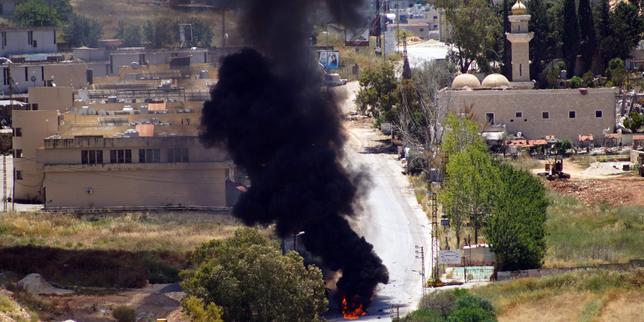
The proclamation of a diplomatic cessation of hostilities frequently obscures the structural mechanics of kinetic enforcement. When the joint declaration between Israel, Lebanon, and the United States established "pilot zones" in early June 2026, standard journalistic reporting framed the subsequent aerial bombardments in southern Lebanon—specifically across Tyre, Nabatieh, Habboush, and Anqoun—as mere violations of a political agreement. This perspective misinterprets the operational logic of modern counter-insurgency.
The continuation of high-tempo military strikes in a post-ceasefire environment is not a breakdown of strategy; it is the execution of a specific strategic framework: asymmetric kinetic friction. To understand why strikes persist despite formal diplomatic agreements, observers must analyze the underlying operational parameters, enforcement mechanisms, and architectural flaws inherent in security frameworks that rely on a weak sovereign proxy.
The Strategic Asymmetry Framework
Traditional state-vs-state ceasefires rely on reciprocal deterrence. Both parties possess centralized command structures capable of enforcing compliance across a unified front. The conflict between the Israel Defense Forces (IDF) and Hezbollah operates under a entirely different set of rules.
+------------------------------------------------------------+
|             THE THREE PILLARS OF KINETIC ENFORCEMENT       |
+------------------------------------------------------------+
| 1. Active Threat Mitigation: Continuous degradation of     |
|    forward-deployed rocket and unmanned aerial vehicle     |
|    (UAV) assets.                                           |
+------------------------------------------------------------+
| 2. Proxy Force Displacement: Forcible clearing of border   |
|    topography to establish a demilitarized zone south of   |
|    the Litani River.                                       |
+------------------------------------------------------------+
| 3. Sovereign Pre-emption: Striking logistics networks      |
|    before an unverified proxy force can assume operational |
|    territorial control.                                    |
+------------------------------------------------------------+
This structural reality creates a distinct operational divergence. While diplomatic communiqués emphasize a transition of authority to the Lebanese Armed Forces (LAF), the IDF utilizes active kinetic friction to reshape the security geography before that transition occurs. The June 2026 strikes target specific nodes—motorcycle-borne logistical couriers in Habboush, command infrastructure in Doueir, and forward staging environments near Tyre—to prevent Hezbollah from re-establishing entrenched positions during the diplomatic window.
The Operational Cost Function of Security Zones
The creation of pilot zones under the supervision of the LAF introduces a critical security bottleneck. In an ideal security model, the sovereign state deploys its regular army to monopolize force and police non-state actors. In the southern Lebanese theater, this model confronts a severe capacity deficit.
The operational cost function of enforcing a demilitarized zone can be broken down into three core variables:
- Detection Probability: The technological and human intelligence resources required to identify low-signature non-state combatants operating within civilian infrastructure.
- Interdiction Capability: The political will and kinetic power needed to disarm or neutralize entrenched insurgent networks.
- Sovereign Resilience: The capacity of the state military to withstand internal sectarian pressure when engaging a heavily armed domestic political faction.
Because the LAF lacks both the technical detection assets and the political mandate to execute high-intensity interdiction against Hezbollah, the burden of verification defaults to external kinetic actions.
When the IDF issued urgent evacuation orders for nine southern villages—including Anqoun, Sarafand, and Tafahata—it signaled a shift from passive observation to proactive geographic denial. The subsequent strikes demonstrate that the tactical objective is not territorial conquest, but rather the creation of a high-risk buffer area. By driving up the physical and logistical cost of remaining in these zones, the military objective is to strip non-state actors of the civilian concealment necessary for launching short-range rocket systems and unmanned aerial vehicles (UAVs).
Logistical Bottlenecks and Causal Mechanisms
The media routinely characterizes the persistence of strikes as arbitrary aggression or diplomatic failure, missing the clear cause-and-effect relationship between tactical maneuvers and strategic reactions.
The primary driver of the June 2026 escalation is the Hezbollah Re-infiltration Vector. When the IDF executed a tactical withdrawal from the village of Dibbine near Marjayoun, a security vacuum was immediately created. Under standard peacekeeping models, UNIFIL forces and LAF engineers deploy to clear debris and secure transit routes. However, this stabilization phase simultaneously lowers the barrier to entry for decentralized insurgent units.
The causal chain operates as follows:
[IDF Tactical Withdrawal]
       │
       ▼
[Sovereign Security Vacuum]
       │
       ▼
[Insurgent Staging Attempts (UAV/Rocket Placement)]
       │
       ▼
[Sensor-to-Shooter Detection (ISR Overflights)]
       │
       ▼
[Pre-emptive Air/Artillery Interdiction]
This sequence explains why areas sheltering displaced persons, such as Anqoun, become kinetic focal points. Non-state networks frequently exploit the logistical cover of civilian movement to transport man-portable air-defense systems (MANPADS), anti-tank guided missiles (ATGMs), and loitering munitions. Consequently, the IDF relies heavily on unmanned intelligence, surveillance, and reconnaissance (ISR) platforms to monitor these transport corridors, executing precision strikes on high-value targets before they can be integrated into subterranean or urban defensive webs.
The Limitations of Cross-Border Deterrence
The strategic flaw in current diplomatic efforts lies in the misallocation of accountability. The joint declaration presumes that the state of Lebanon possesses the institutional capacity to act as a guarantor of security. Historically and operationally, this assumption is invalid.
A cross-border security architecture built on a fragile sovereign proxy faces severe structural limits:
- The Enforcement Paradox: If the LAF attempts to forcibly disarm Hezbollah south of the Litani River, it risks triggering a systemic domestic conflict, effectively fracturing the state it is tasked with protecting.
- Information Asymmetry: External forces rely on remote sensing and aerial platforms, which are highly effective for tracking heavy material but struggle to map underground tunnels or decentralized command structures embedded within municipal centers.
- The Timeline Mismatch: Diplomatic frameworks demand immediate stabilization, whereas the construction of a capable, politically neutral state security force requires years of sustained capital investment and institutional reform.
Given these constraints, the operational reality on the ground will continue to be governed by raw kinetic capability rather than signed accords.
Tactical Reconfiguration
To achieve a stable strategic equilibrium, the parameters of the enforcement mechanism must be adjusted. Relying on reactive aerial bombardments yields high civilian displacement, destroys critical infrastructure, and creates a continuous cycle of friction that undermines diplomatic credibility.
The stabilization of the southern border zone requires transitioning from a model of reactive kinetic enforcement to one of structural denial. The LAF must be deployed not as an observational force, but as an engineering and interdiction barrier. This requires the immediate deployment of automated ground-sensing arrays along key geographic choke points, combined with a strict, verifiable mandate to block the transit of unauthorized tactical gear.
Concurrently, international oversight bodies must shift their metrics from counting political violations to tracking the physical transfer of weapons. Until the logistical pathways feeding non-state armed actors are physically obstructed, security arrangements will remain inherently unstable, and air power will remain the primary, volatile instrument of border management.