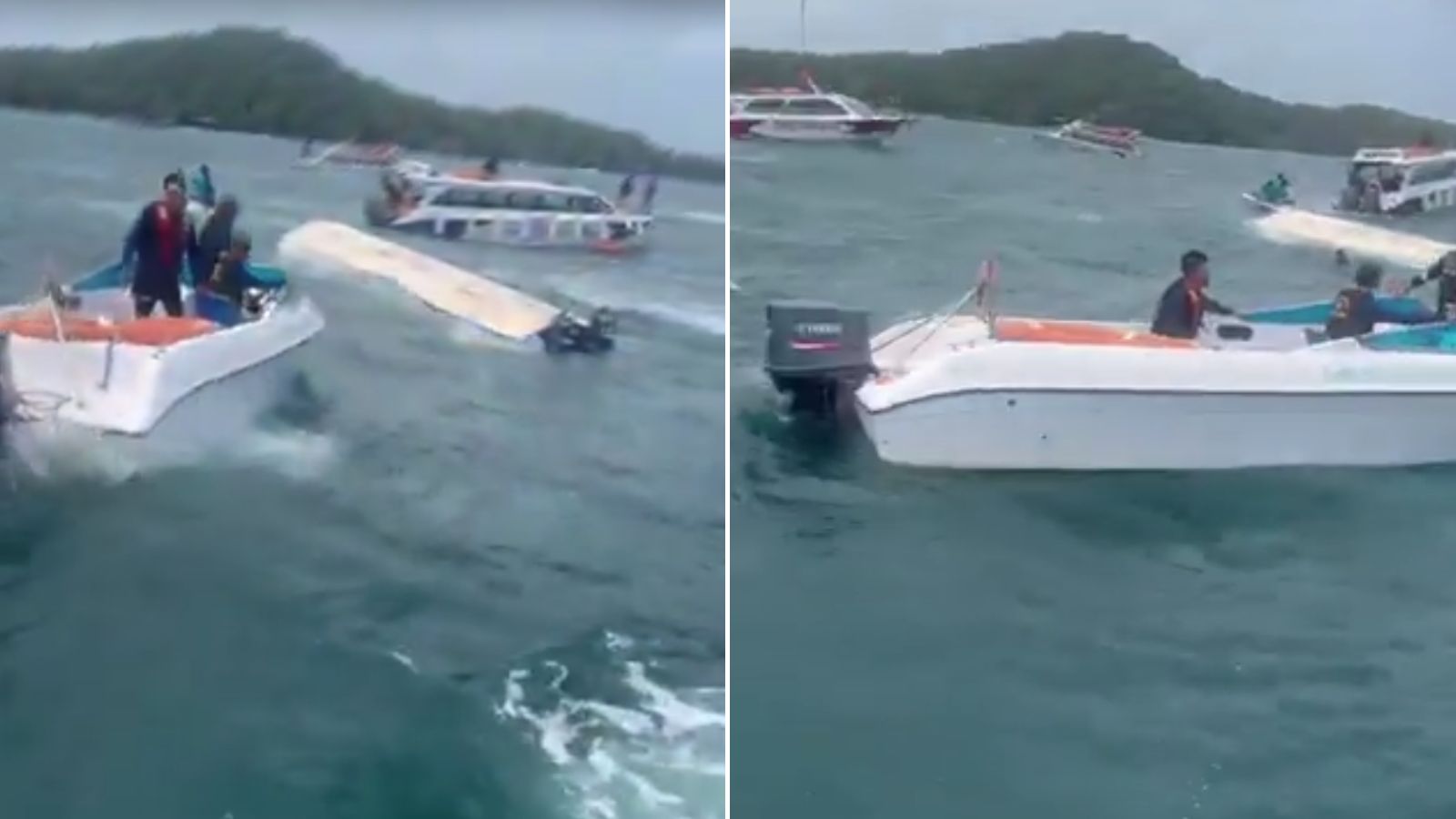
The capsizing of a commercial speedboat carrying 32 Indian tourists and four crew members off the coast of Phu Quoc Island, Vietnam, demonstrates the lethal intersection of volatile micro-climates and compromised vessel stability. The incident occurred approximately 400 meters off Hon May Rut Ngoai Island during a transit toward An Thoi Port. Initial reporting confirms 15 fatalities and 21 survivors. Moving past the initial media reports requires an objective analysis of the structural, environmental, and operational mechanics that govern small-craft maritime safety in emerging tourism corridors.
The Kinematics of Hull Inversion
Evaluating a vessel capsize necessitates assessing the relationship between hydrodynamic forces and the craft's center of gravity. Speedboats operating in tourist hubs like the Kiên Giang province frequently utilize deep-V hull configurations, designed to slice through moderate chop but highly sensitive to distribution of weight and lateral impact.
The causal mechanism of the inversion relies on a three-part failure chain:
- The Metacentric Height (GM) Deficit: As waves increase in magnitude, the rolling motion of the vessel shifts its center of buoyancy. If the vertical center of gravity is elevated—often due to passengers standing or shifts in unbolted payload—the metacentric height shrinks, reducing the vessel's natural righting moment.
- Dynamic Capsizing via Wave Entrainment: Preliminary data from the Phu Quoc Special Economic Zone points to a combination of strong winds and localized high waves. When a vessel is struck broadside (beam sea) by a wave sequence exceeding its freeboard capacity, water ingress introduces a free-surface effect, where shifting liquid ballast destroys remaining lateral stability.
- The Entrapment Bottleneck: Local rescue operators reported that the majority of the 15 fatalities occurred because passengers were physically trapped inside the hull structure post-inversion. In high-speed tourist craft, structural enclosures designed for weather protection frequently convert into air-locked drowning hazards when inverted, severely lowering the probability of autonomous egress.
Crisis Containment and Bilateral Logistics
When a mass casualty event involves foreign nationals, the operational response transitions from immediate tactical rescue to complex diplomatic and medical logistics. The response matrix established by Vietnamese and Indian authorities illustrates this framework.
                  [ Maritime Accident Off Phu Quoc ]
                                  │
         ┌────────────────────────┴────────────────────────┐
         ▼                                                 ▼
[Tactical Rescue Stage]                         [Strategic Diplomatic Stage]
 ├─ Initial Responder Intercept                  ├─ Bilateral Control Rooms Established
 ├─ Tri-Agency Coordination                      │   ├─ Embassy (Hanoi)
 │   (Border Guard/Navy/Coast Guard)             │   └─ Consulate (Ho Chi Minh City)
 └─ Survived/Deceased Segregation                └─ Manifest Verification & Family Liaison
Phase 1: Tactical First-Responder Intercept
The initial phase relied on decentralized civilian intervention before institutional deployment. Private tourist vessels reached the capsized hull within five minutes of inversion. This immediate response is typical in high-density tourism zones, where official naval assets face structural latency due to distance. Subsequently, a coordinated tri-agency deployment—comprising the Vietnamese Border Guard, Navy, and Coast Guard—secured the perimeter, stabilized the 21 survivors, and recovered all deceased individuals from the hull.
Phase 2: Strategic Diplomatic Infrastructure
The diplomatic response requires immediate administrative scale to handle data dissemination and identity verification. The Indian Embassy in Hanoi and the Consulate General in Ho Chi Minh City deployed a dual-node communication network using dedicated operational lifelines:
- Ho Chi Minh City Consulate Hub: +84 36 281 7930, +84 91 552 37 14, and +84 33 452 0414
- Hanoi Embassy Hub: +84 91 308 9165
The primary objective of these communication nodes is managing manifest verification. Passenger manifests in regional tourism hubs are frequently prone to transcription errors or incomplete recording. By releasing the verified names of all 32 Indian nationals onboard, the embassy mitigated information asymmetry, allowing international family networks to cross-reference passenger identities with hospital admissions in Kiên Giang.
Structural Deficiencies in Rapidly Scaling Tourism Hubs
The underlying vulnerability exposed by the Phu Quoc incident is not unique to Vietnam; it is an inherent systemic risk within rapidly accelerating global tourism corridors. When destination marketing outpaces regulatory infrastructure, a safety deficit develops.
The first limitation is the reliance on private operators with variable safety compliance. The vessel in this incident, managed by Ocean Pear Island Company, operated within a high-throughput transit lane where turnaround times directly dictate profitability. This economic model introduces a temptation to optimize passenger volume at the absolute margin of vessel capacity.
The second limitation is the lack of real-time meteorological enforcement at the pier level. Micro-climatic shifts in the Gulf of Thailand can generate localized squalls within minutes. Without centralized, mandatory radar and weather monitoring systems that legally bar small craft from departing when specific wave-height thresholds are crossed, the decision to sail rests solely on the captain's subjective risk tolerance.
To prevent systemic failure in regional maritime tourism, regulatory frameworks must shift from reactive crisis management to strict operational constraints. Governing bodies must mandate the integration of automatic identification systems (AIS) on all commercial tourist craft, enforce hard passenger caps scaled to dynamic weather tiers rather than static hull ratings, and implement mandatory canopy quick-release mechanisms to eliminate the entrapment risks that drove the high fatality rate in this instance.