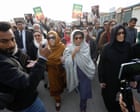
The preventive detention of Imran Khan's three sisters—Aleema Khanum, Uzma Khanum, and Noreen Niazi—in Lahore ahead of the September 27, 2026 protest march marks a structural escalation in Pakistan's state-opposition conflict. By simultaneously incarcerating the immediate family of the imprisoned Pakistan Tehreek-e-Insaf (PTI) founder under administrative orders, the state shifted from targeting formal party hierarchies to severing the informal communication conduits that sustain decentralized political movements.
Standard news coverage treats these arrests as an isolated flare-up of political vendetta or routine pre-protest policing. That framing misses the underlying operational mechanics. When a political party's formal leadership is systematically neutralized through imprisonment or forced defection over a three-year period, non-office-holding family members become the primary authenticators of the leader's directives. Removing them is an effort to induce organizational paralysis before mobilization reaches critical mass.
The Architecture of Pre-Emptive Neutralization
To understand why the Punjab administration executed simultaneous arrests across Lahore on September 20 and September 21, 2026, one must examine the operational sequence of state containment. Rather than waiting for street-level confrontation in Islamabad, authorities deployed a multi-tiered disruption model designed to raise the coordination costs of the PTI's planned long march.
- Decapitation of Informal Command Nodes: With Imran Khan incarcerated since 2023 and senior PTI figures either jailed or sidelined, his sisters functioned as de facto political emissaries. Their prison visits and public statements provided authoritative verification of Khan's strategy to a fragmented party base. Detaining Aleema Khanum while she traveled in Lahore, followed hours later by early-morning raids capturing Uzma Khanum, Noreen Niazi, and extended relatives, eliminated the central hub of message validation.
- Administrative Bypass of Judicial Friction: Authorities did not rely on criminal indictments, which require immediate evidentiary thresholds and judicial scrutiny. Instead, the Lahore Deputy Commissioner issued 30-day preventive detention orders under the Punjab Maintenance of Public Order Ordinance, 1960 (MPO). Administrative detention shifts the burden of initiative onto defense counsel, buying the state a guaranteed window of immobilization while habeas corpus petitions work through the Lahore High Court.
- Mass Attrition and Surety Coercion: Simultaneous with high-profile family arrests, police conducted sweeping detentions of mid-tier organizers and rank-and-file activists across Punjab. Party leadership reported roughly 1,500 workers arrested alongside sitting lawmakers. Crucially, authorities utilized conditional releases—freeing select detainees only after they signed legal affidavits pledging not to participate in the march. This converts state custody into a binding contractual deterrent against future mobilization.
- Judicial Perimeter Restriction: Ahead of the scheduled demonstration, the Islamabad High Court ruled that no political party possesses the lawful right to occupy public roads, highways, interchanges, or government buildings. This ruling pre-authorized law enforcement to treat physical assembly on transit arteries as an immediate statutory violation rather than a protected constitutional exercise.
The Legal Mechanics of the Maintenance of Public Order Ordinance
The core instrument enabling this crackdown is the 1960 Maintenance of Public Order Ordinance. Originally enacted during an era of martial law administration, the statute empowers provincial executive officials—specifically Deputy Commissioners—to detain individuals without formal criminal charges if the official deems it necessary to prevent actions prejudicial to public safety or order.
In operational terms, the MPO functions as an executive pressure valve. Unlike the Anti-Terrorism Act or standard penal code provisions, an MPO order requires no immediate presentation of physical evidence before a magistrate. The initial 30-day detention period covers the critical lifecycle of a planned political protest, ensuring that key organizers remain behind bars until the mobilization window closes. When the initial 30-day term expired in October 2026, the Punjab government extended the orders for an additional 30 days, stretching the custody of Noreen Niazi and Uzma Khanum to 53 days before withdrawing the orders just prior to a scheduled judicial review in November.
This lifecycle reveals a deliberate bureaucratic calibration. By releasing two sisters hours before a Lahore High Court hearing while maintaining a separate detention order against Aleema Khanum, the executive avoids adverse judicial precedent on the legality of the MPO extensions while preserving ongoing bargaining power.
The Compounding Macro-Economic and Humanitarian Variables
State containment strategies do not operate in a vacuum; their efficacy depends heavily on the surrounding economic and informational environment. In September 2026, two external pressures complicated the government's suppression calculus.
First, severe domestic economic distress and acute fuel shortages—driven by geopolitical turmoil across the Middle East and the Persian Gulf—created baseline public frustration. In political science, economic shocks lower the opportunity cost of protest for ordinary citizens. However, severe petrol shortages simultaneously act as a physical constraint on logistics, limiting the ability of opposition convoys to transport thousands of protesters from Khyber Pakhtunkhwa and northern Punjab into the federal capital.
Second, the narrative surrounding Imran Khan's physical health inside Rawalpindi's Adiala Jail introduced an emotional accelerant. Family members and legal representatives repeatedly alleged medical neglect, pointing to deteriorating eyesight and blood pressure complications. In August 2026, the Supreme Court directed that Khan be transferred to a civilian medical facility for evaluation, yet authorities returned him to prison after a brief stay at a government hospital. When Noreen Niazi herself required emergency transfer from Kot Lakhpat Jail to the Punjab Institute of Cardiology in late October due to acute hypertension—without prior notification to her family—the custody of Khan's relatives transformed from a tactical security measure into a potent symbol of state overreach.
Asymmetric Costs of the Suppression Model
Every coercive intervention carries a measurable cost function. While preventive detention successfully disrupted the immediate command-and-control structure of the September march, the operational trade-offs expose distinct vulnerabilities for the governing coalition and the military establishment.
- The Martyrdom Multiplier: In South Asian dynastic and populist politics, the incarceration of female family members violates deeply entrenched cultural norms. Arresting all three of Khan's sisters simultaneously for the first time validated the PTI's core narrative of existential persecution, generating intense domestic outrage and drawing formal condemnation from international human rights monitors regarding obligations to peaceful assembly.
- Institutional Friction Between Executive and Judiciary: Repeatedly invoking administrative detention to circumvent bail orders forces superior courts into direct confrontation with provincial executives. Withdrawing detention orders days before scheduled hearings mitigates immediate legal defeat, but it erodes institutional credibility and signals to domestic and international observers that executive decrees are being used punitively rather than preventively.
- Signal Distortion During Backchannel Negotiations: Maintaining simultaneous pressure on a leader's immediate family complicates off-ramp diplomacy. By November 2026, when authorities facilitated a late-night medical transfer for Khan to the Pakistan Institute of Medical Sciences for an ocular injection and released Uzma Khanum and Noreen Niazi the following day, political analysts immediately interpreted the sequence as evidence of a backchannel settlement involving the military leadership. Retaining Aleema Khanum and Khan's wife, Bushra Bibi, in custody demonstrates that the state is utilizing staggered releases as granular concessions rather than executing a comprehensive political reset.
Limitations of Coercive Containment
Treating preventive detention as a permanent solution to political instability misunderstands the mechanics of networked opposition movements. Administrative incarceration can neutralize specific physical organizers, block highway access, and deter casual participants through affidavit coercion. What it cannot do is resolve the underlying legitimacy deficit or alleviate the macroeconomic pressures—such as energy inflation and supply chain disruptions—that fuel public grievance.
Furthermore, over-reliance on family detentions creates a diminishing return on deterrence. Once the state crosses the threshold of jailing a former prime minister's entire immediate family, it exhausts its escalatory ladder. Future mobilization calls face no remaining psychological barrier regarding family immunity, forcing security apparatuses to rely continuously on physical force, internet blackouts, and highway blockades to maintain order in Islamabad.
Operational Forecast and Strategic Trajectory
The staggered release of Uzma Khanum and Noreen Niazi after 53 days in Kot Lakhpat Jail, paired with the continued detention of Aleema Khanum, establishes the exact template the Pakistani state will deploy through the remainder of 2026 and into 2027. Authorities have transitioned from blanket suppression to calibrated hostage-bargaining, using administrative custody orders as divisible leverage points to extract behavioral compliance from the PTI leadership.
To navigate this environment, opposition strategists must abandon centralized, single-date march architectures that allow the state to pre-emptively decapitate known family intermediaries via 30-day MPO sweeps. Resilient mobilization under this legal regime requires shifting to decentralized, flash-point protests led by anonymous local committees that carry zero formal title and hold no public schedule prior to assembly. Conversely, if the state continues to rely on executive detention extensions rather than verifiable economic stabilization and transparent judicial due process, each subsequent release cycle will trigger a sharper, less predictable wave of street-level unrest.
For an overview of the legal developments surrounding the recent prison releases, see Imran Khan's Two Sisters Released From Jail. This broadcast report details the withdrawal of the extended detention orders in Lahore and outlines the ongoing legal efforts regarding Aleema Khanum's custody.