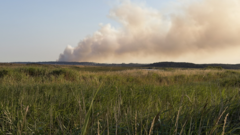
Emergency management during a high-density environmental disaster relies entirely on the velocity of information processing and resource allocation efficiency. When a major heath fire erupts in a region characterized by volatile dry biomass, sandy terrain, and proximity to residential and recreational assets—such as the recent incident in Suffolk requiring the emergency evacuation of homes and a caravan park—the operational challenge shifts instantly from containment to triage. Standard journalism typically reduces these complex multi-agency events to a sequence of frightening visuals and temporary displacement figures. A rigorous deconstruction reveals a distinct architecture of operational vulnerabilities, fluid dynamics in wildfire propagation, and systemic friction points in public safety execution.
The Triad of Wildfire Propagation Variables
Heath fires in lowland environments do not spread randomly; they obey strict physical laws dictated by fuel characteristics, atmospheric conditions, and topographical drivers. In the context of the Suffolk coastal and lowland heaths, the fuel load consists predominantly of gorse, heather, and dry grasses. These vegetation types possess high resin content and low moisture thresholds during seasonal dry spells, creating an acute fire hazard index.
Fuel Load Dynamics and Ignition Energy
Lowland heath vegetation acts as a dense, continuous fuel bed. Unlike mature forest canopies where ladder fuels dictate vertical progression, heath fires spread via surface and crown vectors simultaneously under wind influence. The surface energy release rate per unit area scales directly with relative humidity drops and ambient temperature spikes. When wind speeds exceed critical thresholds, forward rate of spread increases exponentially, transforming a localized thermal anomaly into a fast-moving front that outpaces initial ground crew response times.
Topographical and Meteorological Amplification
Suffolk terrain, while relatively flat, features coastal microclimates characterized by shifting sea breezes and low-lying drainage basins that create erratic wind vectors. These localized gusts alter fire direction unpredictably, bypassing natural firebreaks such as access tracks or drainage ditches. Tactical assessment requires continuous meteorological logging to predict spot-fire generation, where wind-borne embers ignite secondary fronts hundreds of meters ahead of the primary fire line.
The Logistics of Mass Evacuation in Leisure and Residential Zones
Evacuating mixed-use areas—specifically residential housing adjacent to high-density seasonal facilities like caravan parks—introduces severe human behavioral variables and infrastructure bottlenecks. The Suffolk incident highlighted the friction between permanent domestic infrastructure and transient recreational assets.
Infrastructure Bottlenecks and Egress Capacity
Caravan parks and rural residential settlements typically feature single-lane access roads or narrow egress routes designed for low-density traffic. When an evacuation order is issued simultaneously across both zones, vehicle queue times surge past critical thresholds. The primary failure mode in these environments is not a lack of warning time, but throughput capacity constraints. Private vehicles towing caravans or trailers widen the physical footprint on narrow tracks, increasing the probability of mechanical breakdowns or blockades that stall entire evacuation columns.
Triage Communication Protocols
Public safety communication during rapid-onset wildfire events suffers from latency. Emergency services must balance the imperative for immediate evacuation with the risk of mass panic and gridlock. Effective incident command depends on decentralized messaging that targets specific hazard perimeters rather than broad regional alerts, minimizing redundant traffic generation from unaffected sectors that might otherwise clog primary arterial escape routes.
Resource Allocation and Incident Command Friction
Managing multi-agency responses involving local fire and rescue services, police units, and municipal authorities exposes inherent coordination friction. The operational efficiency of wildfire suppression is a function of water supply accessibility, air support integration, and ground crew rotation cycles.
Water Infrastructure Limitations in Rural Heathlands
Unlike urban environments equipped with pressurized municipal fire hydrants, rural heathlands present severe water deficit challenges. Fire engines must establish relay systems from distant water sources or deploy mobile bowsers. In rapidly advancing fire fronts, the time required to establish a sustainable water supply chain creates critical tactical windows where crews must adopt defensive postures rather than aggressive suppression.
Tactical Prioritization Matrix
Incident commanders operate under a strict hierarchy of objectives: life safety, property protection, and environmental conservation. When a heath fire threatens both permanent housing and a caravan park, prioritization must favor rapid personnel extraction over asset defense. Structural protection under heavy ember attack requires specialized personnel deployment that, if misallocated, compromises the primary objective of zero casualties.
The Economic and Environmental Cost Function
The aftermath of a major heath fire extends far beyond immediate property damage and temporary displacement costs. The ecological recovery curve for lowland heath ecosystems is protracted, often requiring decades of active management to restore biodiversity lost in high-intensity burns. From an economic perspective, the incident forces a re-evaluation of municipal zoning laws, setback requirements between residential boundaries and flammable vegetation zones, and insurance risk modeling for coastal and rural properties. Local authorities face recurring capital expenditures for hazard reduction burning and fuel-break maintenance, which must be weighed against the catastrophic tail risk of unmitigated wildfire events.
Implement mandatory perimeter clearance zones of at least thirty meters for all residential and recreational properties situated within high-risk lowland heath sectors, coupled with automated early-detection thermal sensor arrays to compress the initial response time window.