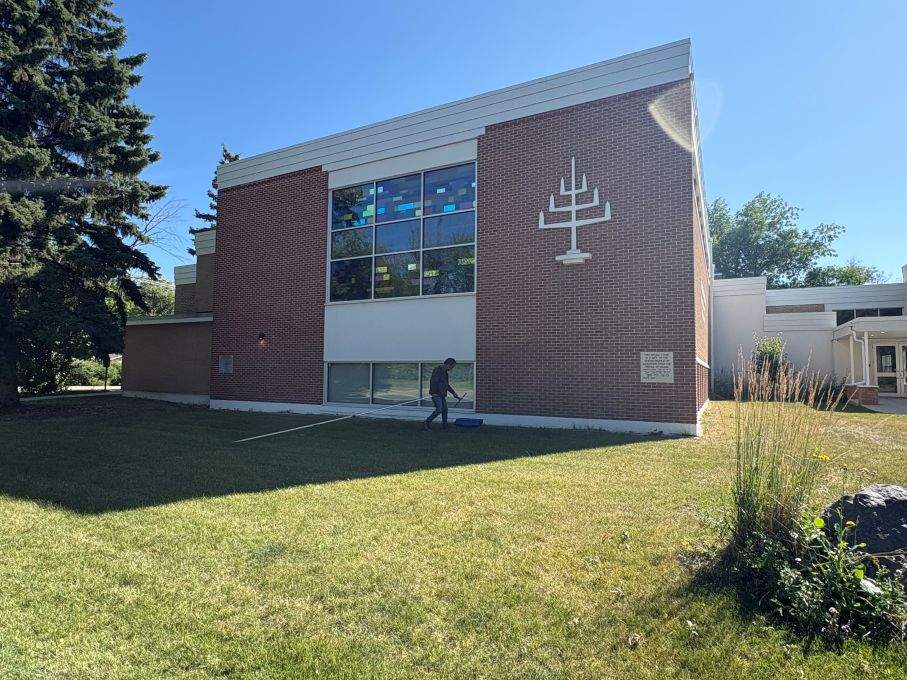
Targeted property damage directed at active houses of worship functions not as random acts of delinquency, but as calculated expressions of intimidation designed to alter the operational security and psychological baseline of minority communities. When the Congregation Agudas Israel synagogue in Saskatoon was struck by projectiles during an active Saturday Shabbat service, the incident exposed the structural vulnerabilities inherent in open institutional architecture.
Evaluating this event requires stripping away moral commentary to examine the mechanics of identity-based vandalism, the escalation curve from property defacement to physical threat, and the systemic cost functions borne by targeted institutions.
The Cost Function of Open Institutional Access
Religious and cultural institutions face a permanent optimization problem: balancing community accessibility with physical security. Open institutions invite engagement, education, and multi-faith coalition building, but they simultaneously maximize their attack surface.
The incident in Saskatoon—occurring in broad daylight while congregants, including children, were inside—demonstrates the limits of low-friction public architecture.
Open Architecture Model
[Public Access] ---> [Minimized Barriers] ---> [High Vulnerability to Asymmetric Harassment]
When an entity relies on a low-security perimeter to signal community trust, it transfers the cost of monitoring onto the occupants. The immediate financial and operational consequences manifest across distinct vectors:
- Direct remediation expenditures for cleaning, structural inspection, and glass replacement.
- Asset depreciation of parked vehicles targeted in the adjacent lots.
- Opportunity costs diverted from community programming to security protocol redesign.
- Psychological overhead that alters attendance metrics and engagement rates among members.
The Escalation Mechanics of Identity-Based Harassment
Sociological and criminological data regarding hate-motivated incidents indicate that escalation follows predictable pathways. Minor vandalism acts as a testing mechanism for institutional response and municipal oversight.
Escalation Pathway
[Phase 1: Symbolic Defacement] ---> [Phase 2: Routine Intimidation] ---> [Phase 3: Structural Threat Expansion]
The progression from symbolic defacement to physical confrontation relies on an absence of rapid deterrence. When perpetrators execute property attacks in daylight without immediate apprehension, the perceived risk-to-reward ratio encourages repeat offenses.
Leadership at Agudas Israel noted historical precedents, referencing past incidents ranging from minor harassment to severe arson threats involving incendiary devices. This historical continuum confirms that low-level property targeting rarely remains static. Without systemic counter-measures, the frequency and severity curve trends upward.
The Multi-Faith Coalition Response Variable
Mitigating the systemic effects of targeted institutional attacks requires evaluating the counter-pressure exerted by civic and religious allies. In structural terms, isolated institutions experience higher rates of revictimization compared to those embedded within robust municipal support networks.
The swift public denunciation by municipal officials and multi-faith organizations in Saskatoon alters the local deterrence environment. By explicitly raising the political and social cost of antisemitic acts, civic coalitions compress the operational window for bad actors.
However, public solidarity statements represent a ceiling of soft deterrence. They fail to alter the physical vulnerabilities of glass windows, parking perimeters, and open entryways. Transitioning from reactive statements to structural resilience requires measurable capital allocation toward physical hardening and surveillance integration.
Strategic Capital Allocation for Institutional Defense
Institutions facing targeted harassment must re-engineer their security frameworks from the ground up. Relying on community goodwill is an insufficient defensive posture in an environment marked by rising identity-based hostility.
- Implement ballistic-resistant window films to prevent easy shattering and reduce clean-up vulnerabilities during active services.
- Upgrade perimeter closed-circuit television coverage to ensure high-definition facial and vehicular capture in all lighting conditions.
- Formalize a direct liaison protocol with municipal law enforcement to reduce emergency response latency during active incidents.
- Establish a restricted-access policy for secondary entry points during peak gathering times without compromising emergency egress routes.


