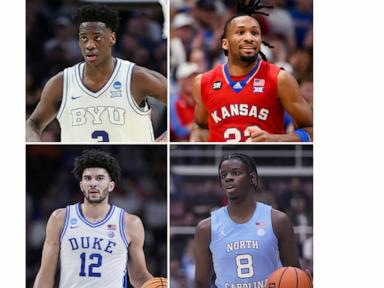
NBA front offices evaluate draft capital through the lens of asymmetric upside versus structural floor. In the 2026 draft cycle, consensus scouting has consolidated around four distinct prospects who occupy Tier One: AJ Dybantsa, Darryn Peterson, Cameron Boozer, and Caleb Wilson. While conventional mock drafts rank these prospects linearly based on team fit or raw box-score metrics, a rigorous analytical framework reveals that each player represents a distinct risk-reward profile defined by specific mechanical and physical variables.
Evaluating these four prospects requires decoupling high-volume college production from scalable NBA utility. By isolating translation mechanisms—such as physical self-creation capacity, defensive positional versatility, and shot-making variance—we can map the precise economic value each prospect brings to a franchise. If you liked this article, you might want to check out: this related article.
The Efficiency Engine: AJ Dybantsa and Isolated Self-Creation
AJ Dybantsa sits atop the 2026 draft class due to his unique combination of positional size, biometric data, and high-leverage shot creation. Standing 6-foot-9 with a reported 42-inch maximum vertical leap, Dybantsa operates as a functional wing creator, a profile that commands premium equity in modern NBA offenses.
The core of Dybantsa's valuation lies in his deceleration mechanics and lower-body flexibility. His ability to drop his hips instantly into pull-up jumpers allows him to bypass defensive contests entirely. At Brigham Young, Dybantsa generated 25.5 points per game, driven primarily by his efficiency in unassisted isolation scenarios. For another look on this development, refer to the latest update from Bleacher Report.
[Deceleration/Hip Fluidity] ---> [Off-the-Dribble Separation] ---> [High-Volume Isolation Scoring]
The underlying risk factors in Dybantsa’s profile center on playmaking processing speeds and shot selection. His college assist-to-turnover profile reveals a tendency to play with tunnel vision when encountering secondary defensive rotations. In isolation, his perimeter footwork is advanced, but when trapped or forced into a baseline funnel, his diagnostic timing lags.
A 33.1% conversion rate from three-point range indicates that his perimeter efficiency remains high-variance. If an NBA franchise cannot optimize his passing vision to punish double-teams, his utility shifts from a primary offensive engine to a highly dependent, volume-heavy secondary scorer.
The Scoring Speculation: Darryn Peterson and Shot-Making Volume
Darryn Peterson represents the pure lead-guard archetype within Tier One. Measuring 6-foot-5 and weighing 200 pounds, the Kansas freshman posted 20.2 points per game using an elite three-level scoring package. Peterson isolates effectively out of pick-and-roll coverage, featuring a quick-release jumper and highly functional rim-finishing packages.
The primary bottleneck to Peterson's evaluation is durability and load tolerance. A freshman campaign limited to 24 games due to lower-extremity cramping and soft-tissue issues created an incomplete statistical sample. When active, Peterson demonstrated a high-volume scoring ceiling, but his playmaking metrics—specifically a low 1.6 assists per game—suggest he projects as an off-guard or scoring combo-guard rather than a traditional table-setter.
The structural trade-off with Peterson involves high offensive usage versus defensive scalability. While his offensive tape shows a player capable of winning scoring titles, his physical profile suggests limitations when switching onto larger wings. Front offices prioritizing Peterson at the top of the lottery are betting on elite shot-making outperforming his current lack of playmaking allocation and injury history.
The High Floor Play: Cameron Boozer and Functional Metrology
Cameron Boozer represents the absolute inverse of the high-variance prospect. At 6-foot-8 and 250 pounds, the Duke power forward built an elite freshman profile anchored by mechanical consistency and physical leverage. Boozer averaged 22.5 points, 10.2 rebounds, and 4.1 assists per game, establishing himself as the most productive operational asset in college basketball.
Boozer's draft value is insulated by three highly scalable skills:
- Processor Speed: A 4.1 assist-to-turnover infrastructure allows Boozer to operate as a short-roll playmaker, finding corner shooters instantly when defense collapses.
- Leverage Mechanics: Excellent core strength allows him to secure deep post position and dominate defensive rebounding sequences against taller opponents.
- Perimeter Scaling: A 39.1% three-point stroke on volume establishes him as a legitimate pick-and-pop threat, preserving half-court spacing.
The debate surrounding Boozer centers entirely on his vertical ceiling. Lacking the explosive, above-the-rim athleticism of Dybantsa or Wilson, Boozer relies on positioning and anticipatory reads. Skeptics question whether his inability to blow past elite athletes out of isolation limits his upside to a high-end secondary starter rather than a foundational superstar.
The Defensive Ceiling: Caleb Wilson and Positional Elasticity
Caleb Wilson represents the archetype of modern defensive elasticity. The 6-foot-9, 210-pound North Carolina forward functions as a highly disruptive frontcourt piece. His value proposition is tied directly to his lateral mobility and second-jump recovery time, allowing him to switch across four positions while maintaining weak-side rim protection.
Wilson’s offensive translation is significantly more experimental than his tier-mates. While averaging 19.8 points and 9.4 rebounds, his 25.9% three-point shooting reveals a broken perimeter profile. His offensive production relies heavily on transition leak-outs, straight-line drives, and offensive putbacks.
The structural gamble on Wilson requires an organization to fix his shooting mechanics while leveraging his immediate defensive impact. If the jumper fails to develop, his half-court offensive utility drops significantly, rendering him a screening big who clogs the paint. If the jumper becomes respectable, his combination of elite defensive versatility and transition playmaking mirrors the highest-value functional wings in the league.
Structural Comparison Matrix
| Prospect | Primary Value Driver | Mechanical Limitation | High-End Target Archetype |
|---|---|---|---|
| AJ Dybantsa | Isolation scoring, elite frame | Playmaking processing speed | Three-level wing engine |
| Darryn Peterson | Three-level shot creation | Durability, playmaking volume | High-volume scoring guard |
| Cameron Boozer | Processing speed, elite floor | Functional vertical verticality | All-NBA connective forward |
| Caleb Wilson | Positional switching, transition | Half-court shooting mechanics | Elite two-way modern wing |
An analytical breakdown of the top four prospects reveals that draft positioning comes down to organizational philosophy and roster composition. Teams requiring an immediate, high-volume scoring option to anchor their perimeter offense must prioritize Dybantsa or Peterson, accepting the inherent risks of processing speeds and medical durability.
Conversely, franchises with established perimeter creators look to Boozer or Wilson to maximize team efficiency. Boozer offers immediate tactical execution and spatial optimization, whereas Wilson provides defensive range capable of shifting a team's entire defensive identity. The optimal strategic play for a franchise holding a top-two pick is to prioritize Dybantsa’s self-creation variance, while teams holding picks three and four must balance Boozer’s guaranteed operational baseline against the defensive ceiling of Wilson.