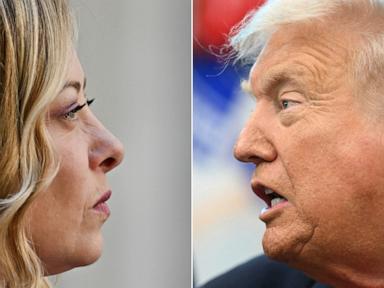
The escalating diplomatic conflict between US President Donald Trump and Italian Prime Minister Giorgia Meloni over an alleged G7 photo-op request exposes a deeper structural shift in transatlantic relations. While media narratives reduce the friction to personal vitriol on social media, the rupture is driven by divergent national interests, constitutional constraints, and competing domestic political calculations. The breakdown of this bilateral relationship can be deconstructed into three operational axes: logistics-as-leverage in asymmetric alliances, the domestic calculus of sovereign positioning, and the systemic breakdown of informal diplomatic channels.
The Asymmetric Alliance: Airfields, Sovereignty, and Operation Epic Fury
The primary catalyst for the diplomatic rupture is structural, rooted in the military logistics of West Asian theater operations. During recent US military actions against Iran, the United States requested unconstrained access to Italian military installations—specifically airfields and runways like NAS Sigonella in Sicily.
Italy operates under strict constitutional frameworks regarding foreign military deployments. Article 11 of the Italian Constitution repudiates war as an instrument of offense against the liberty of other peoples and as a means for settling international disputes. Consequently, offensive military actions launched from Italian soil require explicit parliamentary approval.
[US Operational Requirement] ──> [Request for Italian Airfields]
                                          │
                                          ▼
[Italian Constitutional Constraint] ──> [Requires Parliamentary Authorization]
                                          │
                                          ▼
                                   [Access Denied]
                                          │
                                          ▼
                               [Strategic Bottleneck]
By denying landing and takeoff rights for offensive sorties, Rome imposed an operational penalty on US logistics. The United States maintains a significant financial footprint within NATO, contributing a disproportionate share to collective defense infrastructure. From Washington’s perspective, the denial of access represents an asymmetric transactional failure: the US funds the broader security umbrella, yet faces localized vetoes during active conflicts. For Rome, yielding to the request without legislative consensus would violate sovereign statutory boundaries, transforming a bilateral defense agreement into an extra-constitutional security dependency.
The Domestic Popularity Function: Liability vs. Asset
The shift from alignment to public hostility corresponds with shifting domestic political incentives for both leaders. Political capital functions as a scarce resource, and the utility of international alignment depends entirely on internal voter dynamics.
For Prime Minister Meloni, the utility function of a close alignment with Washington inverted following the defeat of her judicial overhaul referendum. In the initial phase of her administration, close ties provided external validation and market stability. However, as public sentiment chilled toward aggressive foreign interventions, maintaining a visible partnership became a domestic liability.
Meloni's Political Utility = f(Sovereign Defense, Domestic Approval) - c(External Alignment)
Where $c$ represents the political cost of being perceived as a subordinate partner to a highly polarizing US executive. When the narrative emerged via Italian broadcaster La7 that Meloni had "begged" for a photograph at the G7 summit in France to artificially inflate her domestic standing, it struck at her core political value proposition: nationalist sovereignty.
A passive response would validate the depiction of Italy as a secondary client state. Conversely, a sharp rhetorical counter-offensive—exemplified by her video declaration that "neither I nor Italy ever beg"—repositions the friction as a defense of national dignity. This pivot offsets domestic vulnerability by consolidating her nationalist base against external condescension.
For President Trump, the public denunciation reinforces a consistent executive doctrine: strict transactional reciprocity among NATO allies. By framing Meloni’s positioning as a desperate attempt to repair relations after denying logistical support, the administration signals to the broader alliance that access and cooperation are non-negotiable prerequisites for diplomatic favor.
The Disruption of Diplomatic Channels
The immediate consequence of the rhetorical escalation is the formal suspension of ministerial-level statecraft. The cancellation of Italian Foreign Minister Antonio Tajani's scheduled visit to Washington removes the primary bureaucratic buffer between the two executives.
In traditional bilateral diplomacy, institutional channels function to insulate state-to-state operations from executive volatility. When public rhetoric devalues the head of government, the state apparatus is forced to respond symmetrically to preserve institutional credibility. Tajani’s withdrawal indicates that the dispute has transitioned from an online dispute into an official policy freeze.
| Component | Historical Alignment Phase | Present Rupture Phase |
|---|---|---|
| Bilateral Protocol | Direct engagement, backchannel optimization | Formal cancellation of ministerial visits |
| Logistical Access | Shared intelligence, routine base utilization | Strict enforcement of parliamentary vetoes |
| Rhetorical Strategy | Mutual ideological reinforcement | Public zero-sum sovereignty assertions |
This institutional freezing creates a structural vulnerability in NATO's southern flank. Italy serves as the primary logistical hub for Mediterranean maritime security and North African intelligence gathering. When communication channels between the absolute command structures of Washington and Rome degrade, operational coordination becomes rigidly transactional, slowing response times and increasing the friction of joint maneuvers.
Strategic Forecast
The current friction will likely dictate the terms of engagement for the upcoming NATO summit. The United States will continue to leverage its financial dominance within the alliance to demand standardized, unconstrained logistical access during extra-theater conflicts, aiming to bypass localized legislative vetoes.
Italy, facing deep-seated domestic opposition to unchecked military entanglements, will codify its defensive boundaries further, hiding behind multilateral European consensus rather than exposing itself to isolated bilateral pressures. The relationship will shed its ideological veneer and operate on a strict, case-by-case transactional framework, proving that personal affinity between leaders is consistently subordinate to the hard realities of constitutional law and national interest.