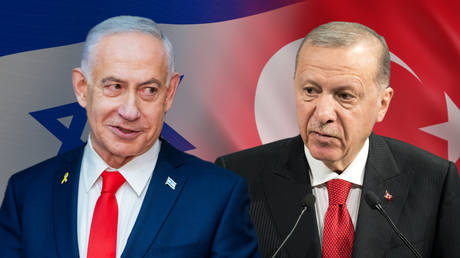
The escalating confrontation between Jerusalem and Ankara is fundamentally mischaracterized as a temporary diplomatic rupture driven by populist rhetoric. It is instead a structural collision over the architecture of Eurasian logistics, energy transit corridors, and maritime jurisdiction.
The systemic divergence between Israel and Türkiye follows a clear trajectory accelerated by two catalysts: the total trade embargo imposed by Ankara and the collapse of the Assad regime in Syria, which revived latent overland infrastructure ambitions. This structural friction operates across three distinct vectors: maritime denial strategies, energy transit containment, and data-logistical corridor competition.
The Maritime Vector: Mavi Vatan and the Exclusionary Zone
The core friction point in the Eastern Mediterranean centers on the legal and physical control of exclusive economic zones (EEZs). Türkiye’s grand strategy relies on the Mavi Vatan (Blue Homeland) doctrine, an expansive maritime framework that asserts Turkish jurisdiction over vast swaths of the Aegean and Eastern Mediterranean.
The primary mechanism of this doctrine is the 2019 Libya-Türkiye maritime memorandum, which draws a continuous diagonal boundary across the Mediterranean. This boundary establishes a geopolitical blockade designed to break up the continuity of the European-backed EastMed gas pipeline project and isolate Israel’s offshore energy fields from direct European market access.
This creates a structural asymmetry for Israel:
- Trade Dependence: Approximately 99% of Israel’s import-export volume relies on seaborne trade.
- Choke Point Vulnerability: Following the prolonged shutdown of the port of Eilat due to Red Sea regional instability, Israel’s trade has become entirely dependent on Mediterranean ports like Haifa and Ashdod.
- The Naval Gap: While the Israeli Air Force maintains clear technological superiority over regional peers, the Israeli Navy operates under severe resource constraints relative to the Turkish Navy, which ranks as the second-largest fleet in NATO.
Türkiye’s strategy exploits this naval gap. By mobilizing civilian maritime assets, expanding emergency regulatory powers, and establishing a presence along the Libyan coast, Ankara can legally and physically harass Israel’s primary shipping lanes without triggering a direct kinetic confrontation.
The Energy Corridor: The Syrian Pipeline Game and the Baku Precedent
The collapse of the Syrian state apparatus in late 2024 fundamentally altered regional energy logistics. Türkiye has moved rapidly to position itself as the exclusive "energy corridor" for non-Russian gas flowing into Europe, systematically attempting to marginalize Israel's competing aspirations.
Ankara’s strategy uses a two-pronged infrastructure push:
1. The Trans-Syrian Gas Pipeline Revitalization
Türkiye is actively seeking to revive the legacy Qatar-Syria-Türkiye pipeline plan. Concurrently, Ankara has explored connecting directly to the northern, long-dormant section of the Arab Gas Pipeline in Syria. If fully integrated, this infrastructure allows Türkiye to source, swap, and control gas flows from the Gulf and the Levant, creating an energy monopoly that bypasses Israeli-controlled waters entirely.
2. The Vulnerability of Third-Party Arbitration
Israel’s own energy security has historically contained structural blind spots related to Turkish transit infrastructure. The 2023 international arbitration court ruling regarding the Iraq-Türkiye Crude Oil Pipeline (ITP) serves as a baseline example. When Baghdad successfully challenged Ankara’s independent oil exports from Iraqi Kurdistan via the Turkish port of Ceyhan, Israel instantly lost access to discounted KBT crude, which had previously supplied up to 40% of its domestic oil refinery needs. This demonstrates that legal and bureaucratic levers controlled by Ankara can disrupt Israel’s energy baseline without a single shot being fired.
Conversely, the current energy trade reveals a mutual, albeit hidden, optimization loop. Israel continues to import Azerbaijani crude oil via the Baku-Tbilisi-Ceyhan (BTC) pipeline, which terminates on the Turkish coast. Even during active trade embargoes, this crude oil continues to flow seamlessly to Israel.
Furthermore, the entry of Azerbaijan’s state oil company (SOCAR) alongside BP into Israel's offshore gas exploration fields (specifically Zone I) introduces a unique buffer mechanism. By masking resources under Azerbaijani production status, corporate and state actors can circumvent direct Ankara-Jerusalem political friction, proving that commercial realities and long-term infrastructure dependencies frequently operate outside the scope of public political boycots.
The Logistical Vector: IMEC vs. The Four Seas Project
Beyond physical commodities, a critical infrastructure battle is being waged over subsea data transmission and intermodal land bridges designed to bypass volatile maritime choke points like the Bab el-Mandeb and the Strait of Hormuz.
The structural collision can be calculated as a direct competition between two distinct logistical networks:
| Multi-Modal Corridor | Primary Sovereign Backers | Geopolitical Objective | Key Bottleneck |
|---|---|---|---|
| IMEC (India-Middle East-Europe Economic Corridor) | United States, India, Saudi Arabia, UAE, Jordan, Israel | Bypasses the Suez Canal via a land-bridge railway terminating at the Port of Haifa. | Slower physical execution and intense regional security vulnerabilities. |
| The Four Seas Project (Alternative Northern Axis) | Türkiye, Qatar, Saudi Arabia, Syria (Post-Assad Regime) | Connects Gulf transit hubs overland through reconstructed Syrian territory directly into Türkiye. | High capital expenditure requirements for Syrian reconstruction and lingering security stability issues. |
Ankara views IMEC as a direct existential threat to its historical status as the primary bridge between East and West. By signing rapid memoranda of understanding with Gulf states and coordinating with the new administrative regime in Damascus, Türkiye is attempting to build out the northern rail and fiber-optic axis faster than Israel can stabilize and expand its domestic port capacities. The winning corridor will dictate the distribution of transit wealth, secure the underlying fiber-optic data flows, and command regional influence for the next half-century.
Strategic Playbook
To counter this multi-layered encirclement strategy, Israel must shift from a reactive military posture to an asymmetric structural defense.
The immediate operational priority must be the formalization of a tripartite maritime alliance with Greece and Cyprus, specifically optimized around defensive naval integration and joint EEZ enforcement. This must be accompanied by the rapid regulatory smoothing of alternate supply chains for heavy industrial imports—such as cement and steel—to permanently neutralize the leverage of Türkiye's trade embargo.
In the energy domain, Israel should systematically utilize third-party sovereign buffers, like Azerbaijan’s SOCAR, to anchor its offshore extraction fields. This forces Ankara to choose between disrupting Israeli supply lines or violating agreements with its closest strategic allies.
Finally, to prevent being sidelined by the Northern Axis, Israel must accelerate the physical construction of the IMEC rail link between the Jordanian border and the Port of Haifa, transforming the land-bridge from a conceptual diplomatic memorandum into an unalterable logistical reality.