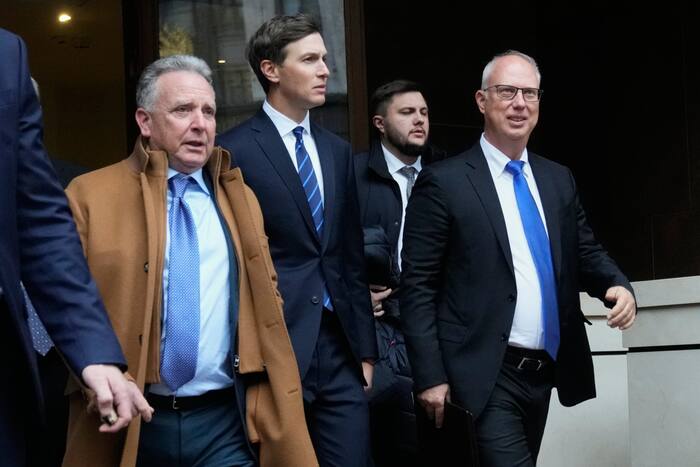
Standard diplomatic reporting treats the November 2026 shuttle circuit—moving from two days of trilateral talks in Abu Dhabi directly to a two-hour Kremlin briefing with Vladimir Putin and onward to Dublin for consultations with Volodymyr Zelenskyy—as a linear march toward a ceasefire. That reading confuses logistical motion with strategic convergence. When U.S. special envoys Steve Witkoff and Jared Kushner stepped into the Senate Palace of the Kremlin on November 12, 2026, they were not closing a deal. They were operating a dual-track mediation mechanism designed to decouple low-friction humanitarian confidence-building from high-friction territorial zero-sum bargaining.
Understanding why nine months of diplomatic paralysis broke in Abu Dhabi—yet failed to resolve the core conflict—requires stripping away diplomatic rhetoric and examining the structural incentives governing Washington, Moscow, Kyiv, and European capitals.
The Structural Anatomy of the November 2026 Diplomatic Circuit
The diplomatic sequence executed between November 10 and November 12, 2026, represents the third formal round of U.S.-mediated trilateral meetings hosted by the United Arab Emirates, following earlier sessions in January and February 2026. Unlike traditional multilateral conferences where all principals occupy the same room, the Witkoff-Kushner model relies on hub-and-spoke shuttle architecture:
- The Technical Hub (Abu Dhabi, November 10–11): Mid-to-senior operational delegations—including Ukrainian officials Rustem Umerov and Kyrylo Budanov alongside Russian representatives Vladimir Medinsky, Igor Kostyukov, and Kirill Dmitriev—negotiate transactional parameters in a neutral Gulf jurisdiction.
- The Sovereign Ratification Node (Moscow, November 12): U.S. envoys fly directly from the Gulf to the Kremlin to test whether technical understandings survive contact with Russia's centralized decision-making authority.
- The Alliance Synchronization Node (Dublin): Envoys immediately pivot to brief Ukrainian leadership and European counterparts, preventing the perception of a bilateral U.S.-Russia settlement imposed over the heads of European stakeholders.
This architecture exists because direct leader-to-leader summits require pre-cooked outcomes. As Kushner acknowledged following the Abu Dhabi sessions, Moscow refuses to authorize a direct Putin-Zelenskyy meeting until technical progress reaches an irreversible threshold. The shuttle circuit is therefore a pre-negotiation filter, not a peace conference.
The Two-Tier Negotiation Matrix
A rigorous audit of the Abu Dhabi outcomes reveals a sharp bifurcation between issues with positive-sum utility and issues governed by indivisible sovereignty constraints. Treating them as a single negotiation obscures why the talks simultaneously succeeded and failed.
Tier One: Transactional Confidence-Building Measures
The primary concrete deliverable from the third Abu Dhabi round was an agreement to execute the largest prisoner-of-war exchange since February 2022, involving more than 1,000 detainees from each side. From a game-theoretic perspective, prisoner exchanges function as low-cost signaling mechanisms:
- Domestic Political Utility: Both Moscow and Kyiv extract immediate domestic legitimacy by returning captured personnel prior to the winter holiday window without conceding strategic terrain.
- Reversibility and Containment: A detainee swap is self-liquidating. Once executed, it creates no permanent alteration to military force posture, border lines, or constitutional claims.
- Channel Validation: Executing a complex logistical swap tests command-and-control compliance on both sides. If intelligence and military apparatus can synchronize the transfer of over 2,000 individuals, the communication channel proves functional for future de-escalation protocols.
Tier Two: Indivisible Territorial and Security Variables
Where Tier One relies on symmetrical exchange, Tier Two—the core driver of the nearly five-year war—remains deadlocked because both sides view the contested variables as existential and non-divisible. By late November 2026, Kushner publicly confirmed that the trilateral track had hit an impasse over the territorial question.
Three structural friction points prevent Tier One momentum from spilling into Tier Two:
- The Unoccupied Territory Demand: Moscow continues to demand full Ukrainian withdrawal from the entirety of the Donbas—including roughly 20 percent of Donetsk Oblast still under Ukrainian military control—alongside administrative control and international recognition of the Kherson and Zaporizhzhia regions. For Kyiv, ceding fortified urban belts without a fight surrenders defensive depth that Russian forces have failed to capture militarily.
- Sequencing Asymmetry: Ukraine operates on a ceasefire-first doctrine, insisting that active hostilities must halt before broader political or security architectures are finalized. Moscow operates on a capitulation-first doctrine, warning that kinetic operations will continue unabated until its territorial preconditions are codified.
- The Enforcement Deficit: Kyiv and its European partners have structured post-ceasefire security around a "Coalition of the Willing" troop deployment backed by U.S. military intervention guarantees in the event of Russian violations. Moscow categorically rejects any Western military footprint inside Ukraine. Without a credible third-party enforcement mechanism, any ceasefire freezes the front line on terms that favor Russian reconstitution.
The European Exclusion Paradox
A critical variable missed in surface-level summaries of the Kremlin visit is the friction between Washington's bilateral speed and Europe's multilateral necessity. Ahead of the November 12 Moscow meeting, European leaders—including German Chancellor Friedrich Merz and G7 finance ministers—stressed that any durable European security settlement requires direct European representation.
This creates an operational bottleneck for the U.S. negotiating team:
- Washington's Incentive: U.S. envoys prefer streamlined, high-level dealmaking with Moscow because fewer veto players accelerate timeline compression.
- Moscow's Incentive: The Kremlin actively exploits transatlantic seams. While Russian officials signaled openness to a trilateral U.S.-Russia-Ukraine format, Moscow explicitly ruled out parallel Russia-EU talks on the sidelines of Abu Dhabi, dismissing European governments as lacking constructive proposals.
- The Financial Reality: Washington cannot unilaterally underwrite Ukraine's post-war reconstruction or long-term containment architecture without European capital and territorial basing. Excluding European powers from the negotiating table guarantees that any framework drafted in Moscow will face institutional resistance in Brussels, Berlin, and Paris.
Kushner's explicit commitment that Washington will not finalize agreements without Ukrainian and European consent acknowledges this constraint, yet it simultaneously strips U.S. envoys of the unilateral authority Moscow prefers to negotiate against.
Operational Limitations of the Envoys' Mandate
Evaluating the Kremlin meeting requires separating diplomatic access from coercive capacity. Witkoff and Kushner possess direct presidential authority from Donald Trump, which grants them immediate access to Putin's inner circle—a rare commodity in wartime diplomacy. However, personal envoy diplomacy suffers from three inherent structural limitations when applied to high-intensity attritional warfare:
- Transactional Bias: Real-estate and commercial negotiation frameworks assume that every asset has a clearing price and that parties will split the difference to maximize mutual gain. Sovereign territorial integrity and regime survival do not obey commercial clearing mechanisms.
- Asymmetric Time Horizons: Democratic administrations operate on electoral cycles and seek visible diplomatic milestones before year-end or mid-term windows. Autocratic systems measure time in multi-year attritional arcs, believing they can outlast Western political attention spans and ammunition supply chains.
- Kinetic Leverage Disconnect: Diplomatic envoys do not control battlefield attrition rates or deep-strike logistics. When Moscow believes winter missile campaigns against Ukrainian energy infrastructure or incremental eastern ground advances will degrade Kyiv's bargaining position by spring, Kremlin negotiators have zero incentive to offer concessions in November.
Strategic Forecast and Policy Execution
The Kremlin meeting of November 12, 2026, proves that high-level communication channels between Washington and Moscow are fully operational, but it confirms that diplomacy cannot outrun battlefield equilibrium. Until the cost function of continuing the war exceeds the domestic political cost of territorial compromise for Moscow, the Abu Dhabi–Moscow–Dublin circuit will yield humanitarian deliverables while remaining deadlocked on sovereignty.
To convert tactical dialogue into strategic leverage over the next two quarters, Western policymakers must execute three coordinated adjustments:
- Exploit Tier One Without Conceding Tier Two: Execute the 1,000-for-1,000 prisoner exchange immediately and expand the Abu Dhabi technical working groups to cover granular, verifiable non-territorial protocols—specifically maritime transit corridors in the Black Sea, nuclear plant safety zones around Zaporizhzhia, and energy infrastructure non-aggression pacts. Build operational interdependence before touching constitutional borders.
- Formalize the European Pillar Before the Next Moscow Visit: Integrate European representation directly into the pre-negotiation alignment phase rather than treating Dublin or Brussels as post-hoc briefing stops. Tie European financial and sanctions-relief commitments explicitly to Russian compliance on ceasefire verification, removing Moscow's ability to play Washington against European capitals.
- Shift Coercive Escalation to Match Diplomatic Cadence: Pair every round of envoy travel with pre-positioned military aid tranches and secondary sanctions enforcement on Russian energy logistics. Envoys cannot extract concessions in the Senate Palace unless the Kremlin calculates that rejecting the proposal on the table will result in an immediate, quantifiable deterioration of its military position on the ground.


