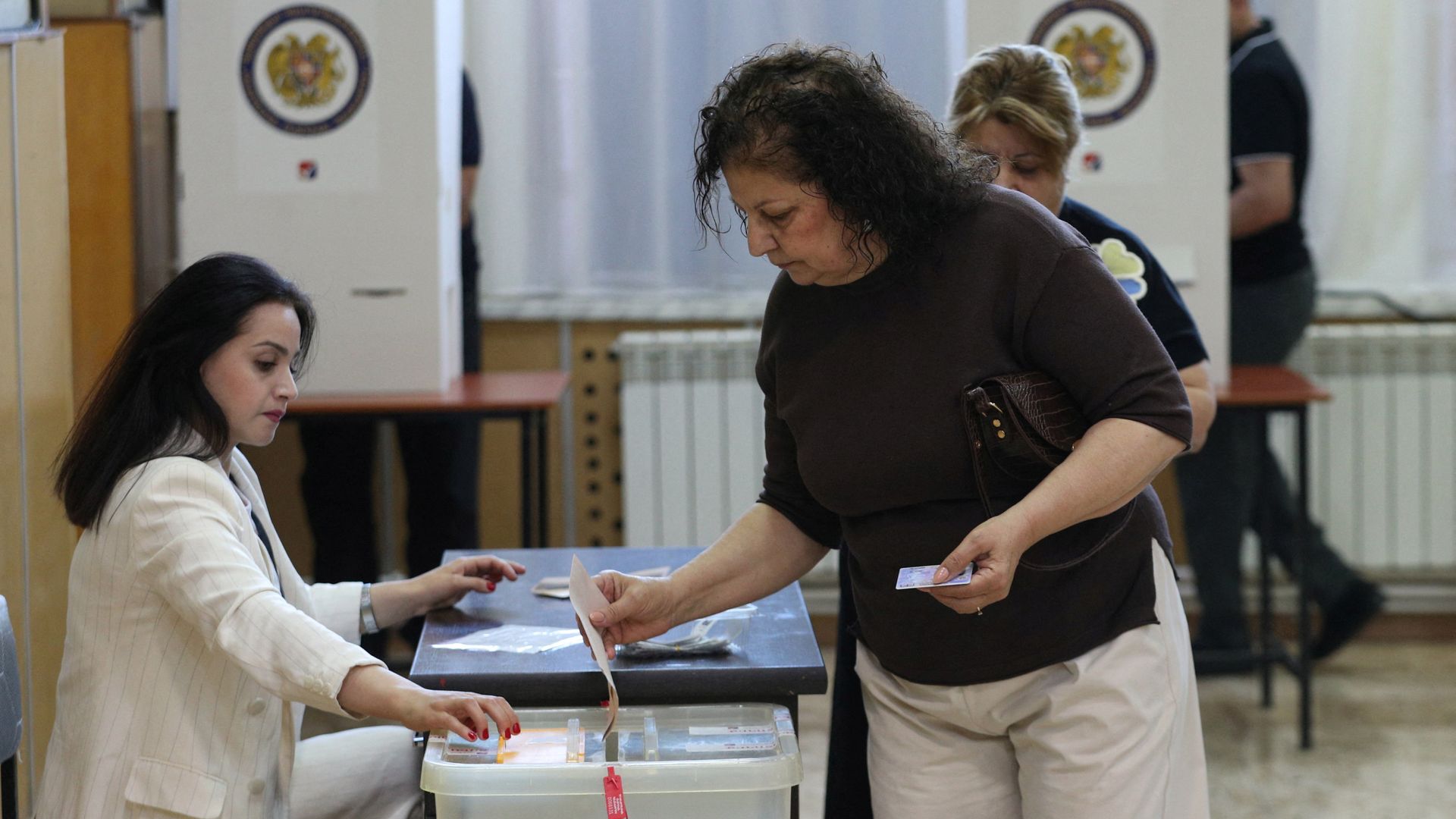
You can't blame Armenians for feeling completely abandoned over the last few years. When Azerbaijan took total control of Nagorno-Karabakh in 2023, Russia—Armenia's supposed treaty ally and security guarantor—did absolutely nothing. Moscow watched from the sidelines. That security failure triggered a massive geopolitical pivot that culminated in Armenia's parliamentary elections, where voters delivered a definitive message.
Prime Minister Nikol Pashinyan’s pro-EU Civil Contract party secured a major victory, capturing 49.81% of the vote. They completely locked down an absolute majority in parliament. This wasn't just a local political contest; it was a high-stakes referendum on whether this small, landlocked nation should break away from Moscow's orbit and sprint toward the West.
Despite intense pressure and explicit warnings from Russian President Vladimir Putin about a potential "Ukrainian scenario," Armenian voters chose European integration. Here is what actually happened on the ground, why the Kremlin’s massive disinformation apparatus failed, and what this means for the region's precarious future.
The Hard Numbers Behind Pashinyan’s Victory
The Central Election Commission confirmed that voter turnout reached over 58%, marking the highest participation rate the country has seen since 2018. The final vote breakdown shows a deeply fractured opposition but a clear mandate for the ruling party.
- Civil Contract (Nikol Pashinyan): 49.81%
- Strong Armenia Alliance (Samvel Karapetyan): 23.29%
- Armenia Alliance (Robert Kocharyan): 9.94%
- Prosperous Armenia: 4.00%
Pashinyan’s main challenger was Samvel Karapetyan, a billionaire Russian-Armenian oligarch who founded the Tashir Group. Karapetyan ran a heavily funded campaign built on a single promise: restore broken ties with Moscow to secure the country's borders. He fell flat. His alliance managed less than half of Civil Contract’s total.
While Karapetyan immediately denounced the election as "shameful" and alleged widespread government repression, international observers and high voter turnout painted a very different picture. Armenia’s Investigative Committee did open 59 criminal cases regarding minor voting irregularities, detaining nine people, but the structural legitimacy of the outcome remains firm.
Breaking Down the Matryoshka Disinformation Blitz
The true battle wasn't just fought at the ballot boxes; it raged across social media networks for eight straight months. Security researchers from organizations like Antibot4Navalny and the Institute for Strategic Dialogue tracked an extraordinarily aggressive, Kremlin-linked influence operation dubbed "Matryoshka."
This wasn't your run-of-the-mill political mudslinging. The campaign utilized sophisticated, coordinated networks of bots, deepfakes, and cloned media outlets to flood the Armenian internet with terrifying narratives.
- Fabricated Scandals: Outright lies accused Pashinyan of everything from systemic high-level corruption to organ trafficking and sexual assault.
- Impersonation: Bad actors built exact replicas of legitimate European and domestic news sites, using fake journalist profiles to publish falsified intelligence reports.
- The Fear Factor: The most potent narrative hammered home the idea that re-electing Pashinyan would directly trigger an immediate military invasion by Russia or Azerbaijan, explicitly drawing parallels to the destruction in Ukraine.
On top of the digital onslaught, the voting process itself faced hybrid attacks. Multiple polling stations received a wave of hoax bomb threats sent from untraceable foreign phone numbers and email addresses. The Interior Ministry quickly identified these as foreign attempts to induce widespread panic and suppress voter turnout. It didn't work. The sheer volume of voters who showed up proved that the public saw right through the scare tactics.
The Cold Reality of Dictating a New Foreign Policy
Pashinyan hailed the outcome as a "historic victory that will ensure Armenia's eternity and development." He's already frozen Armenia's participation in the Russian-led Collective Security Treaty Organization (CSTO), signed a bilateral strategic partnership charter with the United States, and accepted a €50 million support package from the European Union.
But let's look at the map. Moving toward Brussels is a beautiful theoretical goal, but geographical reality is incredibly stubborn.
Armenia is a tiny nation wedged tightly between Turkey, Azerbaijan, Georgia, and Iran. It has no direct physical border with any EU member state. Worse, its economic infrastructure is entirely tangled up with the country it just spurned.
Consider the leverage Moscow still holds over Yerevan's daily survival:
- Trade Dominance: Russia accounts for over 35% of Armenia's total trade volume. By comparison, the EU sits at a distant third with just 11%.
- Critical Infrastructure: Russian state-tied corporations physically own and manage Armenia's railway networks and gas pipelines.
- Energy Dependence: Until very recently, even the domestic electricity grids were entirely under Russian corporate control, and the country relies heavily on cheap Russian gas imports to keep its lights on.
Pashinyan’s new doctrine centers on what he calls the "Real Armenia"—a policy that involves completely dropping historical territorial claims, seeking a permanent peace treaty with Azerbaijan, and re-balancing power in the South Caucasus. Western investors and foreign ministries are paying close attention, but a peace deal with Baku remains complicated because Civil Contract fell just short of a two-thirds parliamentary super-majority.
The Tactical Next Steps for Armenia
Now that the domestic political theater is over, the real, grinding work of governing begins. To prevent Moscow from weaponizing its economic leverage, Yerevan has to move fast on several fronts.
First, the Ministry of Economy needs to rapidly diversify its export markets. Relying on Russia for more than a third of all trade is an economic ticking time bomb. Government officials must immediately utilize the new EU funding packages to upgrade local manufacturing standards so Armenian goods can actually enter Western markets.
Second, energy independence must become a national security priority. The government needs to aggressively fast-track renewable energy projects and seek alternative natural gas transit routes through neighboring Georgia or Iran to minimize the risk of sudden Russian pipeline "maintenance" shutdowns.
Finally, finishing the US-brokered peace talks with Azerbaijan is critical. Securing a stable, legally binding border agreement will reduce the risk of renewed conflict and provide the regional stability necessary to attract serious Western infrastructure investment. Armenia has made its choice, but navigating the fallout will require flawless execution.