The camera lens is a merciless editor. It captures the light, the silk, the perfectly symmetrical smiles, but its true power lies in what it chooses to cut out of the frame.
We live in an era where public figures treat social media grids like high-security borders. Every post is vetted, every shadow calculated, and every caption polished until it reflects only what the curator wants you to see. But sometimes, the omission itself becomes the loudest sound in the room.
When a high-profile family gathers for a wedding, the public expects a predictable cascade of images. The lace. The rings. The ecstatic newlyweds framed by floral arches. So, when a prominent sister shares a sprawling digital lookbook of the event that features almost everyone except the bride and groom, the internet stops looking at the dresses. It starts looking for the story.
The Silhouette of Absence
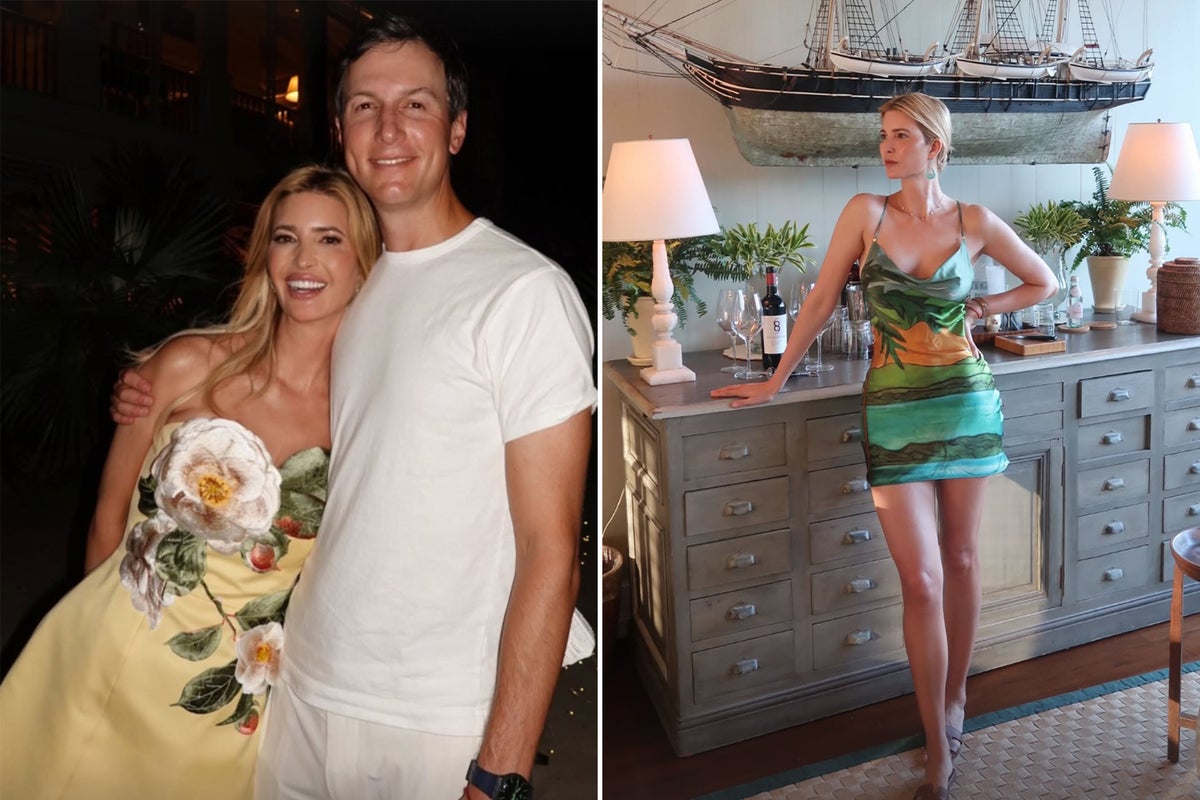
Picture a lavish Palm Beach weekend. The air is thick with the scent of saltwater and expensive perfume. The lighting is that specific, golden-hour amber that makes everyone look like an oil painting. Ivanka Trump stands in the center of a series of photographs, radiant in a pastel gown that nods subtly to old-world elegance. She poses with her children. She smiles alongside her sister-in-law, Lara. She frames herself against the manicured backdrops of a celebration meant to mark the beginning of her brother Michael Boulos’s marital journey with Tiffany Trump.
The images are flawless. They are also strangely hollow.
To scroll through the collection is to experience a bizarre digital choreography. You see the champagne flutes. You see the elegant drapery of the evening wear. You see the family line-up. Yet, the central protagonists of the day—the very reason the marquee was erected and the guests were summoned—are entirely missing from her narrative grid.
It is a masterclass in selective focus.
In the hyper-calculated world of political and social dynasties, a public gallery is never just a collection of memories. It is a statement of alignment. By choosing to broadcast her own presence, her immediate family, and select members of the clan while entirely bypassing the traditional "congratulations to the happy couple" snapshot, a distinct boundary is drawn. The viewer is left with a nagging sense of a story happening just outside the borders of the frame.
The Currency of the Invisible
Every family has its unspoken rules of engagement, but when your surname is a global brand, those rules are magnified by a million lenses.
Psychologists often talk about passive-aggressive visibility. It is the act of showing up physically but withdrawing socially, or conversely, praising the event while ignoring the honorees. In the digital space, this manifests as the deliberate blind spot. You tag the location. You tag the designer. You leave the bride and groom to exist only as rumors in your comment section.
Consider the mechanics of a modern celebrity wedding. Photographers are paid fortunes for exclusive rights, and non-disclosure agreements are handed out like party favors. Sometimes, a lack of photos is merely a strict adherence to a media embargo. But usually, when an embargo is in place, guests hold back all photos of the event to respect the couple's exclusive deal. Sharing the party but omitting the hosts is a entirely different psychological maneuver.
It creates a curious friction. The viewer is invited into the intimacy of the dressing room and the warmth of the family pre-game, only to be locked out of the main event. It feels less like a celebration of love and more like a calculated corporate roll call. "I was there. I looked immaculate. Move along."
Reading Between the Pixels
Human beings are wired for pattern recognition. We notice the anomaly. If a picture is worth a thousand words, an omitted picture is worth a ten-chapter psychological thriller.
The modern audience has grown incredibly sophisticated at decoding these digital crumbs. We no longer just look at who is standing next to whom; we look at who was cropped out, who was tagged in the background, and whose name was left out of the caption. The refusal to showcase the newlyweds on a platform commanding millions of eyes speaks to a deeper, perhaps unconscious, reluctance to cede the spotlight—or perhaps an intentional choice to keep certain relationships strictly transactional, away from the personal brand.
There is a distinct coldness to a congratulatory post that contains no image of the person being congratulated. It reduces the milestone to a background prop for personal branding. The wedding becomes a scenic backdrop for a personal fashion shoot, a curated moment where the joy of others is secondary to the aesthetic cohesion of one’s own feed.
The Uncurated Truth
We seek authenticity in a world of filters. We crave the messy, unaligned, candid laughter that signifies real human connection. When we are fed a diet of immaculate, sterile imagery that purposefully sidesteps the emotional core of an event, it creates a profound sense of detachment.
The true weight of that Palm Beach weekend wasn't in the drape of a designer dress or the perfect symmetry of a family portrait. It was in the quiet promises made between two people under a canopy, away from the flashbulbs and the strategic tagging.
By scrubbing the actual romance from the record of her experience, the narrative shifts away from union and focuses squarely on status. The couple becomes ghosts in their own story, haunting the edges of a beautifully lit, perfectly sterile grid.
In the end, the most telling part of any archive isn't the history it preserves, but the blank spaces it leaves behind. The empty frames tell us exactly where the tension lives, reminding us that no matter how much gold leaf you apply to the surface, the cracks underneath will always find a way to show through.