The Artemis II mission is moving toward a historic milestone that will finally strip Apollo 13 of its half-century-old title for the furthest human travel from Earth. While the original 1970 record was an accidental byproduct of a life-threatening explosion, NASA’s new flight path is a calculated display of orbital mechanics designed to push the Orion capsule 6,400 miles beyond the far side of the moon. This trajectory creates a hybrid mission profile—a "free-return" loop that ensures the crew comes home even if their engines fail, while simultaneously positioning them to witness a rare solar eclipse from deep space. It is a feat of engineering that balances extreme risk with the need for a definitive propaganda victory in the modern space race.
The Engineering Logic Behind the Record
Breaking records is rarely the primary objective of a multibillion-dollar federal program, yet the distance Artemis II will cover is a functional necessity of the Hybrid Free Return Trajectory. NASA cannot risk a complex lunar orbit insertion on the first crewed flight of the Space Launch System (SLS). Instead, the agency is opting for a high-altitude slingshot.
By bypassing a lunar orbit, the mission avoids the need for a massive engine burn to slow down. The moon’s gravity will act as a natural tether, swinging the Orion spacecraft around the lunar far side and flinging it back toward Earth. Because the moon is currently near its apogee—the point in its orbit furthest from Earth—the "swing" happens much further out in the void than it did during the 1970s. We aren't just going further because we can; we are going further because the celestial clock demands it.
The Thermal Stress of Deep Space
Most people focus on the distance, but the real story is the thermal soak. At the maximum distance of roughly 230,000 miles from Earth, the Orion capsule sits in an environment of brutal extremes. When the sun is shielded by the moon or the Earth, temperatures on the hull drop toward absolute zero. Conversely, direct solar radiation can bake the exterior.
Unlike the International Space Station, which stays shielded within Earth's magnetosphere, Artemis II will be fully exposed to the solar wind. The record-breaking distance isn't just a number on a screen; it is a live test of whether modern shielding can protect four human beings from high-energy protons and galactic cosmic rays during a multi-day transit through deep space.
The Solar Eclipse from the Lunar Perspective
The inclusion of a solar eclipse in the flight plan adds a layer of complexity that goes beyond mere photography. For the astronauts on board, the eclipse won't look like the shimmering "ring of fire" seen from a backyard in Ohio. From their vantage point near the moon, they will watch the Earth’s shadow—the umbra—crawl across the surface of the home planet.
This alignment serves a dual purpose. While it provides a once-in-a-generation data set for atmospheric scientists studying how solar radiation interacts with Earth’s upper atmosphere, it also serves as a critical test for Orion’s optical navigation systems. Modern spacecraft don't just rely on GPS; they use star trackers and "Earth sensors" to determine their position. Navigating through the shifting light levels of an eclipse forces the onboard computers to filter out visual noise, proving the system can handle the "dark" side of deep space navigation.
Why Apollo 13 Still Casts a Shadow
To understand the weight of this mission, you have to acknowledge that the Apollo 13 record was never supposed to happen. Lovell, Haise, and Swigert reached 248,655 miles from Earth only because their crippled Service Module forced them into a wider-than-planned arc around the moon to get back home.
For fifty-six years, that number has stood as a monument to a successful failure. Artemis II aims to replace that narrative with one of intentionality. However, the hardware remains a point of intense scrutiny. The Heat Shield on the Orion capsule experienced unexpected charring and "skipping" during the uncrewed Artemis I reentry. NASA engineers are currently working through the data to ensure that the increased velocity gained from the record-breaking distance won't cause the shield to degrade prematurely during the 25,000 mph return to Earth.
The Propulsion Gamble
The European Service Module (ESM) provides the "push" for Orion. It is a complex piece of machinery provided by ESA, marking one of the first times NASA has relied so heavily on an international partner for a critical human-rated system. If the ESM underperforms during the initial burn to raise the orbit, the record won't be broken. The mission would be downgraded to a high-Earth orbit test, a political and scientific setback that would delay the landing of the first woman and person of color on the lunar surface by years.
Comparing the Giants
The differences between the hardware of the 1970s and the 2020s are stark. While the Saturn V was a masterpiece of analog power, the SLS and Orion are digital fortresses.
| Feature | Apollo 13 (1970) | Artemis II (2026) |
|---|---|---|
| Max Distance | 248,655 miles | ~255,000 miles (Projected) |
| Crew Capacity | 3 | 4 |
| Onboard Computing | 74KB Memory | High-speed flight computers |
| Primary Goal | Survival / Lunar Landing | System Validation |
| Trajectory | Emergency Free-Return | Planned Hybrid Free-Return |
The Human Factor in the Void
Beyond the metal and the fuel, there is the psychological reality of being the furthest humans in history. Communication with Earth will have a perceptible lag. At the peak of their arc, the crew will be looking at an Earth that appears 40 times smaller than the full moon appears to us.
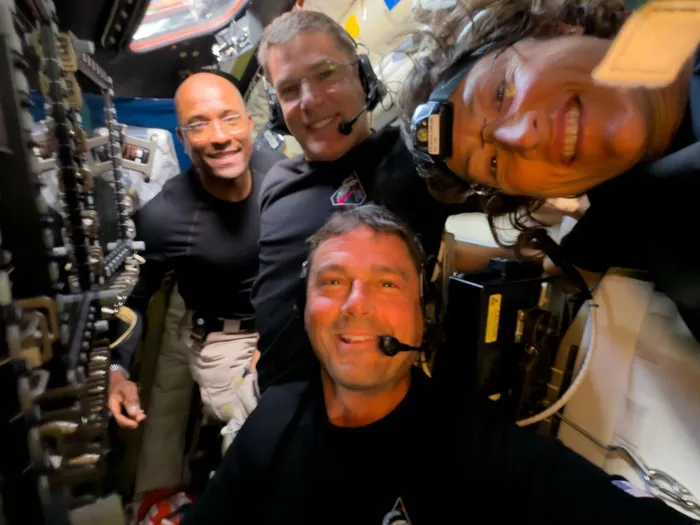
This isolation is a prerequisite for Mars. You cannot go to the Red Planet without first proving that a crew can handle the "Overview Effect" at its most extreme. The Artemis II crew—Reid Wiseman, Victor Glover, Christina Koch, and Jeremy Hansen—are not just pilots; they are biological test subjects. Their heart rates, circadian rhythms, and cognitive functions will be monitored every second they are in the "deep zone" beyond the moon.
The Problem with the Heat Shield
Despite the excitement, there is a technical hurdle that the aerospace industry is discussing in hushed tones: Ablative Material Spalling. During the Artemis I reentry, the heat shield did not wear down evenly. Instead, small chunks of the Avcoat material broke off.
While NASA officials insist the crew would have been safe, a "spalling" event at the higher return speeds generated by a record-breaking distance could be catastrophic. The Orion will hit the atmosphere at nearly Mach 32. At those speeds, the air in front of the capsule turns into plasma. Any irregularity in the heat shield's surface can cause turbulence, leading to localized "hot spots" that could burn through the structure. The decision to proceed with the record-breaking flight path suggests a high level of confidence in the recent fixes, but it remains the mission's single greatest "known unknown."
The Geopolitical Stakes
We are no longer in a vacuum of competition. China’s space agency is rapidly advancing its own lunar plans, aiming for a crewed landing by 2030. Breaking the Apollo 13 record is a signal to the world that the United States has regained its deep-space dominance.
It is a move designed to inspire a new generation, certainly, but it is also a move designed to secure funding. Space exploration is expensive, and nothing sells a budget to Congress like a world record. The "daring moon flyby" is as much a feat of marketing as it is of physics. By timing the mission to coincide with a solar eclipse and a record-breaking distance, NASA is ensuring that every telescope and camera on Earth is pointed toward their spacecraft.
The Mechanics of Re-entry
The final leg of the journey is arguably more difficult than the outbound stretch. After swinging around the moon and reaching the record distance, Orion must perform a "skip reentry."
Imagine skipping a stone across a pond. The capsule will hit the upper atmosphere, "bounce" back out into space briefly to dissipate heat and velocity, and then plunge back in for the final descent. This maneuver extends the range of the landing site and reduces the G-loads on the crew. If the angle of entry is off by even a fraction of a degree, the capsule will either bounce off into a permanent solar orbit or burn up like a meteor.
The distance record is a testament to how much we are willing to risk for the sake of progress. We are moving past the era of "flags and footprints" and into an era of sustained presence. To get there, we have to prove we can survive the deep black, far beyond the reach of any rescue mission.
The Artemis II mission is a bridge between the heroic improvisations of the 20th century and the industrialized spaceflight of the 21st. When the crew looks out the window and sees the moon eclipsing the sun from a quarter-million miles away, they will be standing on the threshold of a new reality. The record they break will likely stand for decades, until a crewed mission finally breaks orbit for Mars, leaving the Earth-Moon system behind forever.
The pressure is now on the engineers at Kennedy Space Center to ensure that the hardware is as resilient as the ambition driving it. The margin for error in deep space is zero. At 250,000 miles from home, there is no room for a "successful failure" this time. Everyone involved knows that a record is only worth breaking if you live to tell the story.