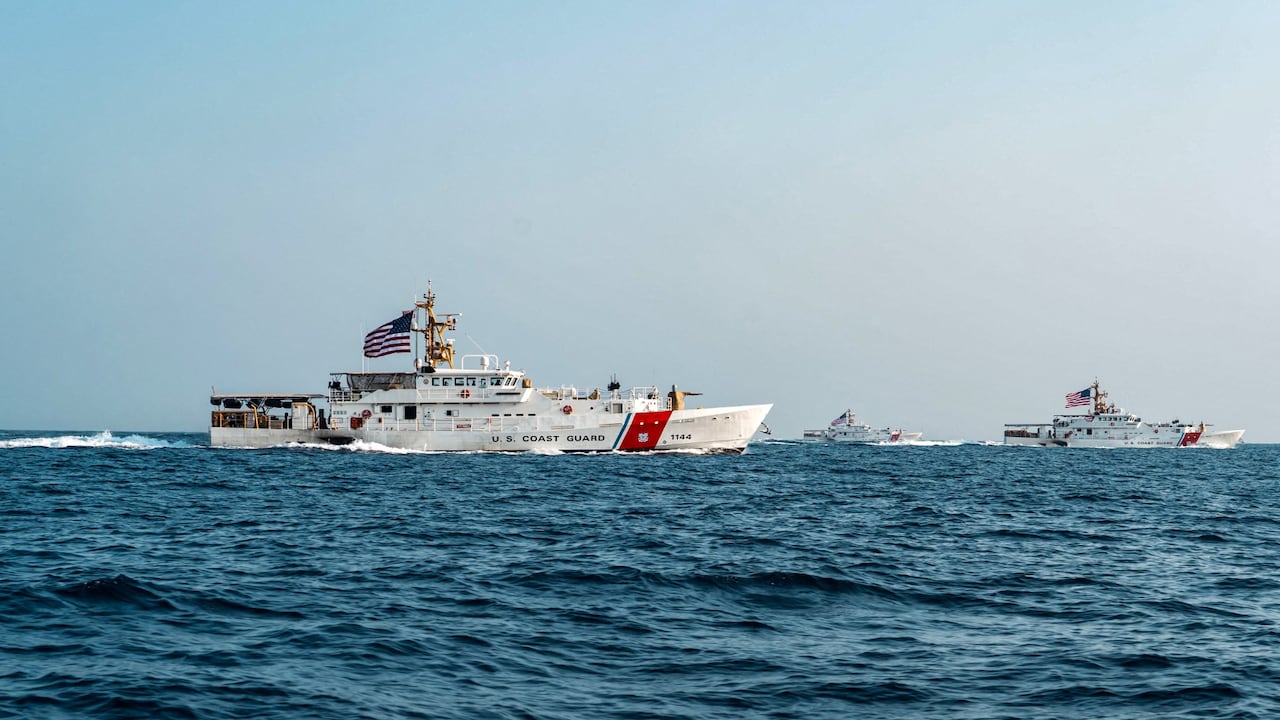
Military strikes targeting Iranian military assets and affiliated proxy infrastructure near the Strait of Hormuz represent a structural shift from passive maritime deterrence to active counter-interdiction. The Strait of Hormuz functions as a critical bottleneck for global energy markets, handling approximately 20 to 21 million barrels of crude oil and refined petroleum products per day, alongside roughly 20 percent of global liquefied natural gas (LNG) supply. When kinetic conflict intersects with this narrow maritime passage, the immediate risk is not merely physical destruction of commercial vessels, but a compounding systemic failure across insurance underwriting, maritime routing protocols, and global energy arbitrage.
Deconstructing this conflict requires analyzing three distinct operational vectors: the mechanics of maritime interdiction, the structural vulnerabilities of regional supply chains, and the strategic calculus governing state-level escalation. Building on this theme, you can also read: Why Trump Strategy to Seize Iranian Assets for Ship Damage Could Backfire.
The Triad of Maritime Chokepoint Interdiction
Naval interdiction in narrow waters relies on asymmetric cost distribution. A state or non-state actor does not need a blue-water navy to disrupt commercial shipping; it requires only sufficient low-cost vectoring capability to raise the risk threshold beyond commercial tolerance. Iran’s maritime operational strategy rests on three distinct pillars.
1. Asymmetric Surface and Subsurface Swarming
Fast Inshore Attack Craft (FIAC) operating in decentralized squadrons exploit the restricted maneuverability of commercial Tankers (VLCCs and ULCCs). These deep-draft vessels require deep-water channels, restricting their transit corridors within the Strait to channels only two miles wide in each direction. By deploying high-speed craft equipped with short-range anti-ship missiles, rocket launchers, and naval mines, asymmetric forces force defending naval assets to allocate high-cost precision munitions against low-cost target vectors. Analysts at NPR have provided expertise on this trend.
2. Shore-Based Anti-Ship Missile Collars
Layered anti-ship cruise missile (ASCM) batteries positioned along the coastal topography of the Zagros Mountains present a persistent line-of-sight and over-the-horizon threat. Positioned on mobile transporter erector launchers (TELs), these systems utilize radar-passive tracking and terminal active radar homing. Their proximity to the shipping lanes reduces target acquisition time to minutes, narrowing the engagement window for ship-borne Aegis or PAAMS air defense systems.
3. Electronic Warfare and Navigation Spoofing
Disruption of the Automatic Identification System (AIS) and Global Positioning System (GPS) signals introduces spatial uncertainty. Spoofing protocols alter positional data received by commercial bridge systems, directing merchant vessels into contested territorial waters or creating artificial navigational hazards that force ships to reduce speed, transforming them into stationary targets.
The Economic Transmission Mechanism
The primary economic damage of a strike in the Strait of Hormuz does not stem from destroyed cargo; it materializes through financial friction and risk repricing long before physical strikes occur.
Kinetic Event / Strike
       │
       ▼
War Risk Joint War Committee Re-classification
       │
       ▼
Hull & Machinery / Cargo Insurance Rate Spike (0.05% ➔ 0.5%+ Vessel Value)
       │
       ▼
Cape of Good Hope Rerouting (+10 to 14 Days Transit)
       │
       ▼
Capital Absorption & Fleet Capacity Reduction (~8-12% Global Tanker Deficit)
       │
       ▼
Spot Freight Rate & Crude Benchmark Premium Spikes
Insurance Underwriting Mechanics
Commercial shipping operates on narrow margins dependent on accessible insurance coverage. When kinetic strikes occur, the Lloyd's Market Association Joint War Committee (JWC) updates its Listed Areas. This re-categorization triggers War Risk Breaches for vessel owners, altering two fundamental cost structures:
- Additional Premium (AP) Charges: War risk premiums can jump from 0.05 percent of vessel hull value to over 0.5 percent per transit during elevated risk scenarios. For a Very Large Crude Carrier (VLCC) valued at $120 million, a single seven-day transit premium climbs from $60,000 to $600,000.
- Protection and Indemnity (P&I) Club Exclusions: P&I clubs, which cover third-party liabilities including environmental damage and crew injury, may invoke war exclusion clauses or enforce steep deductibles, rendering commercial operation legally unviable for publicly traded tanker fleets.
Transit Diverts and Fleet Velocity Deficits
When war premiums exceed commercial viability, shipping lines execute structural rerouting. Bypassing the Persian Gulf and the Bab-el-Mandeb Strait in favor of the Cape of Good Hope adds between 10 to 14 days to a round-trip voyage between the Persian Gulf and Northern Europe.
This geographical extension effectively absorbs global fleet capacity. A 12-day addition on a standard 30-day voyage reduces the effective velocity of the global tanker fleet by roughly 25 percent. Without a single vessel being sunk, the effective supply of oil transport capacity drops, forcing spot freight rates to surge and creating artificial spot shortages at destination refining hubs.
Strategic Escalation Dynamics and Target Matrix
US military strikes against Iranian targets in this context follow a calibrated operational ladder designed to degrade offensive capabilities while avoiding total regional confrontation. The target matrix typically splits into three functional operational tiers.
Functional Operational Tiers
- Tactical Counter-Launch Operations: Direct engagement of active coastal missile batteries, radar installations, and fast-craft staging bases. The objective is immediate threat suppression to secure ongoing commercial transits.
- Command and Control (C2) Degradation: Strikes on maritime intelligence nodes, surveillance platforms, and coastal command centers. Disruption of real-time targeting networks removes the adversary's capability to coordinate complex multi-vector swarm attacks.
- Logistical Supply Node Disruption: Target sets expand to include assembly plants, depot storage for uncrewed aerial vehicles (UAVs), and naval ordnance storage facilities.
The core vulnerability in this escalation model lies in the mismatch of strategic objectives. A naval coalition aims for open sea lanes and operational predictability. Conversely, an asymmetric adversary seeks persistent uncertainty. Complete neutralisation of coastal asymmetric threats requires prolonged, high-intensity suppression of enemy air defenses (SEAD) and offensive counter-air operations over land, creating an extended military footprint that elevates regional contagion risks.
Structural Vulnerabilities in Global Energy Re-routing
Alternative transportation infrastructure cannot absorb a full disruption of the Strait of Hormuz. While pipeline bypass routes exist, their total capacity covers less than a third of daily transits through the strait.
East-West Pipeline (Saudi Arabia)
The Petroline (East-West Pipeline) spans Saudi Arabia from the Eastern Province to the Red Sea port of Yanbu.
- Stated Capacity: ~5 million barrels per day.
- Operational Constraint: Utilizing full capacity requires rerouting logistics and export infrastructure at Yanbu, which itself feeds into the Red Sea—another maritime zone vulnerable to regional chokepoint interdiction.
Abu Dhabi Crude Oil Pipeline (UAE)
Connects the Habshan oil fields directly to the port of Fujairah on the Gulf of Oman, completely bypassing the Strait of Hormuz.
- Stated Capacity: ~1.5 million barrels per day.
- Operational Constraint: The terminal at Fujairah remains within tactical operational range of coastal missile batteries and sub-surface mining operations based across the Gulf of Oman.
The combined operational capacity of operational bypass routes maxes out at approximately 6.5 to 7 million barrels per day. This leaves a structural deficit of over 13 million barrels per day that cannot bypass the Strait of Hormuz through land-based infrastructure, cementing the waterway's position as an irreplaceable node in modern energy transport.
Actionable Risk Protocol for Global Supply Networks
Commercial operators and commodity buyers must transition from reactive risk mitigation to active structural hedging. Energy importers and maritime logistics firms must execute three tactical mandates to insulate capital from recurring chokepoint crises.
Strategic Capital Allocation Strategies
- Contractual Shift to Freight Insurance Hedging: Energy procurement teams must shift pricing formulas from Free on Board (FOB) terms to Cost, Insurance, and Freight (CIF) structures where seller entities bear maritime transit and war risk volatilities, or systematically hedge war risk premiums through customized derivatives in the maritime insurance market.
- Strategic Storage Buffer Maintenance: Importers must maintain operational reserves at destination ports equivalent to a minimum of 45 days of uncommitted demand, dampening the price impact of a 14-day rerouting delay around the African continent.
- Dual-Sourcing Tanker Chartering: Maritime logistics coordinators must split charter commitments between dedicated Persian Gulf fleets and blue-water Atlantic fleets, preventing localized fleet lockdowns from paralyzing global downstream supply chains.


