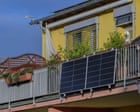
Plug-in solar panels could theoretically shave hundreds of dollars off residential power bills each year, but Australian households remain legally barred from plugging a micro-inverter directly into a standard wall socket. While Great Britain officially cleared the regulatory path for 800-watt plug-and-play kits under updated wiring rules, Australia's strict electrical safety frameworks treat any unauthorized generation source connected to a standard circuit as an immediate hazard. This regulatory chasm leaves apartment dwellers and renters empty-handed, watching European and British consumers capitalize on cheap balcony energy while local authorities dig in their heels.
The appeal of these compact systems is elementary. Instead of paying thousands of dollars for a certified rooftop array bolted down by a licensed professional, a consumer purchases a modular kit consisting of a photovoltaic panel, a micro-inverter, and a standard plug. You mount it on a balcony railing, aim it toward the sun, and insert the plug into an outdoor socket. The generated electricity flows backward through the household circuit, offsetting baseline energy drawn from the grid by power-hungry appliances like refrigerators and standby electronics. You might also find this related story useful: Why MapQuest Still Refuses to Rename Lake On After Thirty Years.
Yet, translating this convenience to the Australian market runs straight into a wall of entrenched electrical standards.
The Regulatory Fortress
Every kilowatt flowing into an Australian home is governed by mandatory safety mandates. Chief among these are AS/NZS 5033 for installation practices and AS/NZS 4777.1 for grid-connected equipment. These codes were drafted decades ago, designed around a one-way distribution model where power flows securely from the street transformer through a dedicated, switchboard-protected circuit. As reported in latest reports by Gizmodo, the implications are significant.
Allowing an unverified appliance to push current back through a standard residential power point bypasses the safety architecture built into standard switchboards. Traditional circuits feature circuit breakers calibrated to protect wiring from drawing excessive current from the grid. When a power point suddenly becomes a generation source, internal wiring can theoretically experience combined current loads exceeding design thresholds if safety margins are miscalculated.
Critics of the current prohibition argue that these fears are overblown, pointing to millions of balcony units operating safely across Germany, Austria, and now the UK. They maintain that capping output at 800 watts eliminates thermal overload risks on standard 10-amp circuits.
Australian authorities counter that European wiring topologies and distribution networks differ fundamentally from domestic infrastructure. Local networks grapple with high ambient temperatures, long feeder lines, and unique voltage rise issues. Introducing thousands of unregistered, uncoordinated micro-generators behind household meters creates headaches for local distribution network service providers who manage grid stability and worker safety. If a suburban transformer is taken offline for emergency repairs, a hidden plug-in panel feeding live current into a dead circuit introduces lethal risks to linesmen.
Insurance Liabilities and Hidden Traps
The friction extends far beyond electrical codes into the grey market of household insurance. Operating an illegal plug-in solar array invalidates standard home and contents policies.
Consider a hypothetical scenario in a suburban townhouse. A resident purchases an imported balcony kit online, plugs it into a weather-exposed patio outlet, and leaves it running unattended during a severe summer storm. Water ingress compromises the cheap inverter casing, triggering an electrical fire that destroys the veranda. When insurance investigators comb through the charred debris, they discover an unapproved generation device wired into a non-dedicated circuit. The claim is summarily denied. The homeowner absorbs the total financial loss, facing potential civil liability if the fire spreads to an adjacent property.
This liability deterrent keeps risk-averse consumers tethered to traditional, high-cost installation models. Renters and strata-managed apartment residents face an even steeper climb. Even if regulatory hurdles vanish tomorrow, securing permission from a landlords' association or body corporate to hang exterior glass panels over a shared courtyard involves bureaucratic hurdles that deter ordinary citizens.
Finding Legal Avenues Around the Blockade
For households desperate to shave down utility expenses without breaking the law, the market currently offers limited substitutes. Portable power stations paired with standalone solar blankets occupy a legal loophole. A consumer can place a 300-watt panel on a balcony to charge a standalone lithium battery bank sitting entirely indoors. Because this system is physically isolated from the household wiring grid, it bypasses network regulations entirely.
You can run your laptop, charge mobile devices, or power a small desk fan directly from the portable battery storage. It does not lower your monthly electricity bill through grid feed-ins, but it provides clean off-grid utility for minor loads.
Community solar initiatives represent another sanctioned alternative. By subscribing to shared regional solar gardens, apartment dwellers buy a slice of a commercial-scale array located elsewhere, receiving direct credits on their utility bills without touching a single wire or bracket.
Meanwhile, industry advocacy groups continue lobbying standard committees to draft an Australian-specific variant of the UK framework. Talks center on establishing an approved product register, mandatory distributor notification protocols akin to the British G98 process, and strict amperage caps.
Until those standards materialize, the plug-in solar revolution remains locked outside Australian borders. Consumers stare at overseas success stories while local regulators weigh convenience against the rigid architecture of electrical safety.



