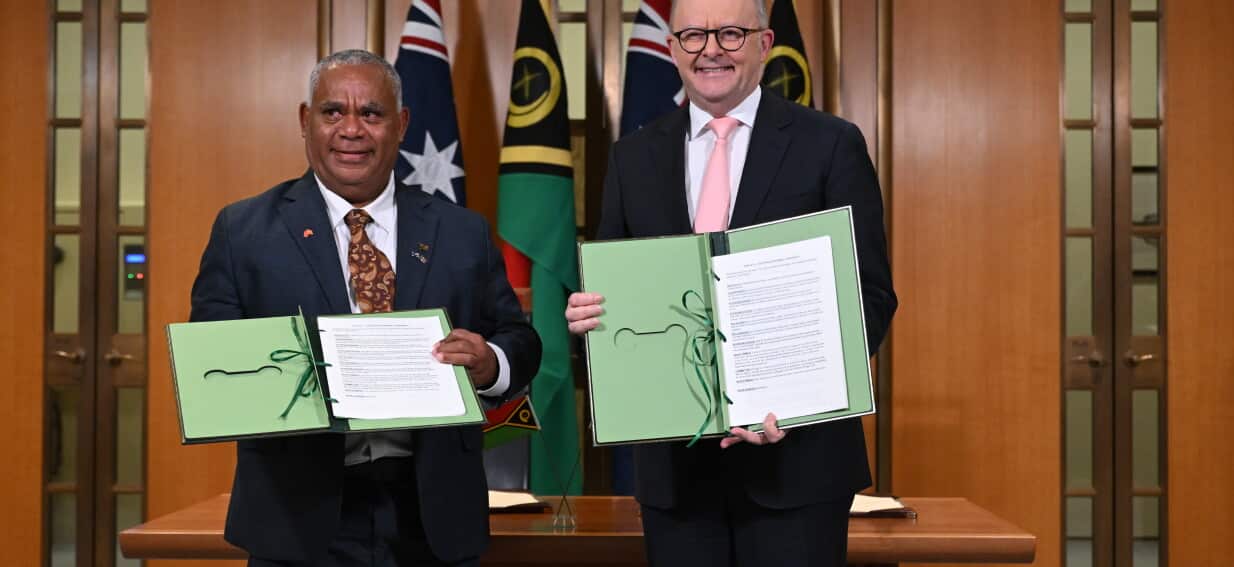
The ink on a treaty does not make a sound, but in the halls of Parliament House in Canberra, it carries the weight of a breaking wave. On a crisp Monday morning, two men put pen to paper, finalizing a document known as the Nakamal Agreement. For Anthony Albanese and Jotham Napat, the prime ministers of Australia and Vanuatu, the moment was a relief. For the rest of the world, it was a quiet declaration of where the boundaries of the Pacific are being redrawn.
To understand why a security treaty with a scattering of islands home to 350,000 people matters, you have to look past the bureaucratic language of "critical infrastructure" and "bilateral frameworks". You have to stand on the black volcanic sands of Tanna or look out over the deep-water harbor of Luganville.
Imagine a local fisherman, let us call him Samuel, cutting the engine of his outrigger canoe just outside Luganville's harbor. The water beneath him is an impossibly deep blue. Decades ago, his grandfather watched American warships drop anchor here during the second global conflict. Today, Samuel watches a different kind of vessel. Large grey hull. Foreign flag. The Chinese navy has been making port calls here. A few miles away sits a massive wharf, expanded with funds from Beijing. Officially, it is built to welcome cruise ships filled with free-spending tourists. Unofficially, defense strategists in Canberra and Washington look at that same concrete slab and see a potential forward base for a superpower's navy.
This is the invisible friction of the modern Pacific. It is not fought with artillery, but with checkbooks, construction crews, and the quiet pressure of sovereign debt.
The Flight That Never Happened
Nine months before this signing ceremony, the view from Canberra was frantic. The Australian Prime Minister was packed and ready to board a flight to Port Vila. The original security pact was drafted, agreed upon by negotiators, and laid out for the cameras. Then, the line went cold.
Vanuatu pulled the plug at the eleventh hour.
In the capital of Port Vila, politicians had revolted. The initial draft gave Australia a heavy-handed power: the explicit right to veto foreign involvement in Vanuatu’s critical infrastructure, from its internet cables to its airports. To many ni-Vanuatu, it felt less like a partnership and more like a return to colonial oversight. Why should a nation that fought so hard for its independence in 1980 hand the keys to its decision-making back to a regional big brother?
They chose to wait. They chose to push back.
The revised agreement signed this week shows the scars of that negotiation. The heavy-handed Australian veto is gone. Instead, Vanuatu has committed to a policy of consultation. If a foreign entity wants to buy into the country's energy grid or upgrade an airstrip, Vanuatu will talk to Australia first. But the final choice remains inside the nakamal—the traditional meeting place where community decisions are made.
Balancing on a Razor's Edge
The core of the deal is simple, yet stark. Vanuatu will not allow its territory to be used for any foreign military base or military infrastructure. Period. In exchange, Australia provides a massive, multi-million-dollar economic lifeline to upgrade ports, cyber security, and aviation networks.
But do not mistake this for a sudden pivot away from Beijing.
Vanuatu is playing a delicate, high-stakes game of survival. Even as Jotham Napat signed the Nakamal Agreement in Canberra, his government was actively negotiating the Namele Agreement with China. That deal, focused on "comprehensive development cooperation," will be made public only once it receives clearance from Beijing.
Consider the reality of governing an island nation prone to cataclysmic cyclones and rising sea levels. When the wind howls and the roofs tear off houses, ideologies do not rebuild roads. Cash does. China is Vanuatu’s largest external creditor, having funded everything from grand government buildings to the smooth tarmac roads that cut through the jungle.
The new treaty acknowledges this reality by refusing to draw absolute lines. While it cements Australia as Vanuatu's primary policing partner, it does not expel the Chinese police personnel who frequently visit the islands to train locals and donate equipment like patrol boats and drones.
It is a messy, compromised reality. It is confusing and tense.
When a major disaster strikes, Vanuatu has agreed to turn first to its traditional allies: Australia, New Zealand, and France. But when the blue skies return, the economic gravity of Asia remains impossible to ignore.
The struggle for influence in the South Pacific will not end with this treaty. The lines of communication remain open, the promises of development are vast, and the quiet spaces of the Pacific grow smaller by the day. Samuel will continue to fish in the shadow of the Luganville wharf, watching the horizon to see which flag arrives next.