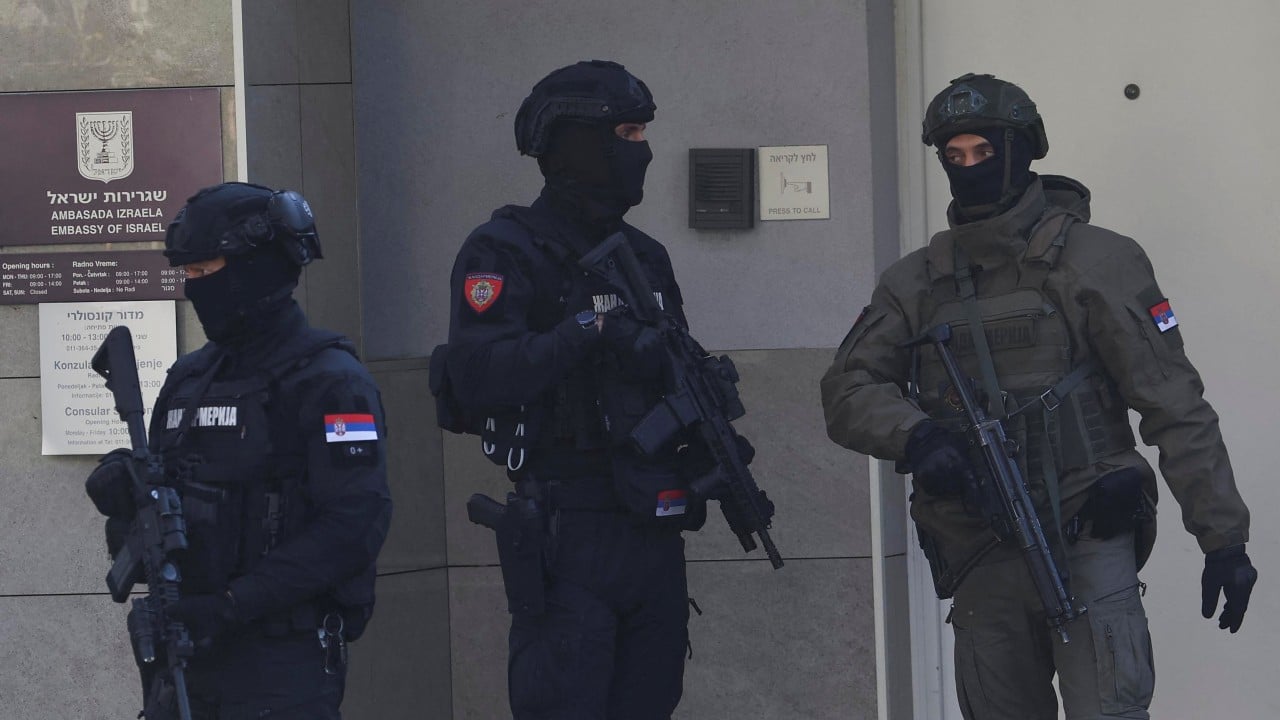
On a quiet Saturday morning in Belgrade, a 25-year-old Serbian convert to Islam walked up to a security booth outside the Israeli embassy, pulled a crossbow from a bag, and shot a gendarmerie officer in the neck. Despite the severe wound, officer Milos Jevremovic drew his service weapon and fatally shot the attacker, identified as Milos Zujovic. The June 29, 2024 incident lasted mere seconds, yet it exposed massive vulnerabilities in how European nations guard high-risk diplomatic compounds against low-tech, lone-actor terrorism.
Most initial news reports treated the shooting as an isolated anomaly. They focused on the bizarre choice of weapon and the immediate heroism of the wounded officer. That surface-level coverage misses the real story. When you strip away the sensationalism of a medieval weapon used in a modern capital, what remains is a textbook case study in intelligence blind spots, the evolution of domestic radicalization in the Balkans, and the tactical nightmares posed by silent, non-metallic, or non-firearm attacks on static guard posts.
The Anatomy of a Low-Tech Ambush
Standard diplomatic security protocols are built around predictable threat models. Perimeter defenses, bollards, metal detectors, and armed guards are primarily calibrated to stop vehicle-borne improvised explosive devices, coordinated armed assaults, or individuals attempting to breach an interior compound with firearms or bladed weapons.
A crossbow breaks that defensive calculus entirely.
First, there is the element of acoustic stealth. A gunshot immediately alerts every security asset within a three-block radius, triggering automated lockdowns and rapid-response protocols. A crossbow bolt makes almost no sound upon release. In an urban environment like Belgrade's Dedinje district—an affluent, leafy neighborhood housing numerous diplomatic missions—the ambient street noise easily masks the snap of a bowstring.
Second, consider the mechanics of approach. Zujovic did not storm the gates. According to Serbian Interior Minister Ivica Dacic, the assailant approached the guardhouse multiple times, asking mundane questions about directions and the location of a nearby museum. He exploited the baseline human courtesy expected of public-facing security personnel. Guards stationed outside embassies are not operating in a active war zone; they are standing on a public sidewalk in a European capital. They cannot treat every pedestrian asking for directions as an imminent lethal threat without causing severe diplomatic friction with the host nation's citizens.
When Zujovic finally drew the weapon from a bag and fired at close range, the kinetic energy of the bolt was sufficient to penetrate soft tissue and lodge near critical arteries in Jevremovic’s neck. At distances under ten meters, a modern hunting or tactical crossbow delivers devastating force, capable of defeating standard soft body armor designed to stop handgun rounds.
The only reason this incident did not result in a successful breach or further casualties was the extraordinary composure of a single wounded man. Jevremovic managed to return fire before collapsing, neutralizing the threat before the assailant could reload or retrieve a secondary weapon. Relying on the superhuman resilience of a fatally wounded guard is not a viable security doctrine.
Domestic Radicalization in the Balkans
To understand why a young man from Mladenovac—a quiet town roughly 50 kilometers south of Belgrade—decided to attack an Israeli diplomatic mission, you have to look at the shifting mechanics of extremism in Southeast Europe. For decades, counter-terrorism analysts viewed the Balkans primarily as a transit corridor or a recruitment pool for foreign fighters heading to conflicts in the Middle East. That threat profile has mutated.
The modern radicalization pipeline no longer requires physical travel to training camps in Syria or Iraq. It happens entirely inside encrypted messaging apps, localized online echo chambers, and isolated domestic cells. Zujovic, who had adopted the religious name Salahudin and relocated to Novi Pazar—a city in southwestern Serbia with a large Muslim population—represented a classic "lone actor" profile, though Serbian authorities quickly moved to dismantle a broader network of associates.
Following the attack, Serbian police declared a red-level security threat and conducted sweeping raids across the country. They arrested several individuals, including Igor Despotovic, a man previously convicted of inciting terrorism who had maintained contact with Zujovic. This detail is critical. It destroys the comforting myth of the completely disconnected "lone wolf."
While Zujovic acted alone at the embassy gate, he operated within an ideological ecosystem that validated and encouraged his actions. Investigators discovered that he had recorded a video message prior to the attack, pledging allegiance and framing his violence as a response to Israeli military operations in Gaza. The conflict in the Middle East acted as an accelerant, turning localized grievances and personal alienation into operational intent.
The Intelligence Blind Spot
Serbian security services, notably the Security Intelligence Agency (BIA), maintain extensive surveillance networks across the region. Yet Zujovic slipped through the net at the operational phase. Why? Because the resources required to monitor every radicalized individual in real time exceed the capacity of any state apparatus.
Intelligence agencies triage threats based on indicators of capability and intent. Buying precursor chemicals for explosives triggers alarms. Attempting to purchase an illegal automatic rifle on the black market triggers alarms. Traveling to conflict zones triggers alarms.
Buying a crossbow does not.
In Serbia, as in many European jurisdictions, crossbows fall into a regulatory gray area. Depending on draw weight, they can often be purchased legally by adults without the rigorous background checks, licensing, and police vetting required for firearms. By choosing an unrestricted weapon, Zujovic completely bypassed the tripwires that normally alert counter-terrorism units that an extremist has moved from passive consumption of propaganda to active preparation for an attack.
Diplomatic Security Architecture Under Pressure
The Belgrade incident sent quiet shockwaves through diplomatic security circles far beyond Serbia. Embassies worldwide have been operating under heightened threat levels since October 2023, facing everything from violent protests and arson attempts to foiled bomb plots. The attack in Belgrade proved that even missions in countries with historically strong bilateral ties to Israel are vulnerable.
Serbia and Israel maintain warm diplomatic and economic relations, and Belgrade has generally been viewed as a relatively permissive, low-threat posting compared to capitals in Western Europe where massive, volatile demonstrations have become routine. That perception of safety can breed operational complacency.
Look at the physical layout of the guard post outside the Israeli embassy in Belgrade at the time of the attack. It was a standard, small sentry box positioned directly on the sidewalk perimeter. While functional for shelter against the elements and basic observation, such structures offer minimal ballistic protection against sudden, point-blank ambushes. Worse, they create a predictable fixed point. An attacker knows exactly where the target will be standing, at what angle they will be facing, and how close a pedestrian can get before raising suspicion.
If you harden the exterior too much—erecting blast walls, closing off entire city blocks, and stationing guards behind armored glass—you turn a diplomatic mission into a fortress. Host governments hate this. It disrupts local traffic, angers neighborhood residents, and sends a visual message that the host country cannot guarantee basic public order. Diplomats hate it too, because their job requires accessibility and engagement.
Yet, when you prioritize accessibility and urban integration, you leave the outermost layer of security—the local police officer standing on the pavement—completely exposed.
The Myth of Deterrence Against Ideological Actors
Traditional security theory relies heavily on deterrence. The visible presence of an armed guard is supposed to convince a rational actor that an attack will fail, leading them to abort the mission or choose a softer target.
Deterrence collapses when the attacker has no intention of surviving.
Zujovic did not bring an escape vehicle. He did not wear a disguise to evade post-incident facial recognition. He approached a heavily armed gendarme with a single-shot weapon, fully aware that the response would be lethal gunfire. In security parlance, this is a martyrdom operation, regardless of how crude the execution may be.
When an adversary welcomes death, armed guards cease to be a deterrent and simply become the primary target. The goal of the attacker is not necessarily to breach the embassy doors and reach the ambassador; the goal is to create a spectacle of violence on the doorstep of the mission, generate international headlines, and demonstrate that the target is not untouchable.
By that metric, despite dying on the pavement, Zujovic achieved a partial strategic objective. For 48 hours, the global news cycle focused on an attack against an Israeli embassy in Europe. Serbia was forced to deploy heavily armed anti-terrorist units to shopping malls, train stations, and public squares across Belgrade, visibly disrupting daily life and imposing significant economic and security costs on the state.
What Must Change in Urban Threat Mitigation
The lessons from Belgrade are uncomfortable because there is no technological silver bullet to stop a determined individual with a legal, silent weapon from walking up to a public guard post. You cannot install X-ray scanners on public sidewalks. You cannot ban pedestrians from asking police officers for directions.
However, security planners can eliminate the structural vulnerabilities that made the Belgrade attack possible.
First, static sentry posts must be redesigned or eliminated in favor of dynamic patrolling. A guard sitting or standing in a fixed glass booth is a stationary target. Two-person mobile patrols operating within a controlled buffer zone force an attacker to track moving targets and account for an immediate flanking response. If one officer is engaged, the second officer has the distance and angle to neutralize the threat before the attacker can fully deploy a weapon.
Second, host nations must establish standoff perimeters around high-risk diplomatic missions, even if it inconveniences local traffic. Allowing unvetted pedestrians to walk within arm's reach of an armed guard protecting a Tier-1 terrorist target is a failure of basic physical security. Simple architectural interventions—planters, retractable bollards, or shifted pedestrian walkways—can create a mandatory three-to-five-meter buffer zone. Anyone crossing that threshold without authorization immediately signals hostile intent, giving security personnel critical extra seconds to react.
Third, intelligence agencies must recalibrate how they monitor low-level extremist networks. When individuals like Despotovic are released after serving sentences for terrorism-related offenses, tracking their digital and physical associations cannot be treated as a secondary priority. The Belgrade attack demonstrated that released offenders frequently act as ideological anchors for younger, unvetted recruits who have not yet appeared on national security watchlists.
Finally, European legislators need to close the regulatory loopholes surrounding high-powered crossbows and similar projectile weapons. Requiring registration and background checks for tactical crossbows will not stop a dedicated terrorist organization from acquiring weapons, but it will create an administrative tripwire that catches isolated, low-resource domestic extremists before they reach the operational phase.
Officer Milos Jevremovic survived the attack following emergency surgery in Belgrade, receiving state decorations for bravery that undoubtedly saved lives. But bravery is an emergency measure, not a security strategy. Until diplomatic protection protocols adapt to the reality of silent, low-tech, lone-actor ambushes, guards standing on pavements across Europe remain dangerously exposed to the next assailant who walks up asking for directions.