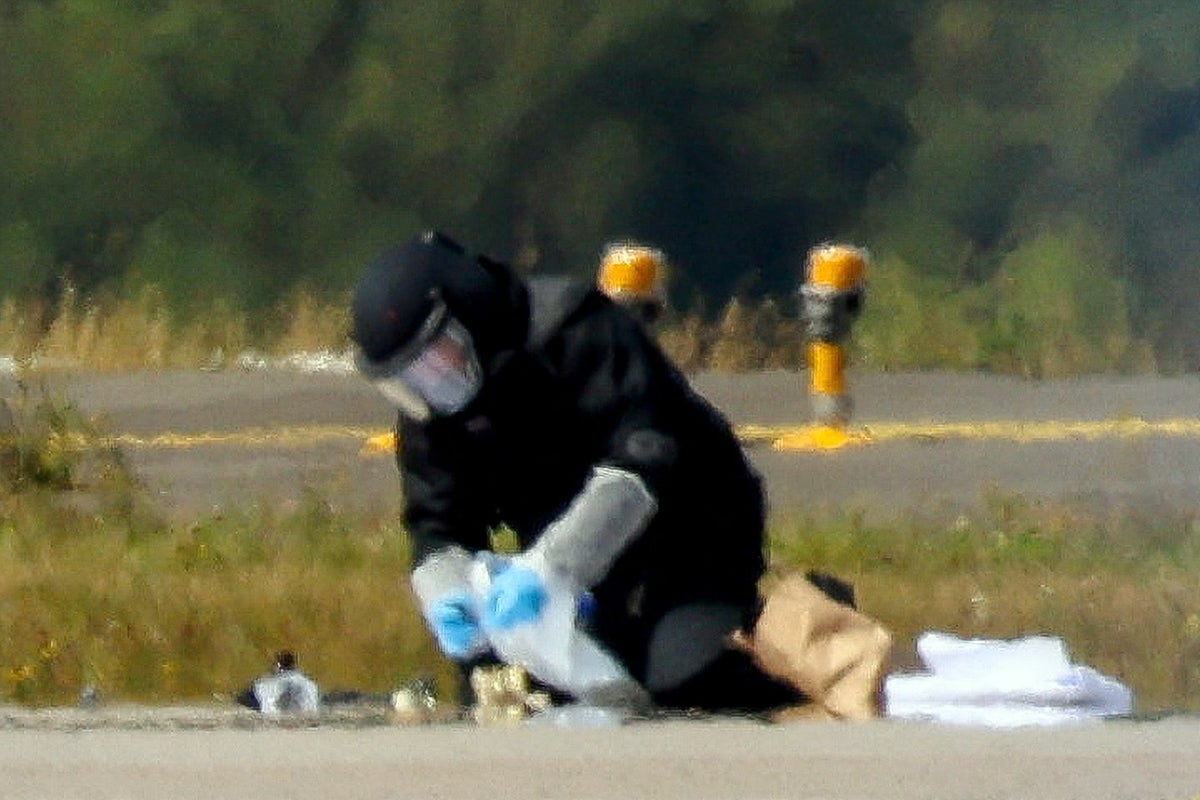
Berlin wants you to look at a botched drone incident on a tarmac, point a finger straight at the Kremlin, and swallow a tidy narrative about good versus evil. Interior Minister Alexander Dobrindt and Foreign Minister Johann Wadephul stepped up to the microphones to declare that Russia is officially behind the August 4 explosive drone strike targeting a Ukrainian Antonov transport plane at Leipzig/Halle Airport.
It is a clean story. It justifies closing a consulate in Bonn, shutting down a cultural center, pushing a fresh wave of sanctions, and cracking down on the so-called shadow fleet. It checks every box for a continent desperate for a unified playbook against hybrid warfare.
There is just one problem. The lazy consensus gripping German security officialdom treats strategic attribution like a multiple-choice quiz with only one answer, ignoring the messy, decentralized reality of modern gray-zone sabotage.
I have spent years analyzing the commercial aviation supply chain and infrastructure vulnerabilities across Central Europe. I have watched billions of euros evaporate into bureaucratic security theater that stops zero determined actors while terrorizing compliant citizens with endless red tape. The official line on Leipzig is not just analytically lazy; it is a strategic cop-out designed to mask the institutional decay of Germany's own domestic counter-intelligence framework.
Let us look at the actual mechanics of the incident. A small commercial-off-the-shelf drone carrying Semtex bounced off a Ukrainian An-124 heavy freighter and failed to detonate. A civilian Boeing 757 freighter later clipped a second drone during a botched go-around. Investigators recovered DNA pointing vaguely toward a trail leading through the Baltics.
From these chaotic, low-tech breadcrumbs, Berlin constructed a masterpiece of political certainty. They point to components and ignition profiles "known from other operations". But in an era where anyone can buy dual-use drone parts off Alibaba, program a flight controller with open-source ArduPilot software, and hire desperate proxies via Telegram channels for a few thousand crypto tokens, matching hardware fingerprints to a state actor is a mug's game.
The Proxy Economy and Plausible Deniability
Modern sabotage is outsourced. Intelligence agencies do not need to send deep-cover operatives to build crude explosive rigs in Saxony. They buy services through fragmented criminal ecosystems where the foot soldiers often do not even know who is ultimately footing the bill.
When Berlin pretends that every amateurish act of kinetic mischief traces back in a straight line to a desk in Moscow, they misread how modern asymmetric conflict actually functions. The primary objective of gray-zone operations is rarely catastrophic destruction. If you wanted to level a Ukrainian transport plane carrying military aid at Leipzig, you would not use a hobbyist quadcopter with an unstable fuse that bounces harmlessly off an airframe.
You use a distributed psychological disruption campaign. You create enough ambient panic to force governments into over-correcting, locking down civilian airspace, and draining political capital on diplomatic expulsions that do nothing to harden a single concrete runway.
Imagine a scenario where a criminal syndicate or a disgruntled third-party contractor with an entirely different axe to grind runs a freelance sabotage shop, selling chaos to the highest bidder in an anonymous dark web marketplace. Pinning every erratic incident on state-level command structures offers a comforting illusion of order. It tells the public that there is an identifiable enemy with an address that can be sanctioned, closed down, or lectured at a press conference.
The truth is far more uncomfortable. Europe’s critical infrastructure is porous because it was built for an era of open borders, low threat assumptions, and maximum economic efficiency. No amount of consulate closures in Bonn will fix the fact that an open airfield spanning thousands of hectares cannot be hermetically sealed against a two-thousand-euro drone launched from a nearby cornfield by a guy wearing a hoodie.
The Real Cost of Political Convenience
By framing the Leipzig drone drop exclusively as a grand geopolitical assault by the Russian state, Germany’s leadership accomplishes two domestic goals.
First, it short-circuits internal accountability. When security agencies fail to detect or prevent an attack on a critical logistics node feeding military supplies to Ukraine, admitting that domestic surveillance failed is politically lethal. Blaming a sophisticated foreign adversary turns a local security failure into an unavoidable act of war, deflecting hard questions about why perimeter defenses at one of Europe's premier cargo hubs looked like a sieve.
Second, it provides a ready-made battering ram to implement long-desired domestic crackdowns. The immediate announcement to shutter the Russian House in Berlin and clamp down on maritime transport shows how quickly a crisis is repurposed to advance pre-existing bureaucratic wish lists.
The danger of this approach lies in escalation dominance. When you publicly back a nuclear-armed adversary into a corner over an ambiguous, botched drone stunt, you narrow your own diplomatic off-ramps. You lock yourself into an escalatory spiral where every future rogue incident—whether caused by a thrill-seeking teenager, an organized crime syndicate, or an actual state proxy—demands an escalating retaliatory response.
Stop pretending that erecting diplomatic tripwires solves an engineering and policing problem. Securing European logistics hubs requires hardening the perimeter, deploying cheap, scalable counter-drone frequency jammers, and overhauling internal vetting for airport logistics personnel. It requires tedious, unglamorous operational security instead of flashy press conferences in Berlin.
Until European leaders stop using foreign bogeymen to distract from structural vulnerabilities at home, the tarmac will remain wide open for the next amateur with a drone and a grudge.