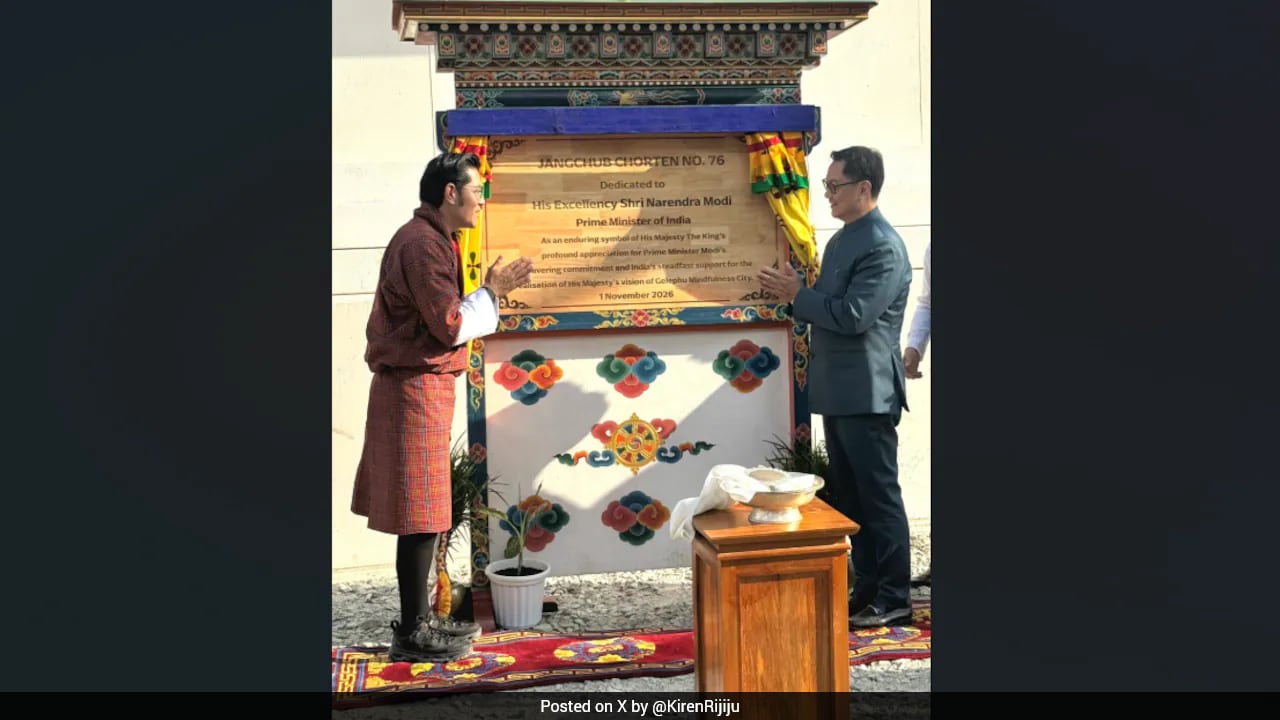
In the southern border town of Gelephu, Bhutanese spiritual leaders recently consecrated 108 stupas, dedicating one specifically to Indian Prime Minister Narendra Modi. On the surface, the ceremony looks like standard diplomatic courtesy between two friendly Himalayan neighbors. Look closer at the geography, the timing, and the massive economic gamble underway in southern Bhutan, and the ritual reveals a calculated geopolitical maneuver.
Gelephu is not a random provincial outpost. It is the designated site of the Gelephu Mindfulness City, a sprawling special administrative region championed by King Jigme Khesar Namgyel Wangchuck to rescue Bhutan from an acute youth brain drain and economic stagnation. By anchoring a major religious consecration directly inside this economic zone and tying India's prime minister to its spiritual foundation, Thimphu is sending an unmistakable signal to New Delhi. The survival of Bhutan's most ambitious modern project depends entirely on Indian capital, Indian infrastructure, and Indian political buy-in.
The Architecture of Spiritual Diplomacy
To understand why a Buddhist monument carries diplomatic weight, you have to understand how power operates in the eastern Himalayas. In Vajrayana Buddhism, constructing and consecrating 108 stupas is an act of immense spiritual merit designed to pacify obstacles, harmonize the environment, and bless a specific territory. The number 108 holds deep cosmological significance across both Buddhist and Hindu traditions, serving as an immediate cultural bridge between Thimphu and New Delhi.
Dedicating one of those 108 structures to a sitting foreign head of government is extraordinary. Protocol in the region usually restricts such honors to revered lamas, deceased monarchs, or major historical patrons of the dharma. Placing Narendra Modi within that sacred geometry elevates a political relationship into a spiritual bond.
Modi has spent his tenure aggressively deploying religious and cultural diplomacy across South Asia, from funding Buddhist circuits in Nepal to inaugurating temples in the Middle East. Bhutanese officials know their audience. They understand that New Delhi responds far more enthusiastically to gestures rooted in shared civilizational heritage than to dry policy papers or trade delegations. The stupa dedication speaks Modi's exact political language.
What Gelephu Actually Represents for Bhutan
Strip away the incense and ceremonial scarves, and Gelephu is a high-stakes survival strategy. For decades, Bhutan relied on hydropower exports to India and tightly controlled, high-value tourism to keep its economy afloat. That model hit a wall.
The COVID-19 pandemic decimated tourism revenues, while delays and cost overruns plagued major hydropower projects. Worse, young, educated Bhutanese citizens began leaving the country in unprecedented numbers, heading to Australia, Canada, and the Middle East in search of better wages. Between 2022 and 2024, tens of thousands of citizens emigrated—a staggering exodus for a nation with a total population of fewer than 800,000 people.
King Jigme Khesar Namgyel Wangchuck responded by announcing the Gelephu Mindfulness City, envisioned as a carbon-negative, zero-emission economic hub spanning over 1,000 square kilometers along the Indian border with Assam. Unlike traditional special economic zones that chase low-cost manufacturing or tax-haven banking, Gelephu is pitched as a magnet for green technology, wellness industries, spiritual tourism, and ethical finance, all governed under a distinct legal framework designed to attract international investors.
None of it works without India.
Gelephu sits directly adjacent to Assam, one of India's northeastern states. Every piece of heavy machinery, every foreign tourist flying into the planned international airport, and every megawatt of cross-border trade has to move through Indian airspace, Indian railways, or Indian highways. Without seamless connectivity to India's northeastern corridor, Gelephu remains an isolated clearing in the foothills.
The Quiet Shadow of Beijing
Diplomats in New Delhi rarely admit it publicly, but every major infrastructure move in Bhutan is viewed through the lens of China. For years, Beijing has steadily expanded its footprint along Bhutan's northern and western borders, constructing villages in disputed territories like the Doklam plateau—the exact flashpoint where Indian and Chinese troops faced off for 73 days in 2017.
China has simultaneously dangled the prospect of formal diplomatic relations and economic aid in front of Thimphu. In late 2023, Bhutan and China held high-level border talks that set off quiet alarm bells inside India's Ministry of External Affairs. Any border swap that gives Beijing strategic high ground near the Siliguri Corridor—the narrow strip of land connecting mainland India to its northeastern states—poses an existential security threat to New Delhi.
Against that backdrop, the Gelephu project serves a dual purpose. For Bhutan, it creates an economic engine tied firmly to the southern border, reducing any temptation to look north toward Chinese investment. For India, a prosperous, heavily integrated economic zone in southern Bhutan acts as a permanent buffer and economic anchor right next to Assam.
By dedicating a stupa to Modi in Gelephu, Bhutanese leadership is reassuring New Delhi that its economic future remains firmly aligned with India, regardless of ongoing border negotiations with Beijing.
Infrastructure Realities on the Ground
Spiritual blessings do not lay asphalt or pour concrete. While the consecration ceremony captures headlines, the physical reality on the ground in Gelephu remains a monumental engineering challenge.
Turning a quiet border town into an international hub requires massive upgrades across multiple sectors:
- Rail Connectivity: India has committed to building the first-ever cross-border railway link connecting Kokrajhar in Assam to Gelephu. Survey work and land acquisition have moved forward, yet building rail lines through flood-prone terrain in the Himalayan foothills is notoriously slow.
- Aviation Upgrades: Gelephu currently has a small domestic airport. Transforming it into an international gateway capable of handling wide-body aircraft demands extensive runway expansion, customs infrastructure, and airspace agreements with New Delhi.
- Energy Grids: A zero-emission city running data centers, green industries, and electric transit requires massive, uninterrupted clean power. Bhutan has the hydro potential, but transmission networks in the south need complete overhauls.
- Border Logistics: Integrated check posts on the Assam side of the border are still playing catch-up. Moving commercial cargo smoothly across the frontier requires modernized customs clearance that matches the ambitions of a special administrative region.
Assam Chief Minister Himanta Biswa Sarma has actively backed the project, recognizing that an economic boom in Gelephu could spill over into western Assam, generating jobs and trade for a region long plagued by underdevelopment. Yet Indian bureaucratic timelines rarely move at the speed of royal visions.
The Risks Nobody Mentions at Ceremonies
The narrative surrounding Gelephu is overwhelmingly optimistic, framed around mindfulness, sustainability, and bilateral brotherhood. Veteran observers of South Asian development know that grand regional projects often collide with stubborn realities.
First, there is the question of capital. Bhutan does not have the domestic financial reserves to fund a multibillion-dollar smart city on its own. It needs sovereign wealth funds, institutional investors, and major Indian conglomerates to write massive checks. Private capital is notoriously unsentimental; investors care about return on equity, regulatory predictability, and dispute resolution mechanisms far more than spiritual branding.
Second, environmental fragility poses a constant threat. Southern Bhutan sits in one of the most active seismic and monsoon zones on the planet. Flash floods, landslides, and shifting river courses regularly wash away roads and bridges during the summer rains. Building dense urban infrastructure in the foothills without triggering severe ecological disruption requires engineering precision that drives costs sky-high.
Third, there is a delicate cultural balancing act. Bhutan spent decades protecting its unique cultural identity and pristine environment by strictly limiting foreign influence and mass tourism. Opening a massive special administrative region that invites thousands of foreign workers, consultants, and tourists introduces social pressures the country has never had to manage at scale. Integrating global business practices while preserving traditional Bhutanese governance will test the administrative capacity of the state.
What Comes Next in the Foothills
The consecration of the 108 stupas marks the spiritual launch of Gelephu's next phase, shifting the conversation from abstract master plans to visible reality on the border. India has already doubled its financial assistance to Bhutan for its current Five-Year Plan, committing roughly 10,000 crore rupees to support infrastructure, connectivity, and the Gelephu initiative.
Over the next twenty-four months, the real test will not be measured in ceremonial dedications or diplomatic communiques. It will be measured in cleared land along the Kokrajhar-Gelephu rail corridor, signed agreements with private anchor investors, and the arrival of construction crews on the tarmac of Gelephu's airport. Spiritual goodwill has cleared the diplomatic path; now the concrete has to be poured before Bhutan's youth pack their bags for good.