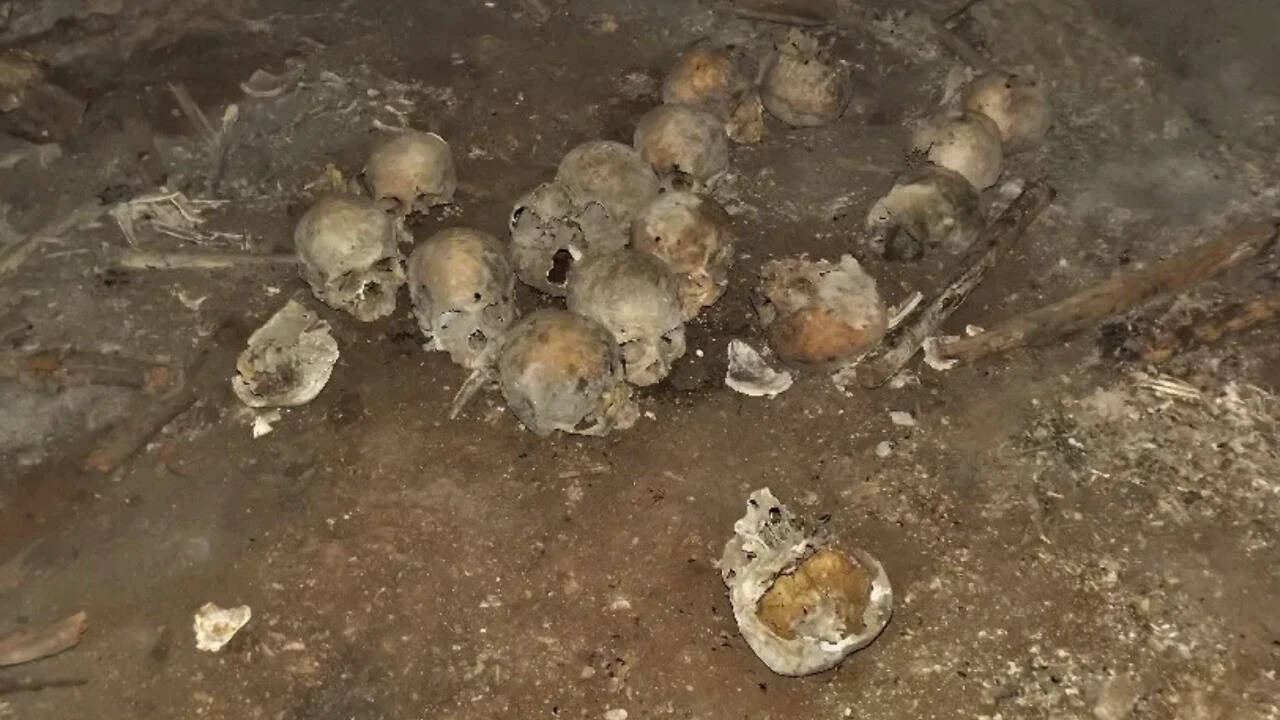
In 2012, Mexican authorities and investigators from the National Institute of Anthropology and History (INAH) recovered 165 human skulls from a dry cavern near Comitán de Domínguez, Chiapas, close to the Guatemalan border. Standard media accounts frame this discovery through the lens of modern cartel violence, treating the site as an anomaly of contemporary criminal pathology. That framing fails under forensic scrutiny. Preliminary osteological assessments established that the remains were centuries old rather than recent homicides, transforming the site from a modern crime scene into a complex taphonomic and bioarchaeological dataset. Understanding the Chiapas assemblage requires stripping away sensationalism and applying rigorous forensic anthropology, Mesoamerican ritual theory, and spatial analysis to separate confirmed osteological evidence from competing historical hypotheses.
The Forensic Triage Protocol
When human remains are discovered in subterranean environments along modern smuggling corridors, investigators must execute a strict diagnostic sequence before assigning historical or criminal causality. In the 2012 Comitán investigation, initial law enforcement assumptions pointed toward organized crime due to the proximity of the border and the sheer volume of cranial elements. INAH physical anthropologists overturned this premise by evaluating four primary diagnostic indicators.
- Collagen Degradation and Cortical Preservation: Fresh bone retains organic lipids and collagen, giving it a dense, greasy texture and distinct odor. The 165 skulls exhibited advanced diagenesis—complete loss of soft tissue, desiccation of the periosteum, and mineral leaching consistent with prolonged exposure to a stable, arid cave microclimate over several centuries.
- Dental Modification and Cranial Vault Shaping: Pre-Columbian Mesoamerican populations practiced intentional artificial cranial deformation (tabular erect and tabular oblique forms) during infancy, alongside dental filing and jade or pyrite inlay work. The presence of culturally modified cranial morphology immediately anchors a specimen in the pre-Hispanic or early colonial period, ruling out modern forensic origin.
- Element Representation Bias: Modern mass graves resulting from cartel executions typically yield complete, articulated skeletons or dismembered remains mixed with ballistic trauma, ligatures, and synthetic clothing fibers. The Chiapas cave contained a heavily skewed demographic and anatomical profile: 165 isolated crania with a near-total absence of post-cranial elements such as femora, vertebrae, or pelvic girdles.
- Perimortem Trauma vs. Postmortem Taphonomy: Forensic examiners distinguish between antemortem healed fractures, perimortem sharp-force trauma (such as decapitation marks on the occipital condyles or cervical vertebrae), and postmortem carnivore scavenging or rockfall damage. The absence of modern high-velocity projectile trauma further invalidated the contemporary homicide hypothesis.
The Four Variables of Subterranean Taphonomy
Caves in the Chiapas highlands act as natural preservation chambers, yet they also introduce specific environmental distortions that complicate archaeological interpretation. To reconstruct how 165 crania accumulated in a single chamber, analysts must isolate four interacting variables.
Microclimatic Stability
Unlike open-air rainforest sites in the Maya lowlands, where acidic soils and torrential rainfall dissolve human bone within decades, high-altitude limestone caves maintain consistent temperatures and low relative humidity. Calcium carbonate-rich cave floors buffer soil acidity, halting microbial bone destruction. This preservation bias explains why large osteological assemblages survive intact in Chiapas karst formations while contemporaneous surface burials vanish.
Hydraulic and Gravitational Sorting
Subterranean karst systems are dynamic geological environments. Seasonal water infiltration, flash flooding, and ceiling collapses routinely disarticulate skeletal remains and transport lighter, rounded elements—specifically crania—away from heavier post-cranial bones. However, hydraulic sorting alone rarely produces a pure assemblage of 165 skulls without depositing silt layers, water-worn abrasion patterns on the zygomatic arches, or scattered long bones in downstream chambers. When crania are stacked or clustered on elevated ledges, human agency supersedes geological transport.
Scavenger Activity
Trogloxene and troglophile scavengers, including rodents, bats, and small carnivores, alter bone surfaces. Rodent gnawing leaves parallel, flat-bottomed grooves along the orbital rims and supraorbital ridges, which inexperienced observers can mistake for sharp-force tool marks. Establishing human ritual manipulation requires microscopic verification that cut marks lack the U-shaped striations of rodent incisors and instead display the V-shaped cross-sections of obsidian or chert blades.
Looting and Secondary Disturbance
Caves throughout southern Mexico suffer from centuries of clandestine looting. Treasure hunters searching for polychrome ceramics or jade artifacts routinely toss human bones aside, piling skulls in corners to clear excavation floors. Consequently, the spatial arrangement observed by INAH investigators in 2012 may reflect modern or historic looting disturbance rather than the original mortuary configuration.
Competing Causal Frameworks for the Assemblage
Once modern criminal activity is eliminated, bioarchaeologists evaluate three primary cultural models to explain why 165 individuals were reduced to isolated crania inside a Chiapas cavern.
Model A: The Tzompantli Secondary Deposition Hypothesis
Across Mesoamerica, from the Maya lowlands to the central Mexican highlands, elites constructed tzompantli—wooden skull racks used to display the severed heads of war captives and sacrificial victims. Archaeological excavations at sites like Tenochtitlan and Chichén Itzá demonstrate that skulls mounted on tzompantli exhibit bilateral perforations through the parietal or temporal bones, created to thread the crania onto horizontal wooden poles.
- Supporting Mechanism: After soft tissue decomposed on the public rack, attendants removed the weathered skulls and deposited them in sacred ossuaries, including caves, to deconsecrate the display or make room for new captives.
- Diagnostic Requirement: This model holds only if a statistically significant percentage of the 165 Chiapas skulls display uniform perimortem perforations on the lateral cranial vault. Without temporal or parietal perforation, the tzompantli hypothesis collapses.
Model B: Ancestor Veneration and Ossuary Re-interment
Mesoamerican cosmology viewed caves as portals to the underworld (Xibalba in Maya tradition) and loci of creation, rain, and ancestral fertility. Classic and Postclassic communities frequently practiced multi-stage mortuary rituals. Bodies were initially buried beneath residential floors; years later, descendants exhumed the skeletons, extracted the cranium as the seat of individual identity and soul force, and transported the skulls to lineage caves for communal re-interment.
- Supporting Mechanism: This practice explains the complete absence of post-cranial skeletons without requiring mass violence. The cave functions as a generational repository rather than an execution site.
- Diagnostic Requirement: Osteological analysis under this model should reveal a broad demographic cross-section—adult males, adult females, and subadults—alongside an absence of perimortem decapitation trauma on the cranial base. Furthermore, the bone surfaces would show weathering patterns consistent with subterranean soil burial prior to secondary transport, rather than open-air sun bleaching.
Model C: Post-Contact Epidemic Mass Burial
During the 16th century, introduced pathogens such as smallpox, measles, and cocoliztli decimated indigenous populations across Chiapas and Guatemala. Mortality rates overwhelmed traditional funerary infrastructure, forcing survivors to deposit corpses rapidly into accessible caves to prevent contagion and scavenger desecration.
- Supporting Mechanism: Rapid deposition of whole bodies followed by centuries of ceiling rockfalls, looting, and selective skull collection by local inhabitants could yield a cranial-heavy assemblage.
- Diagnostic Requirement: If epidemic mortality drove the accumulation, excavation of the underlying cave matrix must yield commingled post-cranial elements beneath the surface layer of skulls, accompanied by early colonial artifacts such as European glass beads, iron fragments, or wheel-thrown ceramics.
Analytical Blind Spots in Public Reporting
Media narratives surrounding the 2012 Comitán discovery consistently fail because they conflate discovery with full archaeological excavation. When authorities extract 165 skulls from a cave and transport them to a laboratory for forensic clearance, three critical evidentiary streams are severed.
First, removing surface crania without conducting systematic stratigraphic excavation of the cave floor destroys contextual provenance. A skull resting on the surface may belong to a Postclassic ritual deposit, while the sediment directly beneath it may contain Preclassic ceramics or colonial textiles. Without three-dimensional spatial mapping (total station recording of every bone's orientation, depth, and association), analysts cannot determine whether the 165 skulls represent a single catastrophic event or six centuries of incremental deposition.
Second, public reporting treats "165 skulls" as a homogeneous population. In physical anthropology, raw cranial counts provide minimal analytical value until disaggregated by biological sex, age-at-death, and pathological markers. A sample composed of 95% males aged 18 to 35 indicates warfare, prisoner execution, or specialized labor mortality. A sample containing infants, elderly females, and males in equal proportions points to catastrophic epidemic mortality or multi-generational lineage burial. Treating the assemblage as an undifferentiated number obscures the social mechanism that created it.
Third, visual inspection cannot establish chronology. Mesoamerican cave utilization spans over three millennia, from the Early Preclassic period through the Postclassic and into the ethnographic present, where contemporary Maya communities still conduct ceremonial rituals in sacred caverns. Without Accelerator Mass Spectrometry (AMS) radiocarbon dating applied to purified bone collagen across multiple specimens, investigators cannot confirm whether the 165 individuals died within the same decade or across five hundred years.
Methodological Limitations and Evidentiary Constraints
Even under optimal laboratory conditions, reconstructing the history of the Chiapas cave assemblage faces strict scientific boundaries.
- Collagen Degradation Thresholds: While dry caves preserve bone morphology, fluctuations in seasonal humidity can degrade organic collagen to the point where AMS radiocarbon dating becomes impossible or yields contaminated dates. If collagen yields fall below 1% by weight, radiometric dating must shift to apatite fractions, which are highly susceptible to carbon exchange with the surrounding limestone cave environment.
- Strontium Isotope Equifinality: To determine whether the 165 individuals were local residents of the Comitán valley or war captives brought from distant polities, bioarchaeologists measure strontium ($^{87}\text{Sr}/^{86}\text{Sr}$) and oxygen ($\delta^{18}\text{O}$) isotope ratios in tooth enamel. However, the geological baseline of the Chiapas highlands shares overlapping isotopic signatures with parts of the Guatemalan highlands. Isotope analysis can rule out coastal origins, yet it often cannot distinguish between neighboring inland valleys.
- Context Loss from Rapid Clearance: Because the 2012 recovery was initiated as a criminal investigation rather than an academic excavation, law enforcement extraction protocols prioritized rapid removal of human remains over micro-stratigraphic sampling. Palynological data (ancient pollen), phytoliths, and macro-botanical remains (such as copal incense residue or pine charcoal) adhering to the crania or underlying sediment are frequently lost during non-archaeological transport and washing.
The Protocol for Definitive Attribution
To move the 2012 Comitán assemblage from speculative news item to peer-reviewed historical evidence, research teams must execute a four-stage analytical sequence on the curated collection and the original cavern.
- Taphonomic and Trauma Scoring: Conduct high-magnification stereomicroscopy on the occipital condyles, mastoid processes, and cranial vaults of all 165 specimens. Categorize every mark as antemortem, perimortem, or postmortem. Quantify the exact frequency of bilateral parietal perforations to definitively confirm or falsify the tzompantli hypothesis.
- Stratified Radiocarbon Sampling: Select ten crania representing distinct preservation states and cranial modification styles. Extract bone collagen for AMS radiocarbon dating to establish the chronological span of the deposit and determine whether the assemblage represents a single mass-mortality horizon or a cumulative ossuary.
- Demographic and Isotopic Profiling: Complete standard osteological scoring of cranial sutures, supraorbital ridges, and dental wear to construct a precise age-and-sex mortality profile. Sample first molar enamel from twenty individuals for strontium and oxygen isotope analysis to differentiate local lineage members from non-local captives.
- Sub-Surface Cave Excavation: Return to the Comitán cavern to excavate test units directly beneath the recovery zone down to sterile bedrock. Screen all matrix through fine mesh to recover missed dental elements, phalanges, and associated grave goods, using stratigraphic associations to lock the surface crania into a secure cultural sequence.


