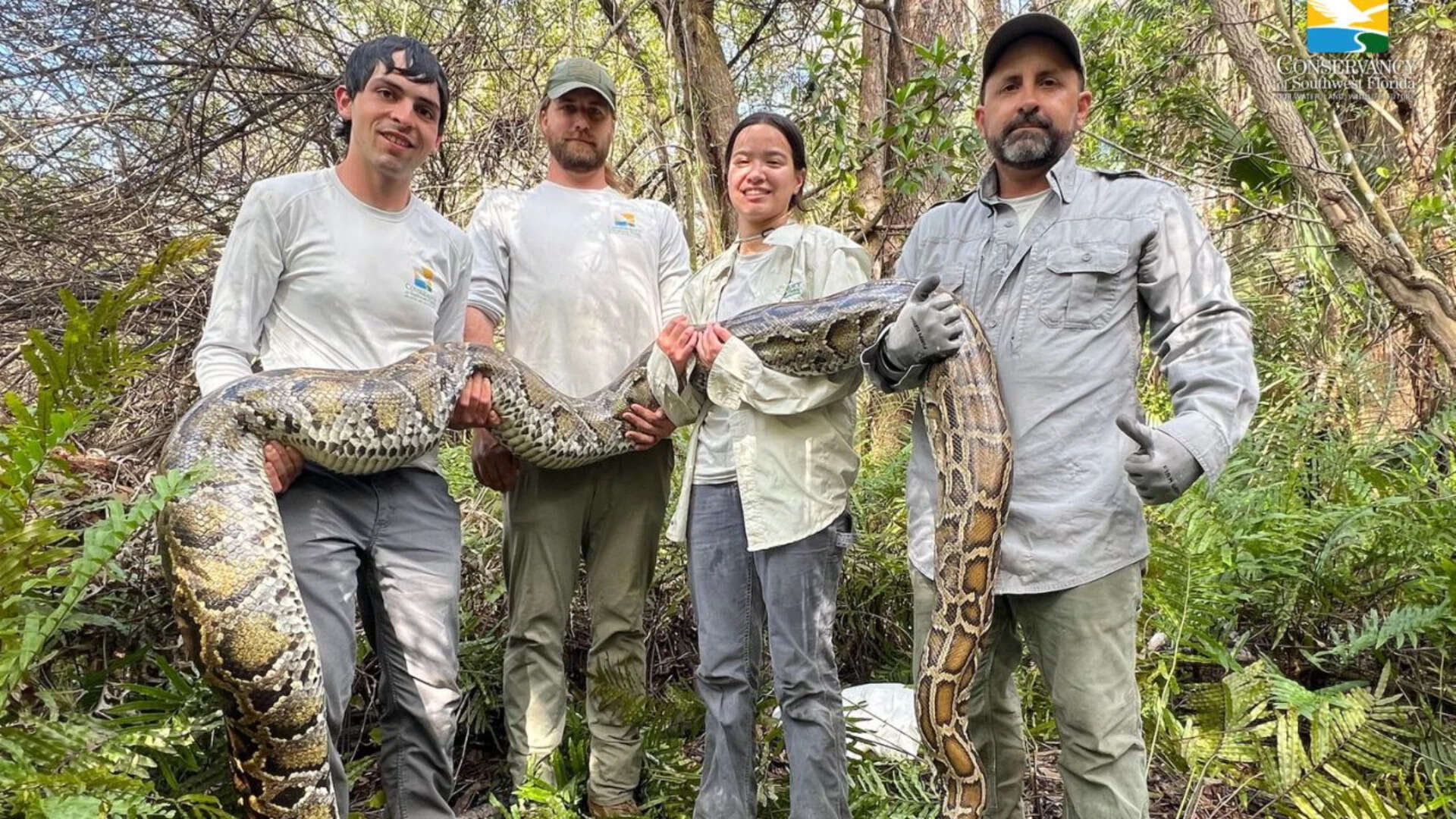
Invasive species management in the Florida Everglades presents an optimization problem defined by extreme detection asymmetry. Python bivittatus (Burmese python) populations occupy hundreds of thousands of acres of contiguous wetland habitat where human visual search efficiency approaches zero. Traditional removal methods—primarily nocturnal road cruising and opportunistic visual surveying—yield low catch-per-unit-effort (CPUE) metrics and selectively harvest small subsets of the broader demographic. Eradication requires targeting reproductive adult males during tight seasonal windows. Utilizing telemetry-equipped female "scout" pythons as biological vectors reverses this detection asymmetry, converting the reproductive drive of wild males into a targeted aggregation mechanism.
The Detection Asymmetry and Passive Search Limits
The primary barrier to managing the Burmese python population in South Florida is not mortality resistance, but detection probability. The species possesses extreme camouflage, low movement frequencies outside breeding windows, and an aquatic habitat structure that severely restricts human access.
Human visual searching along levees and roads suffers from three systemic failures:
- Spatial Bias: Search efforts concentrate on accessible linear infrastructure, leaving core breeding zones in deep interior marshes entirely undisturbed.
- Demographic Bias: Opportunistic visual detection favors mobile sub-adults and foraging adults during warmer months, while missing stationary, reproductive females concealed in subterranean or aquatic refugia.
- Low Yield per Unit Effort: Visual survey CPUE typically requires tens to hundreds of hours of search time per individual snake captured, making broad-scale suppression economically non-viable through manual visual search alone.
Passive removal tactics operate as a low-yield filter rather than a strategic population suppression tool. To alter population trajectories, removal strategies must target adult breeding units before reproductive output occurs.
Biological Mechanics of the Scout Snake Framework
The scout snake strategy relies on the olfactory acuity and mate-seeking behavior of wild male pythons during the winter breeding season, which runs roughly from November through April. During this window, receptive female pythons secrete sex pheromones that travel through air and water channels, creating chemical plumes that males track across long distances.
[Radio-Tagged Receptive Female] ──(Pheromone Secretion)──> [Chemical Plume]
                                                                 │
                                                                 ▼
[Target Male Captured] <──(Manual Extraction)── [Male Aggregation Formed]
Deploying a tracking system involves a precise four-stage operational loop:
- Capture and Surgical Implantation: Wild female pythons of high body mass are captured, evaluated for health, and surgically fitted with internal Very High Frequency (VHF) or GPS transmitters within their body cavity.
- Strategic Release: Implanted females are released back into high-density breeding corridors identified through hydrological and historical sighting models.
- Tracking and Signal Triangulation: Field biologists monitor radio signals via directional antennas or satellite telemetry to pinpoint the exact location of the female as she establishes a home range.
- Interception at Breeding Aggregations: When a tracking signal remains stationary during the peak reproductive window, field teams navigate directly to the coordinate. Receptive females frequently attract multiple competing males, forming breeding balls. Biologists remove and euthanize the attending untagged males while leaving the implanted female intact to continue functioning as a biological lure.
By leveraging the female's natural pheromone dispersal, search teams substitute passive human vision with biological signal amplification. The female python performs the search function across inaccessible terrain, concentrating multiple cryptic males into a single, actionable coordinate.
Efficiency Metrics and Biomass Removal Dynamics
Evaluating invasive species control requires analyzing biomass removed relative to labor hours expended. The scout female methodology fundamentally shifts the cost curve compared to unguided manual searches.
Removal Rate Scaling
In standard visual surveys, catching a single adult python requires continuous manual effort in high-probability corridors. Under the scout snake framework, a single radio-tagged female can lead field teams to multiple adult males within a single breeding season. In high-density zones, individual females have been documented drawing in up to eight breeding males across a single winter cycle.
Demographic Impact
Removing large, mature males directly reduces the operational breeding pool. More importantly, tracking females during the late breeding season frequently reveals previously undetected wild females competing for the same micro-habitats or nesting sites. Eliminating a mature wild female removes both her immediate reproductive contribution and her potential future yield, which can exceed 50 to 100 eggs per clutch depending on body mass.
Labor Efficiency Calculation
The capital expenditure for surgical implantation, transmitter hardware, and tracking logistics is offset by the targeted nature of the retrieval operations. Instead of spending hundreds of hours patrolling low-yield transit corridors, field teams execute surgical strikes on confirmed aggregation points. Labor shifts from broad spatial searching to high-density extraction.
Environmental Constraints and Operational Limits
While biologically effective, deploying live vectors introduces operational bottlenecks and environmental constraints that prevent it from serving as a standalone eradication solution.
Hardware and Telemetry Range Limits
VHF transmitters require close-range directional tracking from aircraft or ground teams, which becomes labor-intensive over vast trackless expanses. Dense vegetation, water depth, and canopy cover attenuate radio signals, requiring field crews to operate within narrow spatial margins to maintain contact with tagged individuals. Satellite-enabled GPS units eliminate ground search hours but increase unit cost, mass, and power consumption, limiting battery lifespan and requiring periodic surgical retrieval to replace dead units.
Biological Variables and Pheromone Variability
Vector effectiveness depends on the physiological state of the tagged female. Non-receptive females, stressed individuals, or those suffering from surgical complications may fail to emit the requisite pheromone profiles, rendering them ineffective as lures for that breeding cycle. Furthermore, wild females may move into deep subterranean solution holes or inaccessible limestone caverns where human recovery teams cannot safely extract attending males.
Density-Dependent Efficiency Decay
As local python densities decline due to sustained removal efforts, the probability of wild males intercepting a tagged female's pheromone plume decreases proportionally. The scout snake method exhibits highest efficiency in high-density populations; its yield per unit effort naturally decays as the target population thins out, requiring field programs to transition to complementary detection technologies in low-density transition zones.
Tactical Integration and Deployment Protocol
Maximizing the ROI of biological vector control requires integrating telemetry tracking into a broader multi-modal management framework. The scout python network must not operate in isolation.
Field programs must structure deployment using a phased operational protocol:
- Pre-Season Habitat Mapping: Utilize historical capture data and hydrological modeling to map thermal refuges and high-probability mating structures prior to the November temperature drop.
- Selective Tagging: Select large-bodied females (exceeding 10 feet in length) for implantation. Larger females possess greater mass, higher pheromone output potential, and higher attraction rates than marginal sub-adult females.
- Integrated Extraction Operations: Combine scout snake tracking with eDNA (environmental DNA) water sampling to confirm male presence in suspected basins before deploying field teams into high-cost remote sectors.
- Selective Preservation: Keep tagged "scout" females alive and active across multiple seasons. Re-capture tagged individuals at the close of the breeding season to assess battery life, health, and physiological readiness for the subsequent cycle.
To achieve population suppression across the broader Everglades ecosystem, vector-based extraction must be paired with automated environmental sensors, targeted spatial barrier fencing in critical ecological corridors, and continuous eDNA surveillance. Deploying telemetry-tagged biological lures addresses the core challenge of cryptic animal detection, turning the reproductive biology of an invasive predator into its primary structural vulnerability.


