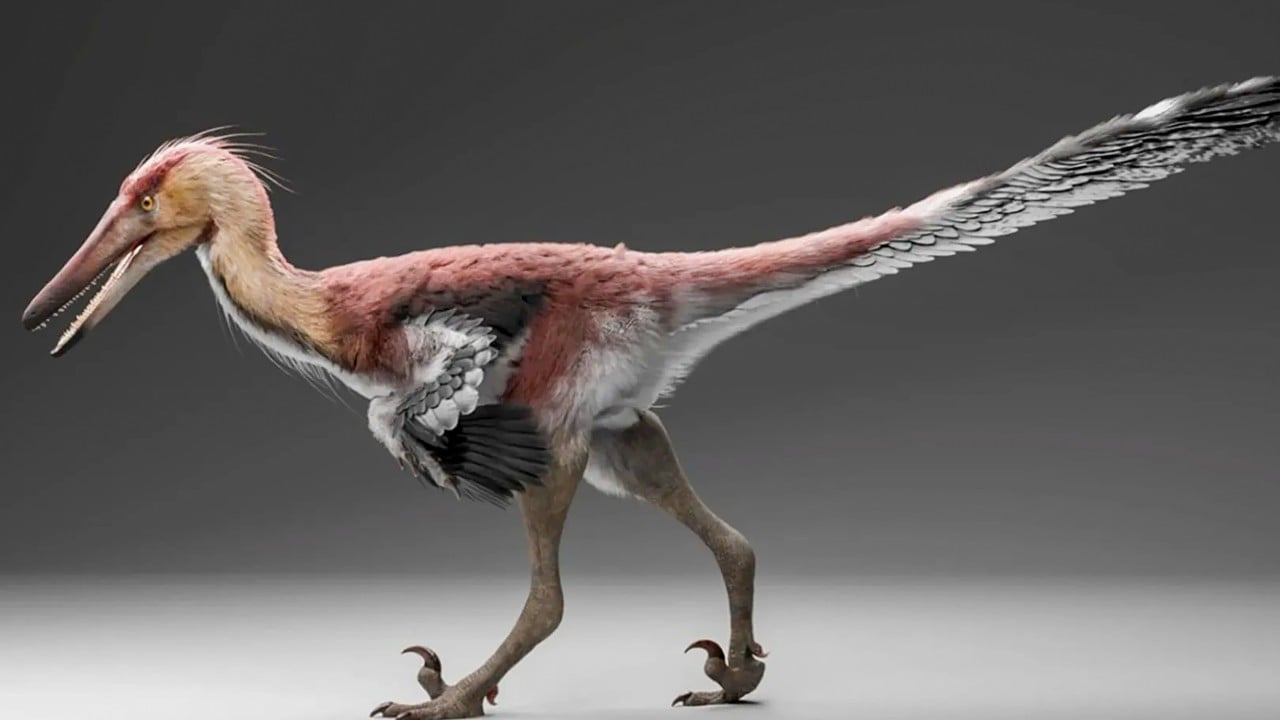
The discovery of Kank australis, a newly identified paravian theropod from the Late Cretaceous Chorrillo Formation of southern Patagonia, invalidates the monolithic archetype of dromaeosaurid dinosaurs as exclusively terrestrial, pursuit-based apex predators. Morphological analysis of the specimen, recovered from Maastrichtian-aged strata (~70 million years ago) at La Anita farm near El Calafate, Santa Cruz Province, Argentina, reveals a highly specialized ecological pivot toward piscivory. By reconciling classical dromaeosaurid synapomorphies with specialized cranial, dental, and cervical adaptations, this taxon represents a distinct evolutionary branch that converged on ecological niches occupied by modern ardeids (herons). Furthermore, the presence of diagnostic subfamilial traits shared between South American Unenlagiidae and Asian Velociraptorinae establishes definitive constraints on historical biogeography, dictating a timeline of faunal dispersal that predates the terminal fragmentation of the Pangaean supercontinent.
The Tri-Axial Morphological Framework of Kank australis
The characterization of Kank australis as a specialized piscivore rests on a tri-axial framework of anatomical adaptations spanning dental microstructure, cervical kinesis, and pedal architecture. Rather than relying on speculative behavioral analogies, its ecological role is quantified through clear mechanical corridors.
1. Dental Microstructure and Friction Optimization
Standard dromaeosaurid dentition features ziphodont characteristics: laterally compressed, recurved crowns equipped with micro-denticulated serrations optimized for slicing through the dense muscle tissue of terrestrial macro-herbivores. Kank australis breaks from this ancestral state by deploying a homodont-leaning array of specialized teeth characterized by:
- Conical Geometry: Circular cross-sections minimize structural stress during multidirectional loading, an essential requirement when gripping struggling, low-viscosity prey within an aquatic medium.
- Pronounced Longitudinal Ridges: The enamel surface features raised vertical ridges that maximize mechanical friction against the slippery, mucus-coated scales of sympatric teleost fish, preventing prey slippage without requiring high-force crushing mechanisms.
- Absence of Serrations: The loss of carinae (serrated edges) points to a functional transition from flesh-shearing to high-precision capture and restraint.
2. Hyper-Pneumatized Cervical Kinesis
The fossil assembly includes highly diagnostic cervical (neck) vertebrae that exhibit intense pneumaticity, characterized by deep internal air chambers. This reduces the structural mass of the anterior axial skeleton without compromising torsional rigidity.
The specific spatial arrangement of the parapophyses and carotid processes indicates a highly developed muscular leverage system. These bony anchor points allowed for the configuration of specialized epaxial and hypaxial muscle groups, mimicking the biomechanical apparatus of modern wading birds. The resulting kinetic profile enabled rapid, low-mass sagittal extension—a high-velocity strike mechanism engineered to breach the water-air interface to intercept aquatic prey with minimal hydrodynamic disturbance.
3. The Functional Dichotomy of the Raptor Claws
Like its northern hemisphere relatives within the Velociraptorinae, Kank australis retains a highly hypertrophied, falciform (sickle-shaped) ungual claw on the second digit of the pes. Within terrestrial theropods, this claw operated as a high-impact puncture tool or a prey restraint mechanism during subduing maneuvers.
In Kank australis, this raptorial claw presented a clear functional dichotomy when contrasted with its gracile, lightweight skeleton, which measured approximately 2.5 to 3 meters in length. The coexistence of an unreduced sickle claw alongside specialized fishing adaptations demonstrates that the evolution of piscivory did not demand the immediate deletion of ancestral predatory toolkits. The ungual claw likely functioned either as a secondary stabilization anchor in soft, estuarine substrates or as a weapon for occasional opportunistic macro-predation within a highly competitive ecosystem.
Biogeographical Connectivity and Dispersal Corridors
The shared morphological traits between the South American Unenlagiidae and the Asian Velociraptorinae illuminate Mesozoic plate tectonics and faunal distribution pathways.
        [ Jurassic Common Ancestor ] (Global Distribution)
                     |
         +-----------+-----------+
         |                       |
(Gondwanan Breakup)      (Laurasian Isolation)
         |                       |
   Unenlagiidae           Velociraptorinae
 (South America)               (Asia)
         |
   Kank australis
The presence of the definitive curved second pedal ungual in both lineages cannot be explained by independent, homoplastic evolution due to deep structural synapomorphies in the phalangeal ginglymoid joints. Instead, this morphological overlap requires a historical physical connection.
This distribution can be traced back to a cosmopolitan ancestral taxon that roamed across the undivided supercontinent of Pangaea during the Jurassic period. As rift valleys formed and epicontinental seaways expanded, fracturing the landmass into Laurasia in the north and Gondwana in the south, these populations underwent geographic isolation.
While Northern Hemisphere clades preserved agile, terrestrial hunting strategies, Southern Hemisphere lineages—specifically within the Unenlagiidae—exploited the expansive river deltas of South America, developing distinct piscivory-driven strategies. Kank australis effectively bridges a critical distributional and stratigraphical gap. It connects the well-documented mid-Cretaceous unenlagiid records of northern Patagonia with fragmentary, unnamed specimens found in Antarctica, proving that this family maintained high environmental plasticity across diverse latitudes until the terminal Cretaceous mass extinction.
Trophic Stratification and Ecosystem Pressures
The Maastrichtian Chorrillo Formation represents a high-energy depositional environment characterized by meandering river systems, seasonal floodplains, and extensive wetlands rich in aquatic macrophytes like water lilies. This highly productive aquatic matrix supported diverse communities of insects, mollusks, and teleost fish, providing a reliable energy base for specialized predators.
Data collected from these fossil beds allows for a reconstruction of the trophic hierarchy, placing Kank australis within a highly stratified competitive landscape:
| Trophic Guild | Representative Taxon | Primary Feeding Mechanism | Ecological Niche |
|---|---|---|---|
| Apex Terrestrial Predator | Maip macrothorax (>10m Megaraptorid) | High-mass pursuit, manual claw shearing | Macro-herbivore predation (Titanosauria) |
| Littoral / Aquatic Predator | Kank australis (3m Unenlagiid) | High-velocity cervical extension, frictional grip | Piscivory, opportunistic small-vertebrate hunting |
| Semi-Aquatic Omnivore / Carnivore | Unnamed Crocodyliforms | Low-profile ambush, ambush crushing | Riparian edge predation, opportunistic scavengers |
| Semiaquatic Insectivore | Patagorhynchus pascuali (Monotreme) | Benthic foraging, electrosensory/mechanosensory probing | Invertebrate consumption, riverbed foraging |
This trophic distribution highlights the resource partitioning that occurred in the Patagonian ecosystem. By transitioning its primary foraging theater to shallow-water littoral zones, Kank australis avoided direct niche competition with much larger coeval theropods, such as the 10-meter megaraptorid Maip macrothorax.
The cost function of hunting in aquatic media involves managing hydrodynamic drag and prey escape velocities. Kank australis solved this via a gracile skeletal design that minimized its displacement footprint in shallow water, alongside its specialized hyper-flexible neck, which optimized acceleration profiles during strikes.
Analytical Limitations and Empirical Boundaries
A rigorous evaluation of the current fossil material requires outlining the limits of available empirical data. The holotype and referred specimens of Kank australis do not comprise a complete skeleton, relying instead on a diagnostic collection of isolated teeth, caudal and cervical vertebrae, and manual/pedal elements.
The diagnosis of specialized piscivory is strongly supported by comparative anatomy and taphonomic association with fish remains, but it remains a functional hypothesis. Conclusive confirmation of its precise dietary breakdown requires the discovery of direct endogastric contents (fossilized stomach contents) or clean, unaltered enamel samples for strontium and oxygen stable isotope analysis. These geochemical approaches are necessary to definitively chart its position within the local marine-terrestrial baseline.
Strategic Research Imperative
To map the exact tempo and mode of unenlagiid evolution across the Gondwanan fragments, field exploration must target the under-sampled Maastrichtian exposures of the Chorrillo Formation.
Future operations should deploy high-resolution micro-computed tomography (micro-CT) scanning on the recovered cervical elements of Kank australis to precisely quantify its internal trabecular structural density and map its neurovascular canals. This analytical step is required to accurately model the exact deceleration forces and angular velocity limits of its strike mechanism.
Additionally, systematic comparative sampling of coeval Antarctic fossil material must be prioritized to determine if the high-latitude paravian lineages represent an offshoot of the Patagonian Kank clade or a distinct, parallel radiation event driven by high-latitude environmental pressures.