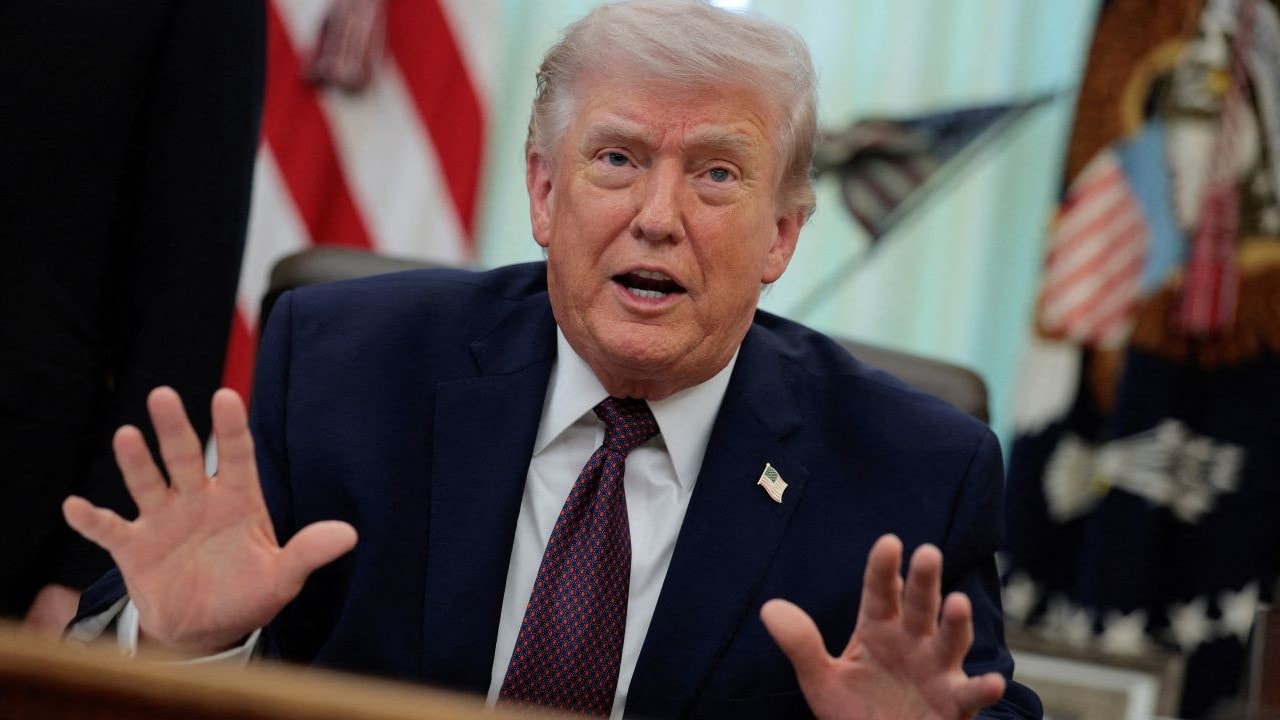
The air in the situation room doesn’t circulate the way it does in normal buildings. It feels heavy, seasoned by the sweat of people who know that a single syllable spoken over a secure line can rewrite the geography of the Middle East. When geopolitical expert Madhav Nalapat watches the chessboards of global power shift, he doesn't just see troop movements or economic sanctions. He sees the terrifying absence of a safety net.
We live in an era captivated by the spectacle of the strongman. We watch presidents and prime ministers stride across tarmacs, signing executive orders with heavy black pens, projecting an aura of absolute certainty. But true strategy is not defined by how loudly you walk into a room. It is defined by how you plan to leave it.
When Donald Trump ordered the drone strike that vaporized Iranian General Qasem Soleimani outside the Baghdad airport, the world held its breath. It was a dramatic, cinematic burst of violence that felt, to many, like a definitive assertion of American might. But strip away the immediate shockwave, and you are left with a much darker reality. It was a move executed without a map. A leap off a cliff with the vague hope that the ground would rise up to meet the fall.
The Illusion of the Hard Line
To understand the sheer weight of this gamble, you have to look past the cable news chyrons and step into the shoes of an ordinary Iranian citizen. Imagine a young woman in Tehran. Let's call her Shirin. She is twenty-four, holds a degree in computer engineering, and loves bootleg Western music. She does not love the oppressive regime that dictates what she wears and how she speaks. For years, she and her peers represent the greatest threat to the fundamentalist status quo: a young, connected population yearning for integration with the global community.
When economic sanctions hit, they don't hit the elite revolutionary guards who control the black markets. They hit Shirin. They hit her father, who can no longer afford the imported medication he needs for his heart condition.
Then comes the drone strike.
Suddenly, the nuanced internal debate within Iran evaporates. When a foreign superpower assassinates a national figure—even a brutal one—the psychological chemistry of a nation changes overnight. Tribalism is a primal human instinct. When under attack, communities close ranks. The moderate voices, the reformists, the young people dreaming of a secular future are instantly silenced. To dissent from the regime during a national crisis is rebranded as treason.
By backed-up aggression without a diplomatic off-ramp, the policy achieved the exact opposite of its stated goal. It didn't weaken the regime's grip; it handed them a shield of national unity on a silver platter.
Walking Into a Corner With No Doors
Professor Nalapat’s critique of this doctrine cuts straight to the bone of modern statecraft. The fundamental flaw was not the display of force itself, but the utter lack of an endgame.
Think of international diplomacy like high-stakes mountaineering. Before you scale a vertical rock face, you must know exactly where your anchors are. You must know where you will pitch your tent if a storm rolls in, and you must have a clear path back down to safety. The maximum pressure campaign against Iran had no downward path. It was an ascent driven purely by adrenaline.
If your strategy is to pressure an adversary until they bend to your will, you must give them a face-saving way to bend. If you demand total, unconditional capitulation from a proud, historic civilization, you leave them with only two choices: total humiliation or total resistance.
History tells us which one nations choose. Every single time.
Consider what happens next when pressure mounts without an exit strategy. The targeted nation doesn't just sit quietly and starve. They look for leverage. They look for vulnerabilities in the global nervous system. They harass oil tankers in the Strait of Hormuz. They accelerate their uranium enrichment. They fund proxy networks across Iraq, Syria, and Yemen.
It is a slow, grinding escalation where neither side can afford to blink first. The danger here isn't necessarily that a leader wakes up and decides to start a global conflict. The danger is miscalculation. A stray missile. A misunderstood radar blip. A panicked commander on a naval destroyer. When you push a conflict to the absolute brink, you hand the match to chance.
The Human Cost of Abstract Strategy
We tend to talk about geopolitics in bloodless terms. We use words like deterrence, strategic ambiguity, and asymmetric warfare. These terms are comfortable. They allow policymakers to sit in climate-controlled offices and treat human lives like data points on a spreadsheet.
But the friction of these decisions rubs against real skin.
The real cost is found in the merchant families in Dubai who have traded across the Gulf for generations, now watching their livelihoods dry up as shipping lanes become war zones. It is found in the families of service members stationed at isolated bases in the Iraqi desert, lying awake at night wondering if a retaliatory ballistic missile is currently tracking toward their kitchen tables.
This is the invisible tax of a foreign policy built on theater rather than theology. When a superpower operates on impulse, it destabilizes the mental health of the planet. Markets twitch. Alliances fray. Trust, the most fragile currency in human affairs, vanishes.
Western strategies often suffer from a profound lack of cultural empathy. This isn't about sympathizing with a hostile government; it is about understanding how they think. You cannot successfully play chess against an opponent if you refuse to look at the board from their side of the table. To the hardliners in Tehran, Western aggression is not a temporary political phase—it is an existential reality they have prepared for since 1979. They are built for endurance, comfortable with deprivation, and deeply adept at asymmetric survival. Assuming they will break under the sheer weight of a loud decree is a profound misreading of human psychology.
The Architecture of True Strength
What does a real endgame look like? It doesn't look like a triumphant press conference or a dramatic explosion captured on a thermal imaging camera.
It looks like quiet, tedious, exhausting work. It looks like back-channel negotiations handled by diplomats whose names will never appear in a headline. It involves creating a framework where both sides can claim a measure of victory to their domestic audiences while quietly stepping back from the ledge.
True strength is the willingness to endure the political vulnerability of dialogue. It is the understanding that a signed treaty, no matter how flawed, is infinitely more stable than an unguided missile. Nalapat’s warnings echo through the halls of history because we have seen this script play out before. We saw it in the catastrophic miscalculations of the early 2000s, where regimes were toppled with zero plan for the chaos that would inevitably rush into the vacuum.
The world cannot afford another era of unguided momentum. The stakes are no longer measured in political points or election cycles; they are measured in the stability of global energy grids, the non-proliferation of nuclear material, and the survival of innocent people trapped between the egos of distant capitals.
The drone strike faded from the news cycles. The headlines moved on to newer, fresher crises. But the structural damage to the international order remains, a hairline fracture in the foundation of global security.
Somewhere in Tehran, Shirin still listens to her music, looking out the window at a city caught in the suffocating embrace of a cold war that shows no signs of thawing. She is older now, a little more cynical, her dreams postponed indefinitely. She is the living definition of collateral damage—not from the shrapnel of a bomb, but from the quiet, devastating absence of a plan.