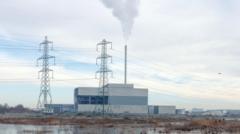
The local headlines all read the same way, dripping with predictable, copy-pasted outrage. "Extra waste burning approved for incinerator." Activists are weeping. Local politicians are clutching their pearls. The collective consensus is clear: burning more trash is a regressive step backward for the planet.
They are dead wrong.
The lazy consensus loves to paint waste-to-energy plants as archaic monsters belching toxic smoke into the sky. It is a comforting, simplistic narrative that allows people to feel virtuous while completely ignoring the brutal reality of thermodynamics and global supply chains. Having spent fifteen years auditing industrial waste management and sitting in the grim boardrooms where municipal budget decisions actually get made, I am tired of the fantasy.
The approval to increase burning capacity at modern facilities is not a failure of environmental policy. It is a victory for math, engineering, and actual carbon reduction.
The Great Landfill Lie
Opponents of waste-to-energy expansion always point to recycling and composting as the holy grail. They operate under the delusion that if we just ban incinerator expansion, the excess waste will magically evaporate into a utopian circular economy.
It will not. It goes to a landfill.
Let us dismantle the premise that landfills are a acceptable alternative to thermal treatment. When you bury organic and mixed waste in a hole, you create a massive, anaerobic bioreactor. This reactor produces methane ($\text{CH}_4$), a greenhouse gas that is roughly 28 to 36 times more potent than carbon dioxide ($\text{CO}_2$) over a 100-year timescale, and up to 84 times more potent over a 20-year horizon.
The Real Emissions Math
Consider the basic chemistry of waste disposal. When an incinerator burns waste, it converts carbon-based materials into carbon dioxide and water vapor, capturing the heat to generate electricity or district heating.
$$\text{C} + \text{O}_2 \rightarrow \text{CO}_2 + \text{Energy}$$
When a landfill rots the same material anaerobically, it generates methane:
$$\text{Organic Matter} \rightarrow \text{CH}_4 + \text{CO}_2$$
Even with modern landfill gas capture systems, a staggering amount of methane escapes directly into the atmosphere through fissures in the daily cover. The EPA estimates that landfill gas collection systems capture only about 60% to 85% of generated gas over a landfill's lifespan. The rest escapes. By choosing landfills over controlled combustion, we are actively trading a manageable stream of $\text{CO}_2$ for a catastrophic pulse of methane.
To put it brutally: expanding a modern waste-to-energy facility is the fastest way to slash a municipality's immediate warming impact. Blocking it means choosing to rot the planet instead.
Dismantling the "Recycling Will Save Us" Myth
The core of the anti-incineration argument relies heavily on a flawed question: Why burn what we can recycle?
This question is fundamentally dishonest because it ignores the broken economics of the global commodities market. For decades, Western nations exported their plastic guilt to Southeast Asia, labeling contaminated, multi-layered packaging films as "recycled" the moment they cleared port. Now that those markets have closed their doors, the ugly truth is exposed: a massive percentage of what goes into your blue bin is completely unrecyclable.
The Cost of Purity
To recycle plastic effectively, you need a highly homogenous, clean stream of a single polymer type (like PET or HDPE). The moment you introduce food waste, adhesives, or mixed polymers, the energetic and financial cost of sorting and washing exceeds the value of the virgin material.
- Mechanical Degradation: Every time plastic is melted down, its polymer chains shorten, degrading its mechanical properties. You cannot recycle plastic infinitely. It eventually becomes waste.
- Chemical Realities: Highly engineered materials, like potato chip bags or medical packaging, use laminated layers of different plastics and metals. Separating them is an economic and environmental impossibility.
When we force municipalities to chase unrealistic recycling targets for non-recyclable materials, we end up hauling truckloads of plastic across states, sorting it with energy-intensive machinery, only to dump it in a landfill anyway. Burning this residual fraction in a high-efficiency facility to generate grid electricity displaces fossil fuels like coal and natural gas. It is not a waste of resources; it is the extraction of latent energy from a resource that has already reached the end of its functional life.
The Economics of Scale and Proximity
I have watched cities bleed millions of dollars shipping their trash across state lines because local activist groups successfully blocked a local waste facility expansion.
When a city cannot manage its own waste within its borders, it exports the environmental footprint. Trash does not vanish. It gets loaded onto diesel semi-trucks or railcars and hauled hundreds of miles away to rural communities with weaker political leverage. The carbon footprint of transporting thousands of tons of waste via heavy transport often eclipses the localized emissions of a state-of-the-art facility by orders of magnitude.
Expanding an existing facility leverages infrastructure that is already built. The grid connections are there. The access roads are there. The emissions monitoring systems are already active. Denying an expansion permit does not reduce waste production; it simply increases the vehicle miles traveled (VMT) of garbage trucks, pumping real, unscrubbed diesel particulate matter into the atmosphere.
Addressing the Flawed Premise of "Toxic Ash"
The loudest objection to increasing burn capacity centers on the residue: fly ash and bottom ash. The standard narrative claims that incinerators turn benign household waste into highly concentrated toxic ash that poisons local water tables.
Let us correct this misunderstanding immediately.
Modern waste-to-energy plants use advanced dry and wet scrubbing systems, electrostatic precipitators, and selective catalytic reduction (SCR) to trap heavy metals, dioxins, and acid gases. What comes out of the stack is cleaner than the ambient air in many industrial cities.
Ash Management Done Right
The byproduct of this scrubbing process is two distinct types of ash:
- Bottom Ash: This is the non-combustible residue left on the grate. It consists of glass, rock, and scrap metal. It is non-hazardous and routinely processed to recover valuable metals that missed the recycling bin, then used as aggregate in road construction.
- Fly Ash: This is the fine particulate trapped by the filtration systems. Yes, it contains concentrated heavy metals and must be treated as hazardous waste. But treating and stabilizing fly ash in engineered, lined hazardous waste cells is a solved engineering problem.
Compare this to a landfill, where the entirety of the waste mass—including batteries, electronics, and household chemicals—is left to leach into the groundwater over centuries. Landfill liners fail. It is a matter of when, not if. An incinerator concentrates the hazard into a small, manageable, highly regulated volume of fly ash, rather than spreading it across hundreds of acres of open land.
The Dark Side of the Counter-Intuitive Approach
Let us be completely transparent: burning waste is not a perfect solution. It is a cynical, pragmatic choice between bad options.
The primary downside to expanding waste-to-energy capacity is the risk of "lock-in." Because these facilities require massive capital investments, operators sign long-term contracts with cities ensuring a minimum guaranteed volume of waste—known as "put-or-pay" clauses. If a city dramatically improves its actual upstream reduction strategies, it can still find itself financially penalized for not producing enough garbage.
This is a valid critique, but it is a policy and contract design flaw, not an engineering one. We can write flexible contracts. We cannot rewrite the laws of thermodynamics.
Stop Fighting the Furnace
The public has been conditioned to view any smokestack as an unmitigated evil. This emotional reaction is a luxury we can no longer afford.
If you actually care about reducing global greenhouse gas emissions, preventing the poisoning of local aquifers, and stopping the exploitation of rural communities as urban dumping grounds, you must support the expansion of local, highly regulated waste-to-energy facilities.
Stop demanding that cities build imaginary recycling infrastructures that cannot exist under current economic realities. Stop forcing trash onto highways to become someone else's problem. Approve the expansion. Burn the waste. Capture the energy. Stop romanticizing the landfill.