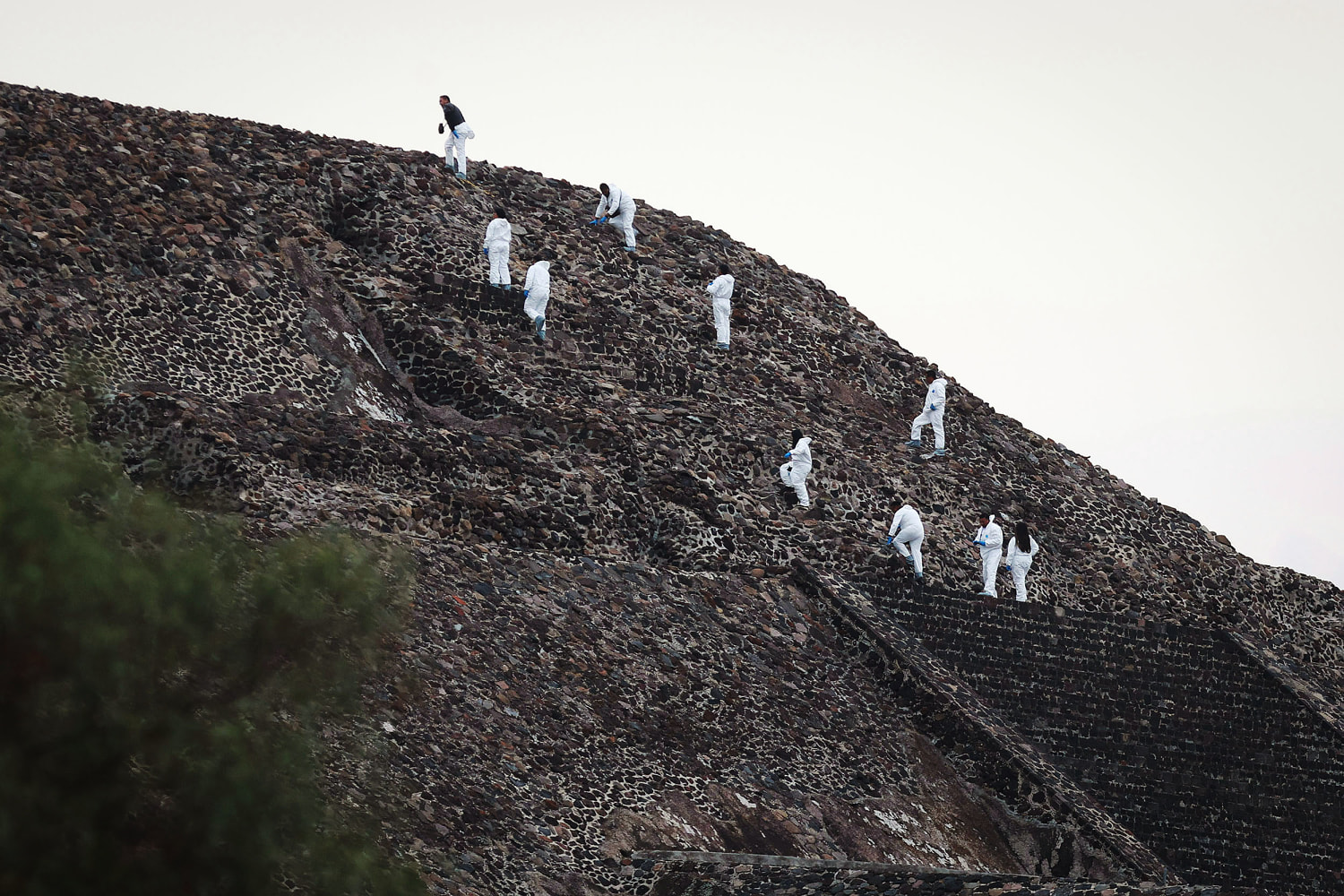
The gunfire erupted just as the afternoon light hit the Temple of the Feathered Serpent. What was supposed to be a pilgrimage to the cradle of Mesoamerican civilization, the ancient city of Teotihuacán, turned into a frantic scramble for cover behind volcanic stone walls. On the ground, the reality is stark. A site that once represented the architectural zenith of the Americas is now the backdrop for the escalating friction between Mexican security forces and the criminal cartels that increasingly operate without borders. While initial reports focused on the immediate panic of the tourists, the deeper story lies in the complete erosion of the "safe zone" status historically granted to Mexico’s primary archaeological treasures.
For decades, there was an unwritten rule in the underworld. You don't touch the ruins. You don't target the golden goose of the tourism sector because the federal response would be too expensive for business. That rule has vanished. The recent violence at these historic sites is not a series of isolated accidents or "wrong place, wrong time" scenarios. It is the result of a deliberate expansion of territorial control by regional syndicates into the lucrative corridors of the State of Mexico and beyond.
The Myth of the Tourism Bubble
Governments and travel agencies work hard to maintain the illusion of the "tourism bubble." This is the idea that as long as you stay within the confines of designated historical zones or high-end resorts, the surrounding instability won't touch you. It is a lie. The infrastructure that brings a traveler to a pyramid—the roads, the local transport, the vendors, and the nearby towns—is the same infrastructure used for the movement of illicit goods.
When a shooting occurs at a major site like Teotihuacán or near the Mayan ruins in the south, the official narrative usually pivots to "targeted attacks between rival groups." This is designed to reassure the international public that they are not the targets. However, the ballistic reality of a high-caliber rifle doesn't care about your passport. When a firefight breaks out in a crowded plaza, the distinction between a "targeted hit" and a "public massacre" becomes a matter of centimeters.
The logic of the cartels has shifted from avoiding the spotlight to owning it. By operating in or near high-profile landmarks, these groups signal to the government and their rivals that no territory is sacred. They are testing the limits of the state's resolve, and so far, the state is failing the test.
A Failed Security Architecture
The presence of the National Guard at Mexico’s historical sites has become a permanent fixture, yet their effectiveness remains questionable. You can see them everywhere: standing in the shade of the Sun Pyramid, clutching rifles, wearing tactical gear in the sweltering heat. But their role is largely performative. They are there to provide the appearance of safety, a visual sedative for the thousands of foreigners pouring off tour buses every morning.
The problem is structural. These security forces are often reactive rather than proactive. They are trained for military engagement, not for the nuanced protection of a high-density civilian area filled with ancient, fragile monuments. When the shooting starts, their primary objective is to survive and neutralize, which often leads to crossfire in areas where cover is minimal and the crowd density is high.
The Intelligence Gap
The failure isn't just about manpower; it’s about a lack of localized intelligence. The groups moving into the regions surrounding the archaeological zones are not outsiders. They are integrated into the local economy. They own the trucking companies, the small shops, and sometimes even the stalls selling trinkets to travelers. This integration makes it nearly impossible for federal forces to root out the rot without dismantling the entire local economy.
For the traveler, this means that the person selling you a bottle of water might be the lookout for the group that will cause a lockdown an hour later. It is a cynical way to view a vacation, but it is the only way to view the current security environment in the State of Mexico with any degree of accuracy.
The Economic Blackmail of Archaeological Sites
Tourism is Mexico’s third-largest source of legal foreign exchange. The government is effectively held hostage by this fact. If they admit the full scale of the danger at Teotihuacán, Chichén Itzá, or Tulum, the economic fallout would be catastrophic. This leads to a cycle of minimization.
Every time a violent incident occurs, official statements emphasize that the site remains open and that security has been "reinforced." Reinforcement usually means adding more soldiers for two weeks until the news cycle moves on. This is not a strategy; it is a PR exercise. The reality is that the cartels have figured out that the government is too afraid of losing tourism dollars to launch the kind of sustained, aggressive military campaign that would actually be required to clear these corridors.
The Changing Geography of Risk
Travelers used to be told to avoid specific states—Sinaloa, Tamaulipas, Michoacán. The advice was simple: stay on the beaten path and you’ll be fine. That path is now beaten by different players. The violence has bled into the "Heartland" of the country, the areas surrounding Mexico City that were long considered the safest parts of the interior.
The Teotihuacán valley is a prime example. Its proximity to the capital and its status as a UNESCO World Heritage site should make it the most protected square mile in the country. Instead, the surrounding municipalities have seen a sharp rise in extortion, kidnapping, and turf wars. The pyramids are no longer an island of safety; they are a high-value target in a widening war.
High Stakes and Low Visibility
What we don't see in the headlines are the daily threats faced by the staff and archaeologists who work at these sites. They live in the communities where the cartels are the de facto law. When a shooting happens, they are the ones who have to go back to work the next day, knowing exactly who pulled the trigger and knowing that talking to the authorities is a death sentence.
The "terrifying moments" described by tourists are, for the locals, a permanent condition. The visitor leaves and takes their trauma back to a safe country. The site remains, and so does the pressure.
Why the Current Warnings Aren't Enough
The State Department’s travel advisories are often late to the party. They rely on reported crime statistics that are notoriously under-reported in Mexico due to a deep-seated distrust of the police. By the time a region is upgraded to a "Level 4: Do Not Travel," the local situation has usually been dire for months or years.
Travelers need to look past the bureaucratic language. When a shooting occurs at a major site, it isn't a "security incident." It is a failure of the social contract. It means the government has lost the ability to guarantee the safety of its most prized assets.
The Logistics of Survival
If you are going to travel to these areas, the old rules of thumb are obsolete. It isn't enough to stay with a group. In fact, large groups are more difficult to move in an emergency. The priority has shifted to situational awareness and mobility.
- Avoid peak hours. Most major incidents occur when the crowds are thickest, providing cover for attackers to blend in and escape.
- Know the exits. This sounds paranoid until you are trapped in a narrow passage between two stone walls with no way out.
- Monitor local news, not just international media. Local Twitter (X) feeds and "Nota Roja" sites often report shootings and roadblocks hours before the official word gets out.
The romanticized version of Mexican travel—the idea of wandering through ruins and finding a deeper connection to the past—is being choked out by a brutal present. We are witnessing the "Acapulco-ization" of the country’s interior. Acapulco was once the jewel of the Pacific; now it is a cautionary tale of what happens when the state cedes control to the syndicates. The pyramids are the next frontier in this struggle.
The stones of Teotihuacán have seen centuries of blood, mostly from ritual sacrifice intended to keep the sun moving. Today, the blood being spilled is of a different sort, and the rituals are those of modern power, money, and a total disregard for the sanctity of history. The sun is still rising over the pyramids, but the shadow it casts is getting longer and darker every year.
Demand more than a "reinforced" security presence. Demand a transparent accounting of the risks involved in visiting these sites. Until the Mexican government prioritizes the safety of its visitors and citizens over the optics of its tourism industry, the next "terrifying moment" is already on the calendar.
Stop looking at the pyramids as relics of a dead civilization and start seeing them as the front lines of a very active, very modern conflict.