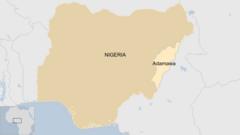
The recent massacre of at least 29 people in Borno State marks a grim milestone in West Africa’s deteriorating security situation. Islamic State West Africa Province (ISWAP) claimed the credit, but the dry headlines tell only a fraction of the story. While the world watches conflicts in the Middle East and Eastern Europe, the Lake Chad Basin has become a laboratory for a more resilient, more sophisticated form of insurgency. This wasn't just a random act of violence. It was a calculated demonstration of territorial control in a region where the state is increasingly absent.
The victims, mostly fishermen and farmers near the town of Dikwa, were executed with a clinical efficiency that has become the hallmark of ISWAP. Unlike the erratic, scorched-earth tactics of its predecessor, Boko Haram, ISWAP operates with a warped sense of quasi-governance. They tax locals. They provide a perverted form of "justice." When they kill, it is often a message to those who refuse to pay or those suspected of collaborating with the Nigerian military.
The Strategy Behind the Slaughter
To understand this attack, one must look at the geography of the insurgency. The Lake Chad region is a porous maze of marshes and islands. It provides perfect cover for a group that has successfully integrated itself into the local economy. ISWAP doesn’t want to rule a graveyard. They want a captive, productive population.
The execution of 29 people suggests a shift back toward high-visibility brutality. Security analysts suggest this may be a response to internal pressures or a need to reassert dominance over splinter factions. By killing civilians, the group forces the hand of the Nigerian government, dragging soldiers out of fortified bases and into ambushes. It is a cycle of provocation and reaction that the military has struggled to break for over a decade.
Beyond the Official Narrative
The Nigerian government often describes these incidents as the "dying gasps" of a defeated enemy. This rhetoric is dangerous. It ignores the reality that ISWAP has successfully professionalized its ranks. They use drones for surveillance. They have a sophisticated media wing that mirrors the high-production values of the central Islamic State nodes in Iraq and Syria.
The military's "Super Camp" strategy—where troops are concentrated in large, well-defended hubs—has left the rural population vulnerable. Between these camps lie vast "no-man's-lands" where the insurgents are the only authority. When a convoy of fishermen ventures out to earn a living, they are entering a space where the Nigerian flag carries no weight.
The Intelligence Gap
Human intelligence is the lifeblood of counter-insurgency. However, in Borno, that well has run dry. Villagers are caught in a pincer movement. If they report insurgent movements to the army, ISWAP kills them. If they don't, the army treats them as accomplices. This environment of total fear makes it nearly impossible for the state to anticipate attacks.
The 29 people killed in the latest raid were likely monitored for days before the strike. The insurgents knew when they would be there, what they were doing, and exactly how long it would take for reinforcements to arrive. They aren't hiding in the shadows; they are operating in broad daylight because they know the response will be too slow to matter.
The Failed Promise of Regional Cooperation
On paper, the Multinational Joint Task Force (MNJTF)—comprising troops from Nigeria, Niger, Chad, and Cameroon—should be the solution. In practice, it is a bureaucratic tangle. National interests often trump collective security. When Nigerian troops push insurgents toward the border, they frequently find that their neighbors are unwilling or unable to catch the spillover.
Chad was once the powerhouse of this coalition. However, internal political instability in N'Djamena has distracted their military leadership. Niger is dealing with its own coups and shifting alliances. This leaves Nigeria to shoulder a burden it is clearly ill-equipped to handle alone. The border areas have become a safe haven because the coordination required to seal them simply doesn't exist.
The Economic Engine of Insurgency
Follow the money. War is expensive, yet ISWAP remains well-funded. They don't rely solely on external donations. They have seized control of the lucrative dried fish and charcoal trades. They operate "checkpoints" that are essentially toll booths for traders moving goods across the Sahel.
By controlling the means of survival, the insurgents have made themselves a permanent fixture of the landscape. They offer a predictability that the state cannot match. If you pay the ISWAP tax, you are—relatively—safe. If you don't, you end up like the 29 victims near Dikwa. This isn't just a religious war; it’s a brutal form of racketeering.
The Human Cost of Apathy
Every time an attack like this happens, the international community issues a statement of condemnation. Then, the news cycle moves on. This apathy is a gift to the insurgents. It reinforces the idea that the lives of those in the Global South are disposable, providing a potent recruitment tool for those who feel abandoned by the world.
The displacement figures are staggering. Millions have been forced into camps that are often as dangerous as the villages they fled. These camps are breeding grounds for resentment. When the state provides nothing but a tent and a meager ration of grain, the insurgent's offer of "order" and "purpose" becomes an easier sell to a desperate young man with no future.
Equipment and Morale
Reports from the front lines suggest a widening gap in morale between the insurgents and the soldiers. While the Nigerian government spends billions on hardware—including Super Tucano aircraft from the United States—the ground troops often lack basic necessities.
Technological superiority is useless if you cannot hold ground. You can't win a guerrilla war from 30,000 feet. The insurgents are motivated by a mixture of ideology and survival. The soldiers are often tired, underpaid, and fighting a war that seems to have no end. When these two forces meet in the scrubland, the outcome is rarely determined by who has the better jet.
A Broken Feedback Loop
The lack of accountability within the Nigerian defense budget is a systemic rot. Money meant for ammunition and equipment frequently vanishes into the pockets of the political and military elite. This isn't a secret; it’s a tragedy that the Nigerian public discusses daily.
Until the corruption at the top is addressed, the blood on the ground will continue to flow. The 29 people killed this week are victims of ISWAP, yes, but they are also victims of a state that has failed in its most basic duty: the protection of its citizens. The insurgency is a symptom of a much deeper institutional collapse.
The Role of Technology in the Conflict
ISWAP has mastered the art of the "Technical"—pickup trucks with heavy machine guns mounted in the back. These vehicles provide the mobility needed to strike and disappear before the military can scramble air support. They have also started using improvised explosive devices (IEDs) with greater frequency, turning the few passable roads in the region into death traps.
They are using social media as a battlefield. Every attack is documented, edited, and blasted across Telegram and other encrypted channels. This creates an aura of invincibility. It frightens the population and demoralizes the security forces. The war for hearts and minds is being lost one viral execution video at a time.
The Illusion of Containment
There is a comforting fiction that this violence is contained to the Northeast. It isn't. The tactics used by ISWAP are being adopted by "bandits" in the Northwest and separatists in the Southeast. Nigeria is facing a multi-front security crisis where the lines between terrorism, organized crime, and political rebellion are blurring.
The attack near Dikwa is a warning. It shows that despite years of military operations, the insurgents can still gather in force, execute dozens of people, and vanish. They are not a "defeated" force. They are a transforming one.
The reality of the Lake Chad Basin is that the state is losing the war of attrition. Without a radical shift in how the government engages with its rural populations—providing actual security and economic alternatives to the insurgent tax—the death toll will only continue to climb. The 29 people lost in this latest attack won't be the last. They are simply the latest entries in a ledger of failure that the world continues to ignore. The insurgency has found its rhythm, and right now, no one in Abuja or the international community seems to know how to stop the music.



