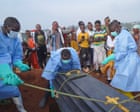
The global health apparatus is running its favorite playbook in the Democratic Republic of Congo, and it is a masterclass in performative crisis management.
The Director-General of the World Health Organization flies into the outbreak hub. Bureaucrats express deep concern. Neighboring countries panic and slam their borders shut. The international media prints terrifying headlines about climbing case counts.
Everyone feels like they are doing something. Everyone is wrong.
This reactive choreography does not stop viruses. It feeds them. Having spent years tracking public health supply chains and crisis responses across Sub-Saharan Africa, I have watched this exact cycle play out. We treat outbreaks as military invasions to be contained by borders and high-ranking visits, rather than what they actually are: predictable failures of local infrastructure and trust.
If we want to stop Ebola, we need to stop looking at the map and start looking at the ground.
The Myth of the Hard Border
When an outbreak hits, the immediate political reflex is to close borders. It looks strong. It satisfies a frightened public.
It is also public health suicide.
Viruses do not respect immigration checkpoints. When you close a legal, monitored border crossing, you do not stop people from moving. You simply force them into the bush. Instead of crossing at a designated point where health workers can check temperatures, isolate suspected cases, and track contacts, merchants and families use unmonitored footpaths.
The data proves this. During the 2014–2016 West Africa outbreak, mathematical modeling published in The Lancet Infectious Diseases demonstrated that border closures did not significantly delay the spread of the virus. Instead, they crippled the containment effort.
Consider the economic reality. In the border regions of the DRC, Uganda, and Rwanda, trade is not a luxury; it is survival. If a mother cannot cross the border legally to sell her vegetables, she will find an illegal way. Except now, she is hidden from the grid. If she falls ill, she will avoid formal health centers for fear of being penalized for illegal crossing.
Border closures do not lock the virus in. They lock the surveillance out.
The High Cost of VIP Public Health
There is a distinct theater to international aid. A high-profile tour by global health executives is designed to signal urgency and secure funding.
In reality, these visits drain local resources.
When a convoy of armored SUVs rolls into a remote Congolese town, the entire local health department grinds to a halt. The few competent doctors and administrators on the ground—the people who should be tracing contacts and managing isolation wards—are pulled away to brief executives, manage logistics, and pose for photographs.
"We spent three days preparing briefing documents for a delegation that stayed on the ground for exactly forty-five minutes," a regional health coordinator in North Kivu told me during a previous outbreak. "While we were printing reports, two contacts slipped out of our tracking network."
This top-heavy approach creates an immediate disconnect. The Geneva perspective views an outbreak as a logistical math problem: send $X$ amount of PPE, deploy $Y$ number of vaccines. But Ebola containment is not a logistics problem. It is an anthropological one.
The Institutional Blind Spot: Trust Over Tech
The conventional wisdom says that the solution to Ebola is faster diagnostics and newer vaccines. We have those now. The Ervebo vaccine is highly effective.
Yet, cases still climb. Why?
Because a vaccine is completely useless if the community believes you are using it to kill them.
Public health institutions consistently treat community resistance as ignorance. They assume that if they just explain the science louder, people will comply. This ignores the historical context. In many regions of the DRC, the population has suffered decades of state neglect, corruption, and violence. Suddenly, when a deadly virus appears, foreigners and government officials arrive in biohazard suits offering free injections.
Of course there is suspicion.
When the WHO and international partners prioritize top-down mandates over local partnerships, they spark backlash. During the 2018–2020 Eastern DRC outbreak, treatment centers were attacked because the local population felt excluded from the response and dehumanized by the protocols. Bodies were snatched from graves by relatives because international burial teams refused to accommodate sacred local funeral traditions.
If you want to stop the climbing case count, you do not need more international experts. You need to hire the local youth leaders, the traditional healers, and the market women. You need to pay them properly, equip them, and step out of the way.
Dismantling the Panic Economy
The current international health regulations incentivize the wrong behavior. We operate on a panic-and-neglect cycle.
[Outbreak Occurs] -> [Global Panic & Media Frenzy] -> [Emergency Funding Floods In] -> [Outbreak Ends] -> [Funding Evaporates & Infrastructure Decays]
When an outbreak hits the news, hundreds of millions of dollars flood the zone. This creates a perverse economy. International NGOs rush in to establish parallel systems rather than building up the existing ministry of health. They lease the best buildings, hire away the best local doctors by offering triple the government salary, and create a temporary bubble of excellence.
Then, the outbreak ends. The cameras leave. The funding dries up. The international NGOs pack up their Land Cruisers and go home.
The local health system is left weaker than it was before the outbreak. The local doctors have lost their government positions, the parallel clinics are abandoned, and the basic infrastructure remains broken. Until the next mutation jumps from an animal host, and the entire circus starts over.
The Flawed Questions We Keep Asking
Look at the standard inquiries driving the current narrative, and you can see exactly why the strategy is failing.
Should neighboring countries close their borders immediately to prevent transmission?
No. This is a political theater tactic that achieves the exact opposite of its intended goal. It drives migration underground, destroys local economies, disrupts the supply chain for medical countermeasures, and alienates the very communities needed for contact tracing.
Why are Ebola cases continuing to rise despite the availability of an effective vaccine?
Because vaccines require trust, not just refrigeration. If the deployment mechanism ignores local leadership, uses coercive tactics, or fails to address basic healthcare needs alongside Ebola treatment, the community will reject it. An unadministered vaccine has an efficacy rate of zero percent.
Is a visit from global health leaders necessary to mobilize the response?
Only to satisfy donors and secure press coverage. On the ground, these visits function as an operational tax, diverting scarce security, transport, and administrative resources away from frontline containment efforts.
Shift the Paradigm or Get Out of the Way
The harsh truth is that the current approach is built to sustain institutions, not eradicate pathogens. We are addicted to the crisis. It justifies budgets, fuels news cycles, and allows politicians to look decisive.
If we want a superior strategy, we must accept the downsides of decentralized control. It means international agencies must surrender their monopolies on funding. It means allowing local leaders to dictate response protocols, even if those protocols do not align perfectly with a bureaucratic manual written in Switzerland. It means investing in running water, basic roads, and reliable nursing salaries during the quiet years when there are no headlines to harvest.
Stop looking at the climbing numbers as an isolated security threat to be policed with border guards and high-level tours. The outbreak is a symptom. The system is the disease. Turn off the cameras, open the checkpoints, and fund the people who actually live there.