Sarah drives north on Interstate 5, her knuckles white on the steering wheel. She is not a smuggler. She is a fifty-two-year-old schoolteacher from Bellingham, Washington, with Type 2 diabetes and a bank account bled dry by American pharmacy counters. In the passenger seat sits an empty cooler. In her purse, a paper prescription.
Just two hours later, she walks out of a small pharmacy in British Columbia. Inside her cooler are three boxes of semaglutide. The total cost? About three hundred American dollars.
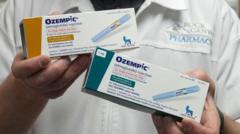
If Sarah had filled that same prescription back home, the receipt would have read $1,200. Same manufacturer. Same sleek, pre-filled plastic pens. Same clear liquid shifting inside the glass barrel.
This is the quiet geography of survival. A geographic lottery where crossing an invisible line in the dirt slashes the price of life-altering medication by seventy-five percent. But while thousands of Americans look to Canada as a safety valve for astronomical drug prices, a stranger anomaly has quietly emerged in the pharmacy aisles.
Canada now has access to a generic version of the world's most famous weight-loss and diabetes medication. The United States does not.
To understand why, we have to look past the shiny marketing campaigns and look deep into the gears of patent law, government mandates, and corporate chess. The difference isn't just about geography. It is about how two neighboring nations choose to value corporate innovation versus public health.
The Mirage of the Miracle Drug
Every week, millions of people watch television commercials bathed in soft, optimistic lighting, showcasing vibrant people living their best lives. They are told to ask their doctors about semaglutide. What the commercials omit is the quiet panic at the cash register.
For an American uninsured patient, or someone whose high-deductible insurance plan denies coverage for weight loss, the price tag is a wall. It is a monthly mortgage payment. It is a choice between retirement savings and metabolic health.
When a drug becomes a cultural phenomenon, we expect the free market to do what it always does: compete. In a normal market, high demand breeds alternatives. Cheaper options emerge. Prices fall.
But medicine is not a normal market. It is an artificial construct protected by walls of paper.
Consider a hypothetical pharmacy shelf. In the US, that shelf holds only the brand-name pens, locked behind a premium price point guaranteed by federal law until at least 2032. In Canada, that same shelf now features a generic alternative, manufactured by a local laboratory, costing a fraction of the price.
How did two countries with deeply integrated economies end up on completely different planets regarding the same chemical compound?
The Fortress of the American Patent
To understand the American gridlock, we must understand the concept of the patent thicket.
When a pharmaceutical company invents a breakthrough molecule, society offers a deal. The company receives a monopoly for a set period—usually twenty years from the date of filing—to recoup their massive research and development costs and turn a profit. After that, the recipe becomes public domain, generics enter the market, and prices plummet.
That is the theory. The reality is far more predatory.
American patent law allows companies to file secondary patents on almost every aspect of a drug. They patent the specific dosage. They patent the mechanism of the injection pen. They patent the formulation's stability at room temperature. They patent the manufacturing process.
By layering these patents like shingles on a roof, companies create an impenetrable fortress. A generic manufacturer might successfully duplicate the molecule, but they cannot ship it because they would violate the patent on the plastic clicker at the top of the pen.
This strategy effectively extends monopolies for decades past the original expiration date. In the US, the core patent for semaglutide is fiercely guarded. Any generic manufacturer attempting to launch a bio-equivalent version faces immediate, crippling litigation from an army of corporate lawyers. The American legal system rewards the fortress.
The Canadian Practicality
Now, look across the northern border. Canada’s legal and regulatory landscape handles intellectual property with a radically different philosophy.
Canada operates under a legal framework that treats healthcare as a public good rather than a pure market commodity. While Canada respects international patent laws, its courts and regulatory bodies are historically less tolerant of "evergreening"—the practice of tweaking a drug slightly just to extend a monopoly.
More importantly, Canada possesses a unique regulatory body called the Patented Medicine Prices Review Board. This entity places a hard cap on what pharmaceutical companies can charge for patented drugs, benchmarking Canadian prices against other developed nations. Right from the start, the financial incentive to hoard a monopoly in Canada is lower than it is in the unrestrained American market.
But the real catalyst for Canada’s generic breakthrough lies in a specific legal mechanism: the summary judgment on patent utility and infringement.
Canadian courts allow generic drug manufacturers to challenge weak or secondary patents much more swiftly than American courts do. If a Canadian generic company can prove that a secondary patent—such as the design of the delivery pen—does not represent a truly novel invention, the court can invalidate that specific barrier.
This is precisely what paved the way. A Canadian generic manufacturer identified a vulnerability in the secondary patent armor. They didn't just look at the molecule; they looked at the legal loopholes. They successfully argued that certain delivery mechanisms or formulations did not warrant absolute monopoly protection under Canadian law.
The result? Health Canada approved a generic version of the semaglutide injection. The fortress collapsed because the Canadian legal system refused to give it a foundation.
The Wild West of Compound Pharmacies
Because legitimate, FDA-approved generics are blocked in the United States, a massive, unregulated gray market has rushed to fill the vacuum. Walk into almost any med-spa or click on a digital health popup ad, and you will see offers for "compounded semaglutide" at a deep discount.
It sounds like a generic. It is priced like a generic. But it is fundamentally different.
To understand the difference, imagine a bakery. An approved generic drug is like a loaf of bread baked in a massive, highly regulated commercial facility. Every ingredient is measured by machines to the microgram, tested for contaminants, and stamped with a government seal of approval.
A compounded drug is like a loaf of bread baked in a local kitchen.
Compounding pharmacies are legally permitted to mix custom medications when a drug is on an official shortage list. However, they do not undergo the rigorous, multi-year clinical trials required for true generic approval. They source their raw chemical powders from various global suppliers, some of which are unregulated. The FDA does not review these compounded formulations for safety or effectiveness before they hit the market.
Americans are injecting these gray-market mixtures into their bodies every single day. They aren't doing it because they prefer unregulated medicine. They are doing it because the legal system has denied them a safe, affordable, regulated generic alternative.
They are gambling with their health because their wallets have already lost.
The Human Toll of Policy
We often discuss these realities in the abstract language of economics. We talk about profit margins, intellectual property frameworks, and regulatory capture. But these sterile phrases mask a profound human toll.
Consider what happens when a life-saving class of medication is priced out of reach. It is the grandfather who cuts his doses in half to make the prescription last through the winter, unaware that he is rendering the medication useless. It is the mother who watches her blood sugar creep upward, knowing the solution exists just beyond her financial reach.
The contrast between Bellingham and British Columbia is not just a quirk of economics. It is a reflection of national priorities.
One system prioritizes the maximization of return on intellectual property, betting that high profits will fuel the next generation of medical breakthroughs. The other system prioritizes access, betting that a society is healthier when its citizens can actually afford the medicine discovered today.
Sarah packs her cooler with ice packs for the two-hour drive back down the interstate. She will cross the border, show her passport, and return to her classroom. She will feel a sense of relief, but also a simmering undercurrent of anger.
She shouldn't have to be a health tourist. She shouldn't have to navigate international border crossings just to secure a standard medical treatment.
As her car crosses back into Washington State, the digital billboard on the highway flashes an advertisement for a local medical spa offering discounted, compounded weight-loss shots. The American medical landscape remains fragmented, expensive, and desperate, while just a few miles north, the first boxes of safe, affordable generic semaglutide are quietly being stacked onto pharmacy shelves.