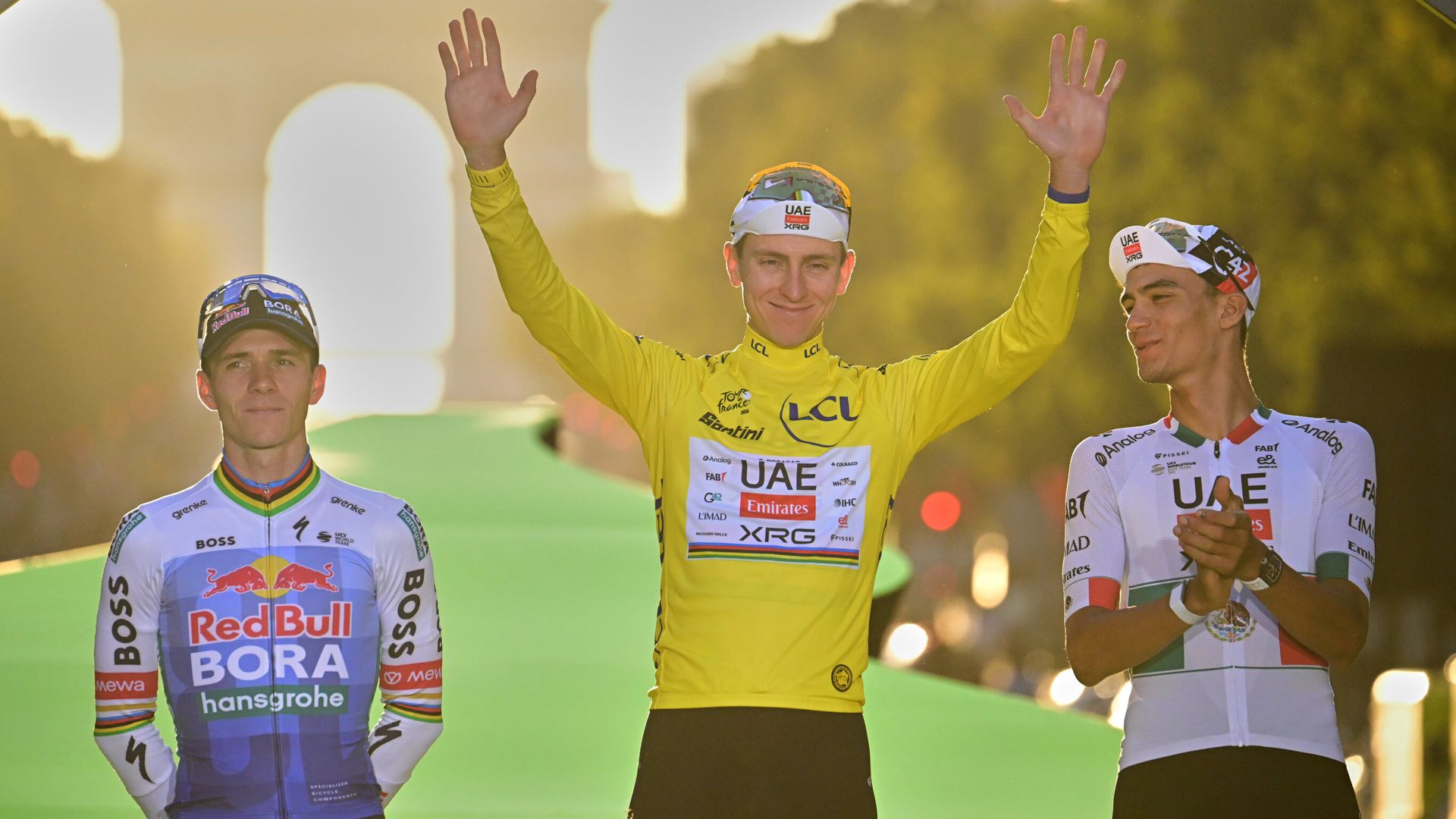
The air at the summit of the Tour de France is thin, smelling faintly of heated rubber, dry pine, and the damp wool of thousands of rain-soaked jerseys. It is an altitude where oxygen is scarce and legends are forged. When Tadej Pogacar crossed the finish line to secure his fifth yellow jersey, the celebration on the Champs-Élysées was not merely a coronation. It was an inventory of exhaustion.
To understand what it means to win five Tours de France, you have to stand on the side of the Col de la Madone on a Tuesday in April when the mist is clinging to the asphalt like a damp shroud. You have to watch a rider descend at eighty kilometers per hour, their knuckles white, calculating the friction of tire against wet grit with the cold precision of a surgeon. Cycling is often mistaken for a cardiovascular test, a grueling exercise in lung capacity and wattage thresholds. That is a lie told by computers. Cycling is a psychological endurance trial. It is an arena where twenty-one days of suffering are compressed into three weeks of frantic, beautiful geometry.
Pogacar does not look like a conqueror when you see him away from the podium. He looks like a student who skipped a chemistry lecture to go ride his bike. His shoulders are narrow, his smile quick and slightly crooked, his skin browned by months of Mediterranean sun. Yet beneath that boyish exterior lies a competitor who treats pain not as a warning sign, but as a negotiation.
Let us return to the Pyrenees, deep into the second week of the tour. The heat is radiating off the tarmac in shimmering waves that distort the horizon. The peloton is a jagged, breathing organism, stretching and snapping like a rubber band under tension. In the sports car trailing the lead group, a team directeur sportif is gripping the radio microphone so tightly his knuckles are bleached. He is watching the data feed. Heart rate: 185 beats per minute. Power output: 450 watts sustained on a twelve percent gradient.
"He is going too early," a veteran mechanic mutters, wiping grease from his thumb with a rag. He has seen champions burn themselves to ash on these very slopes.
But Pogacar is not looking at the data. He is looking at the bend in the road ahead.
This is the invisible architecture of his dominance. While his rivals calculate watts, kilograms, and nutritional intake down to the single gram—a modern sport science obsession that has turned the peloton into a fleet of human calculators—Pogacar races by instinct. He attacks because the silence of the pack bores him. He accelerates because he wants to know if the men behind him are willing to hurt as much as he is.
History does not hand out five yellow jerseys to the cautious. Before this moment, the pantheon of riders who had conquered the French grand tour five times was an exclusive club of titans. Jacques Anquetil, Eddy Merckx, Bernard Hinault, Miguel Indurain. Names that sound like ancient kings carved into granite. When you mention them in a French cafe, older men lower their voices, remembering the eras of titanium frames, leather hairnets, and roads lined with tobacco smoke and shouting peasants.
To join them required stepping across a generational divide. The modern peloton is faster, leaner, and more scientifically optimized than anything Merckx ever faced. Nutritional scientists monitor blood glucose in real-time. Aerodynamicists wind-tunnel test socks. Every calorie is accounted for, every gram of drag eliminated. In this hyper-controlled environment, dominating five times is statistically improbable. It requires surviving crashes, crosswinds in the plains of Flanders, high-altitude mountain passes where snow flurries blind the cameras, and the microscopic margins of modern doping controls and biological passports.
Consider the physical toll. A Grand Tour strips the human body down to its barest components. Over three weeks, a rider burns roughly 120,000 calories. They lose muscle mass in their upper bodies. Their immune systems crash, leaving them vulnerable to the subtle viruses circulating through team hotels. By the third week, every tendon screams, every saddle sore feels like an open flame, and the mere act of standing up in the morning requires a mental grit that defies biology.
Yet, watch Pogacar on the podium after a brutal mountain stage. He takes a sip of warm champagne, sprays the crowd with a grin that stretches from ear to ear, and signs autographs for children who were not even born when he won his first title.
There is a lightness to him that confounds his rivals. The great champions of the past—Hinault with his cold, unyielding stare, Merckx with his insatiable cannibalistic hunger—often looked crushed by the weight of their own ambition. They rode with fury. Pogacar rides with joy. It is a terrifying combination. Joy makes a rider reckless. Joy makes a champion attack on a descent when a conservative rider would tuck in and protect a lead.
That joy was forged in the small Slovenian town of Komenda, far from the cycling powerhouses of France, Italy, and Belgium. There were no velodromes in his backyard, no grand institutional backing when he was a boy chasing his older brother down gravel tracks. There was only an old bike, rough roads, and an endless curiosity about how fast a human being could move under his own power.
That childhood curiosity has evolved into a tactical ruthlessness. During the crucial mountain stages of this record-breaking tour, his rivals tried to isolate him. They set a brutal tempo at the base of the final climb, shedding his teammates one by one until he was alone in a sea of rival jerseys. A lesser rider would have folded, calculating the numbers, waiting for a teammate to bridge the gap.
Pogacar simply smiled, shifted into a heavier gear, and launched an acceleration that tore the race to ribbons.
It was not a move born of software or algorithmic pacing. It was pure theater. He left the trailing camera motorcycles struggling to keep pace, their engines whining in protest as the Slovenian rider vanished into the mist of the high Alpine pines. Behind him, hardened professionals slumped over their handlebars, their eyes fixed on their stems, praying for the summit to arrive.
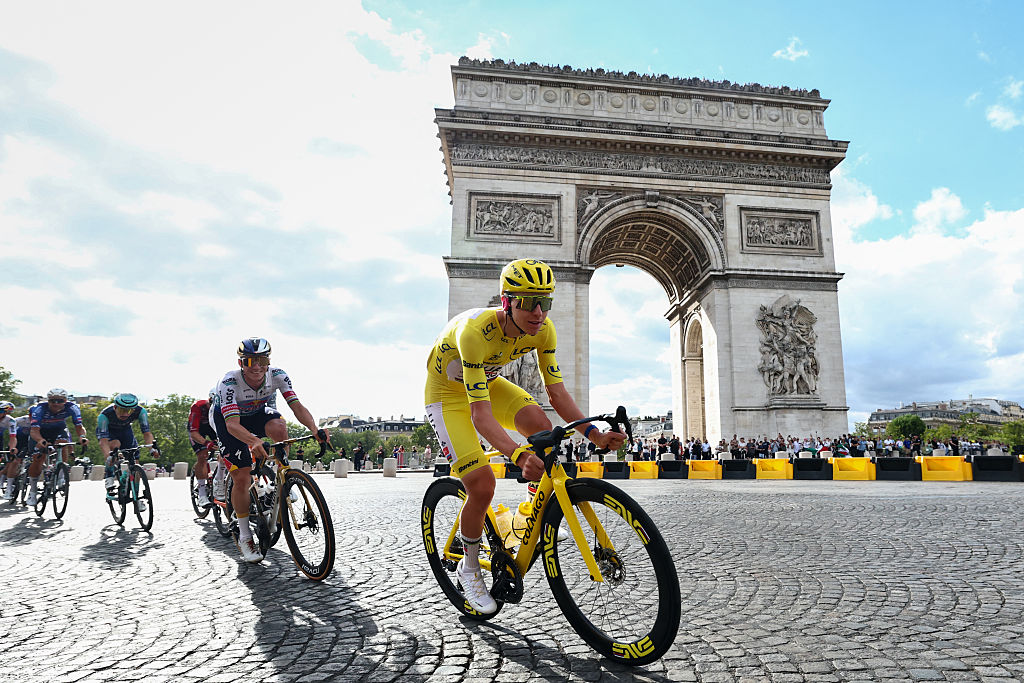
When the final stage concluded on the Parisian avenue, beneath the shadow of the Arc de Triomphe, the statistical reality settled over the press corps like falling snow. Five titles. He sits alongside the immortals now. But numbers fail to capture the texture of the achievement. They do not measure the sound of breathing echoing inside a carbon fiber helmet at 2,000 meters altitude. They do not capture the split-second decision to risk everything on a wet hairpin turn with thirty kilometers left to race.
The crowd dispersed as dusk settled over the Seine, streetlights flickering to life along the grand boulevards. The barriers were dismantled, the podium disassembled, the team buses packed with wheels, frames, and bruised bodies. Tomorrow, the cycling world will begin preparing for the next season, analyzing the new routes, measuring the next generation of phenoms waiting in the wings.
Upstairs in a quiet hotel room overlooking the city, Tadej Pogacar sits with his legs elevated against the wall, an ice pack strapped to his knee. He is scrolling idly through his phone, perhaps looking at a video of a local climb back home in Slovenia. The jersey hangs on a chair nearby, a bright banner of yellow fabric catching the dim light of a bedside lamp. He has conquered the mountain five times over, etching his name into the bedrock of sport history. And yet, looking at him, you get the distinct impression he is already wondering what lies just beyond the next ridge.