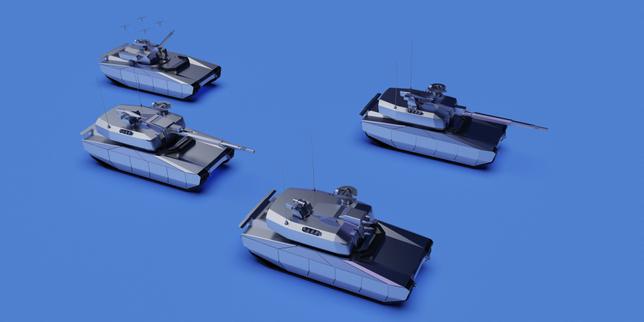
The Fracture Inside European Armored Warfare
Military modernization programs rarely die in public disputes over specifications or ballistic requirements. They wither in procurement offices, fractured by industrial rivalry, divergent national doctrines, and the quiet realization that shared ambitions rarely survive the collision with sovereign defense budgets. The Main Ground Combat System, known across defense circles as the MGCS, was supposed to anchor the future of European armored warfare. Conceived as a technological leap beyond contemporary platforms like the Leopard 2 and the Leclerc, the program aimed to deliver a networked, multi-vehicle combat system capable of dominating the future battlefield.
Instead, the initiative is caught in an accelerating cycle of mistrust. French military planners and industrial stakeholders have watched with growing alarm as Berlin recalibrates its defense priorities, pursuing parallel tracks and signaling a willingness to look elsewhere for heavy armor solutions. The official communiques speak of ongoing alignment, but the reality on the ground points toward a slow-motion unraveling. When strategic trust erodes between Paris and Berlin, the consequences ripple across the entire continent's defense architecture, leaving policymakers to question whether joint European military production is fundamentally incompatible with national industrial protectionism.
The friction is not accidental. It stems from conflicting industrial footprints, divergent export controls, and deeply entrenched institutional cultures. France approaches defense procurement through the lens of strategic autonomy, demanding systems that can be deployed independently anywhere in the world without third-party licensing hurdles. Germany operates within a multilateral framework dictated by strict constitutional export restrictions and a procurement machinery heavily influenced by domestic industrial giants. When these two philosophies attempt to build a next-generation combat platform together, every design compromise becomes a political battleground.
The Industrial Divergence Behind the Stalled Programs
To understand why the MGCS program is faltering, one must examine the uneasy marriage between KNDS, the holding company formed by Krauss-Maffei Wegmann and Nexter, and the broader political machinery of both nations. The initial division of labor was designed to balance engineering prowess and workshare equity. One nation would take the lead on the turret, the other on the chassis. Yet, as technological requirements shifted toward active protection systems, artificial intelligence integration, and high-frequency sensor fusion, those rigid workshare boundaries began to choke innovation.
Germany's parallel moves have done little to reassure its partners. The introduction and continuous industrial promotion of upgraded transitional platforms, combined with shifting procurement timelines, suggest that Berlin is hedging its bets against the success of the binational framework. From the perspective of French military leadership, these maneuvers look less like pragmatic risk management and more like a deliberate erosion of the shared commitment.
Procurement timelines tell the story with brutal clarity. While original projections placed the operational deployment of the new combat system in the mid-2030s, current industrial hurdles suggest that date is slipping further into the future. Modern land warfare is evolving at a pace dictated by electronic warfare and unmanned aerial systems, rendering heavy armor design cycles that span decades increasingly obsolete. By the time a committee-designed compromise rolls off the production line, the threat matrix it was engineered to defeat will have fundamentally transformed.
The Strategic Cost of Disunity on the Continent
Europe cannot afford a fractured defense industrial base. The return of high-intensity conventional conflict to the eastern edge of the continent exposed the fragility of continental stockpiles and the lack of industrial surge capacity. Armored brigades require heavy logistics, standardized ammunition, and interoperable maintenance chains. If the two largest military powers within the European Union cannot even agree on how to build a shared tank, the broader ambition of a credible European defense pillar remains an illusion.
The debate goes far beyond heavy steel and smoothbore cannons. It touches on the fundamental question of who controls the intellectual property and software architecture of future combat vehicles. Software-defined defense systems represent the core of future battlefield dominance. Whoever writes the algorithms for target acquisition, threat prioritization, and decentralized network communication controls the capability. Neither Paris nor Berlin is willing to cede ground in this domain, resulting in institutional gridlock.
Smaller European nations watch this diplomatic and industrial sparring with mounting frustration. States along the eastern flank, needing immediate deterrence against pressing threats, are purchasing off-the-shelf platforms from non-European suppliers or turning to existing German inventory to plug immediate capability gaps. Every month that the joint program stalls, the market for European land systems shrinks, replaced by imports that permanently weaken domestic industrial competence.
The Reality of Sovereign Defense Priorities
Sovereignty remains the ultimate ceiling for multinational defense projects. When economic pressures mount, national governments inevitably pivot toward protecting domestic jobs, research grants, and manufacturing capabilities. The rhetoric of European integration dissolves the moment a defense minister has to explain to domestic voters why specialized manufacturing contracts were outsourced across the border.
The path forward requires an honest reckoning. If joint development programs continue to serve as proxies for industrial protectionism, they will continue to fail. A functional approach demands clear centralized authority, ruthless prioritization of technological capability over workshare distribution, and a willingness to accept that not every domestic manufacturer can play a primary role in every major program.
The defense industrial landscape of the coming decades will not reward compromise engineered by committee. It will favor nations and coalitions capable of rapid innovation, agile prototyping, and unhesitating execution. As the window for modernizing continental armored forces narrows, the diplomatic friction surrounding the heavy armor initiative serves as a warning sign for every other collaborative defense project on the drafting board. The machinery of European defense integration is grinding against the unyielding rock of national self-interest, and the sparks are flying visible to all.