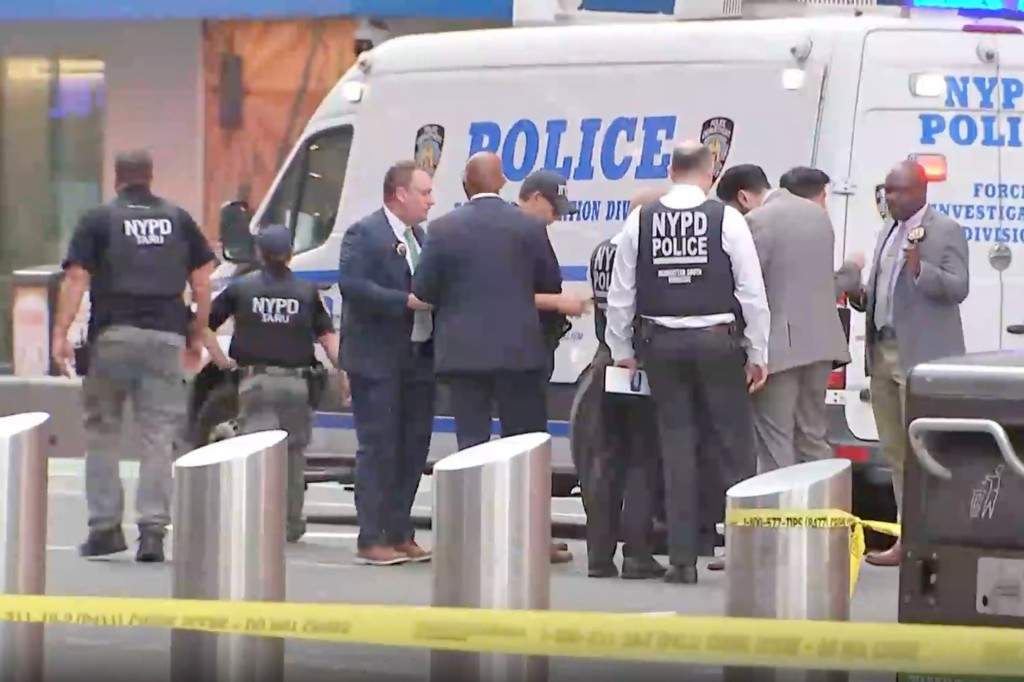
Erin Piacenti went to Midtown Manhattan like thousands of corporate professionals on any ordinary Monday, only to have her life stolen in a frantic twenty-second window at the crossroads of the world. The thirty-two-year-old Bank of America vice president was cut down near West 42nd Street and Seventh Avenue by an assailant wielding two kitchen knives pulled from a red Target bag. The attacker, 49-year-old Pamela Cisneros, also stabbed a 68-year-old man before police officers confronted her, deployed a Taser that failed to connect effectively, and ultimately shot her dead after she advanced with explicit threats.
This brutal sequence exposes a systemic fracture in urban safety that goes far beyond a single tragic headline. Commuters and corporate executives walk past armed volatility every day, operating under the fragile assumption that heavy tourist foot traffic equals security.
The Anatomy of a Twenty-Second Attack
The timeline established by the New York Police Department reveals terrifying operational speed. At approximately 4:30 p.m., Cisneros targeted her first victim near West 41st Street, stabbing the man in the abdomen as he stood near a crosswalk with his wife. Within seconds, she surged north up Seventh Avenue toward 42nd Street, zeroing in on Piacenti.
There was no argument, no prior exchange, and no connection between the victims and the assailant. It was entirely random.
Police officers stationed in the heavily monitored Midtown hub responded quickly, engaging Cisneros for roughly four minutes. Witnesses and officials noted that she refused to drop the weapons, shouting threats directly at the responding detail before charging forward. When a Taser failed to halt her advance, officers discharged their firearms. While law enforcement action prevented further bloodshed, the intervention occurred after irreversible damage had already been dealt.
Systemic Failures in Mental Health Interventions
Public officials were quick to point out that Cisneros possessed a documented mental health history with the police department dating back to 2018 and 2019. That disclosure is the most damning indictment of the entire episode. A documented history implies repeated touchpoints with municipal institutions, yet the individual remained on the streets, armed with dual kitchen knives, capable of executing a lethal rampage in broad daylight.
When acute psychiatric crises go unmanaged, public spaces become default holding facilities for society's most vulnerable and dangerous failures. Current intervention frameworks rely heavily on reactive policing rather than proactive clinical containment. Street-level mental health teams are chronically understaffed, and involuntary commitment laws remain legally narrow, prioritizing civil liberties up to the exact moment a knife pierces flesh.
The human cost of this legal and institutional paralysis falls on innocent commuters. Piacenti worked in business selection and conflicts for a major financial institution, navigating high-stakes corporate risk management daily. No amount of corporate risk mitigation, however, prepares an individual for the breakdown of civic order on a public sidewalk.
The Illusion of Urban Fortification
Times Square represents the most heavily policed square mileage in the Western Hemisphere. Surveillance cameras blanket every storefront, private security guards monitor corporate towers like Bank of America’s nearby One Bryant Park, and uniformed officers are a constant fixture.
Yet deterrence fails when an assailant acts entirely divorced from rational calculation. Surveillance cameras record murders; they do not intercept blades.
Corporate leaders frequently debate return-to-office mandates, weighing productivity metrics against employee preferences. Rarely do these boardroom calculations factor in the baseline hazard of urban transit and pedestrian commutes. Employees are expected to plug into high-performance cultures while navigating municipal infrastructure where social safety nets have completely unraveled.
The public discourse following such incidents invariably loops through predictable cycles. Pledges of increased patrols are issued, political figures praise the swift response of first responders, and urban analysts debate procedural tweaks. None of these measures address the core rot of untreated psychiatric deterioration festering in plain sight across American metropolitan centers.
Piacenti’s life was reduced to a statistical data point in a municipal crime report over the course of twenty seconds. Until cities confront the structural realities of chronic mental illness and abandon the comforting fiction that police presence alone constitutes public safety, the crossroads of the world will remain a place where routine commutes end in arbitrary slaughter.

