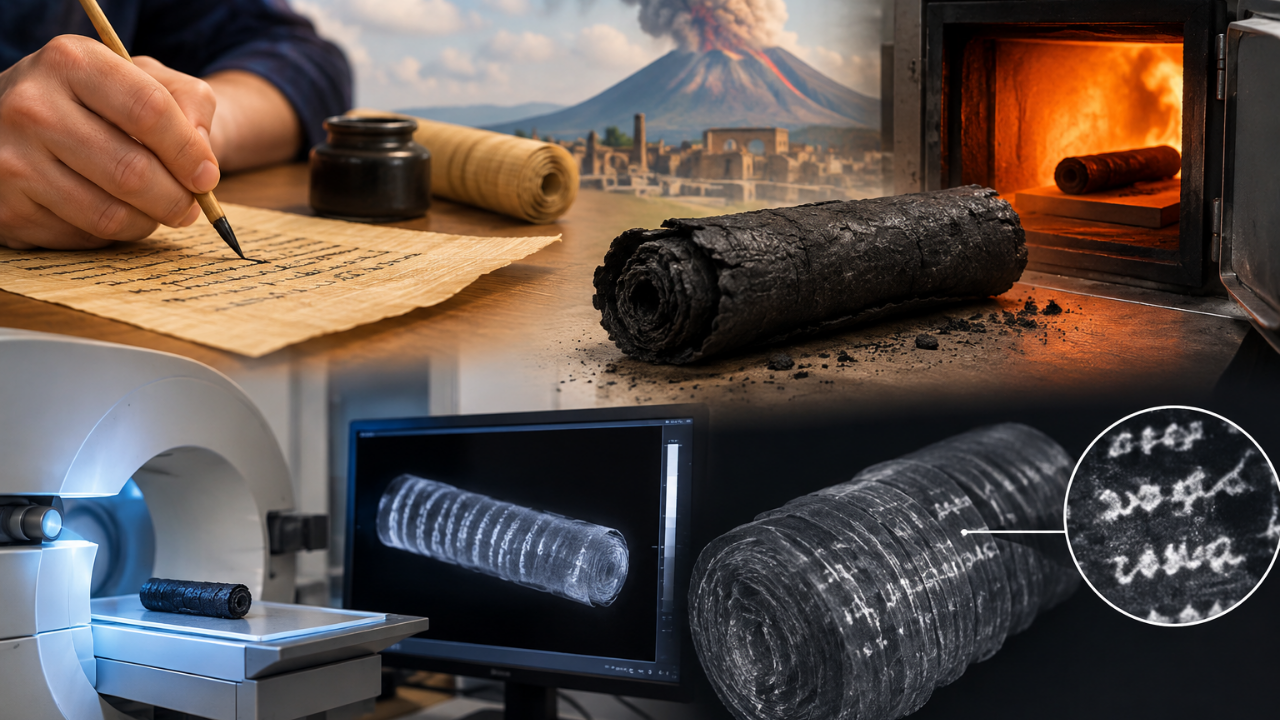
For centuries, the most frustrating library on Earth has sat silent beneath volcanic rock. When Mount Vesuvius erupted in 79 C.E., it did not merely bury the ancient Roman resort town of Herculaneum; it flash-carbonized an entire elite residential collection known as the Villa of the Papyri. The resulting artifacts look less like books and more like charred lumps of firewood. To pry them open by hand is to turn invaluable classical philosophy into black dust.
Yet a stubborn cohort of physicists, chemists, and experimental archaeologists has refused to accept this historical blackout. Led by researcher Douglas Seiler alongside academic partners, a team recently took a radical approach to solving the digital imaging crisis plaguing classical studies. They built modern replicas of ancient scrolls, had students write on them, and intentionally baked them to a crisp in low-oxygen chambers. If you enjoyed this post, you should read: this related article.
The objective was straightforward. They needed to discover why standard X-ray imaging struggles so profoundly with ancient carbonized text, and how a specific chemical anomaly might change everything.
The Core Problem of Carbon on Carbon
To understand why thousands of Herculaneum scrolls remain unread, one must understand the frustrating chemistry of the ancient writing surface. Traditional papyrus is made from the pith of the Cyperus papyrus plant, woven into sheets and dried. The ink used by Greco-Roman scribes was typically lampblack—essentially carbon soot mixed with a binder like gum arabic. For another look on this event, see the latest update from Mashable.
When Vesuvius blew, the pyroclastic surge baked these scrolls at extreme temperatures, transforming the papyrus into pure carbon and simultaneously turning the carbon-based ink into... more carbon.
Attempting to read carbon ink on a carbonized background using standard X-ray imaging is roughly equivalent to trying to read black ink written on black construction paper from across a dark room. The density differential is practically zero. For years, computer scientists applied advanced machine learning and artificial intelligence to surface micro-cracks and virtual folds in high-resolution X-ray computed tomography (CT) scans, achieving stunning breakthroughs. But doing so across roughly 1,800 intact scrolls and fragments remains a torturously slow, computational bottleneck.
The field needed a shortcut. They needed a chemical signature that would scream at an X-ray scanner, bypassing the low-contrast trap of pure carbon.
Manufacturing Ancient Disaster
Rather than risking unique antiquities to test unproven scanning methodologies, Seiler’s team engaged in experimental archaeology. They sourced traditional materials: raw papyrus and reed pens from Egypt alongside lampblack ink. They enlisted students to write various texts—ranging from historical passages to modern pop-culture references—onto the fresh sheets.
Crucially, the team experimented with formulations containing trace amounts of heavy metals, specifically lead, mimicking historical ink preparation practices where metallic additives or contaminated mixing vessels occasionally introduced heavy elements into writing fluids.
The modern scrolls were rolled, bound, and placed into specialized ovens to simulate the devastating thermal profile of the Vesuvius eruption. The resulting synthetic artifacts emerged as brittle, charcoal cylinders virtually identical in physical structure to the real archaeological specimens housed in European institutions.
When these experimental logs were subjected to 3D X-ray CT scanning and X-ray fluorescence, the results defied baseline expectations.
Why Leaded Ink Changes the Calculus
The physics governing X-ray absorption rely heavily on atomic number and density. Carbon, being a light element with an atomic number of six, allows X-rays to pass through relatively unimpeded. Lead, boasting an atomic number of 82, acts as a massive radiation shield by comparison.
In the team's trials, leaded ink absorbed up to twenty-five times more X-rays than the surrounding charred papyrus matrix. Under 3D tomography, the handwritten characters illuminated the scan data with staggering clarity, glowing like neon traces against a dark background.
This discovery shifts the operational strategy for the entire Herculaneum archive. Instead of pouring millions of dollars of computing power into blindly attempting to virtually unroll and segment every single fragment, institutions can utilize portable, relatively inexpensive X-ray fluorescence scanners to screen collections beforehand.
If a scroll registers a high concentration of lead along its hidden layers, it gets fast-tracked for high-resolution synchrotron CT scanning. If it lacks the metallic signature, researchers can deprioritize it, saving precious time and resources for specimens with guaranteed optical contrast.
The Brutal Reality of Classical Recovery
Despite the enthusiasm surrounding the recent findings, seasoned veterans in artifact conservation urge a degree of operational caution. Not all ancient inks contained lead. In fact, standard carbon-based black ink was far more common throughout the classical Mediterranean.
This means the lead-detection shortcut is not a universal master key that will suddenly unlock every single lost tragedy by Sophocles or missing book of Livy. It is a targeted filter—a forensic sieve designed to unearth the anomalies within a collection that stubbornly guards its secrets.
Furthermore, virtual unrolling algorithms still demand immense processing power. Even when an ink signature lights up cleanly in a 3D volumetric rendering, the software must accurately track warping, crushing, and physical degradation across microscopic layers of compressed plant fiber without tearing the digital mesh.
The work remains grindingly methodical. Yet, for the first time in two thousand years, researchers possess a reliable methodology to separate the readable husks from the unreadable blanks before a single digital scalpel touches the past. The mountain buried the library, but modern chemistry is slowly forcing it back open.
A modern simulated scroll being scanned and virtually unread
This short video demonstrates the process of scanning a modern replica scroll using X-ray techniques to virtually reveal hidden text without damaging the fragile material.