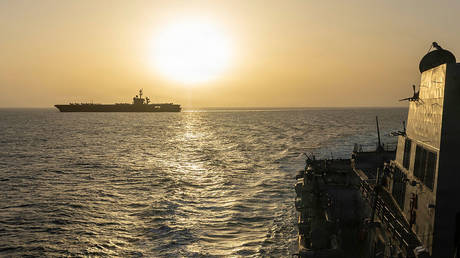
The Strait of Hormuz is the world's most vital energy jugular vein, through which roughly twenty percent of global petroleum and a massive share of liquefied natural gas transit daily. When military officials from the Islamic Revolutionary Guard Corps announced intentions to completely choke off what Tehran classifies as "illegal routes" through this narrow channel, mainstream analysts treated it as predictable rhetoric. That was a severe miscalculation. This declaration marks a fundamental operational shift in how regional actors weaponize geography against conventional superpowers, bypassing traditional rules of naval engagement to enforce a de facto blockade.
To understand why this posture is terrifyingly effective, one must look past the superficial veneer of standard geopolitical posturing. The chokepoint is narrow, geographically punishing, and bordered by Iranian territory that allows asymmetric coastal defense systems to dominate the waterway. Traditional naval power projection, symbolized by carrier strike groups and heavy escorts, faces immense hurdles when confronted with low-cost loitering munitions, anti-ship cruise missiles, and stealthy naval mining operations. Washington has attempted to maintain an open corridor through heavy escorts and retaliatory strikes, but military deterrence has failed to secure absolute freedom of navigation. Tehran has correctly diagnosed that absolute security is mathematically impossible to guarantee in a contested maritime corridor of this scale.
Insurance syndicates have responded to this persistent danger by adjusting premiums to prohibitive levels, effectively pricing neutral commercial shipping out of the Gulf. Tanker operators are forced to weigh the catastrophic financial risk of hull loss against the dwindling margins of Middle Eastern crude delivery. When a civilian merchant vessel is struck by an unidentified projectile or brushes against a suspected naval mine, the psychological shock ripples through global energy markets instantly. Shippers do not care about legal niceties under the United Nations Convention on the Law of the Sea when their crews are under fire and their insurance policies are being canceled.
The friction extends far beyond liquid hydrocarbons. The Persian Gulf region accounts for a massive percentage of globally traded fertilizers, and undersea communications cables running through the corridor remain vulnerable to intentional disruption or collateral damage from kinetic strikes. Regional states depending entirely on these subsea fiber-optic arteries face continuous connectivity threats alongside their energy bottlenecks. The crisis has thus evolved from a localized naval dispute into a systemic shock to global supply chains, affecting everything from crop yields in developing nations to baseline regional communications.
Attempts by external powers to impose solutions through sheer firepower have run headfirst into the reality of asymmetric endurance. While American and allied air campaigns can systematically degrade Iranian coastal installations, they cannot permanently eliminate the threat posed by mobile launchers, hidden sea mines, and small fast-attack craft. Mine countermeasures in a hostile, narrow strait under constant threat of aerial surveillance require a level of force protection that strains even advanced navies. De-mining an active zone while under the shadow of persistent drone threats is a nearly impossible operational paradox.
Consequently, the enforcement of these so-called illegal routes by the Revolutionary Guard represents a grim milestone in modern maritime conflict. It demonstrates that a determined regional power can successfully rewrite the operational rules of an international chokepoint, defying international maritime law without suffering total economic or military collapse. As long as the underlying military standoff persists without a durable diplomatic settlement, maritime commerce through the region will remain hostage to the whims of asymmetric geography. The international community is waking up to the sobering realization that naval dominance alone cannot restore an open ocean order once it has been deliberately fractured.
Iran will soon block 'illegal routes' through Strait of Hormuz, military official says
This video provides direct footage and reporting on the Islamic Revolutionary Guard Corps' announcement regarding the restriction of transit routes through the Strait of Hormuz.



