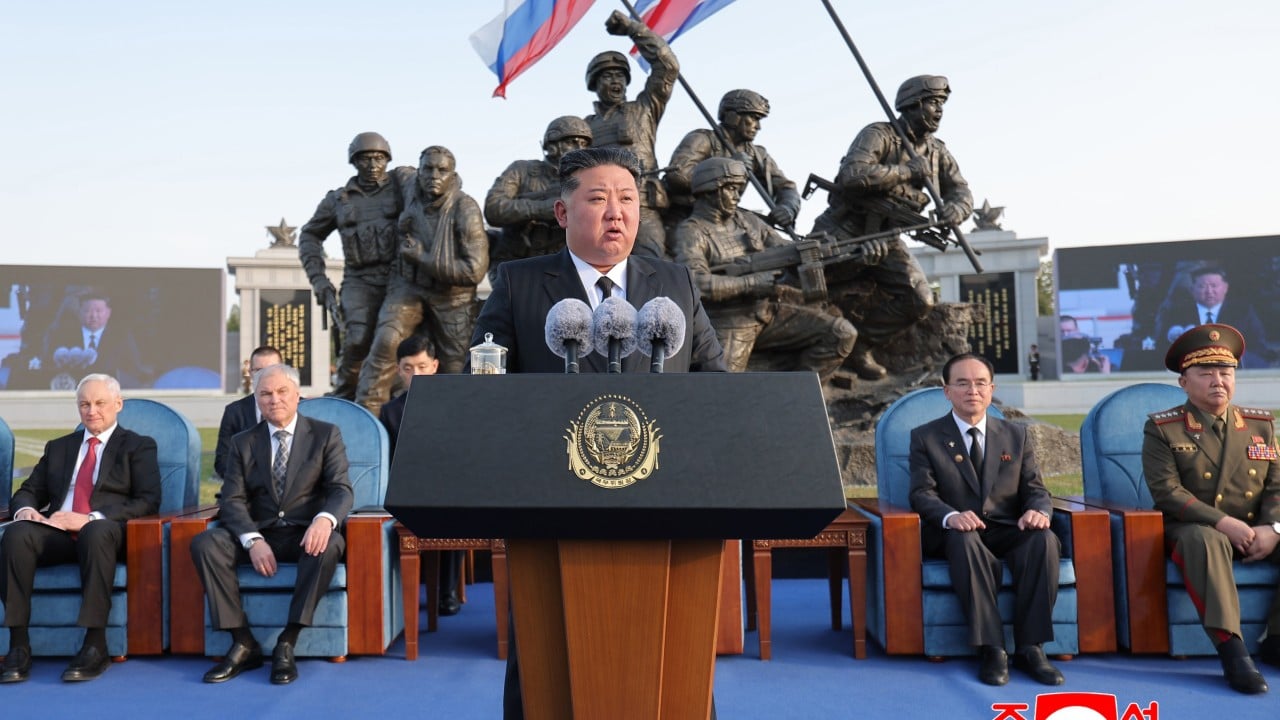
The partnership between Kim Jong Un and Vladimir Putin has moved past symbolic handshakes into a pragmatic, high-stakes military exchange that is actively reshaping the front lines in Ukraine. This is not a vague diplomatic "bulwark" against the West. It is a cold, calculated transaction where North Korea provides the massive volume of low-tech artillery and ballistic missiles Russia desperately needs to sustain its war of attrition, while Moscow offers the sophisticated satellite and submarine technology Pyongyang has spent decades failing to master.
The immediate impact is visible in the cratered fields of the Donbas. Western intelligence estimates and debris analysis confirm that North Korean KN-23 short-range ballistic missiles are now a recurring feature of Russian strike packages. While these missiles occasionally suffer from quality control issues—some failing in mid-air—the sheer volume compensates for the lack of precision. For Putin, quantity has a quality all its own. For Kim, Ukraine has become a live-fire testing ground for his weapons against Western air defense systems, providing data that no simulation in the hills of North Hamgyong could ever replicate.
The Shell Game Fueling the Front
The logistical backbone of this alliance rests on a steady flow of shipping containers moving from the North Korean port of Rajin to Russia’s Dunay. We aren't talking about a few thousand rounds. We are looking at millions of shells. This transfer effectively solves Russia’s most pressing problem: a domestic manufacturing rate that, despite being on a total war footing, cannot keep pace with the 10,000 to 20,000 rounds fired daily across the Ukrainian theater.
North Korea’s defense industry is uniquely suited for this role. Because their entire military doctrine is built on the Soviet-era philosophy of massive artillery barrages, they maintain stockpiles and production lines for 122mm and 152mm shells that are perfectly compatible with Russian hardware. This is a match made in a munitions factory. It bypasses the complexities of modernizing old Russian plants by simply plugging in a pre-existing, hungry supply chain.
However, the "powerful bulwark" rhetoric masks a deep-seated desperation on both sides. Russia is forced to rely on a pariah state for basic military sustainability, a massive blow to its prestige as a global arms exporter. North Korea, meanwhile, is trading its long-term strategic reserves for immediate relief. If the war in Ukraine ended tomorrow, the leverage Kim holds over the Kremlin would evaporate almost instantly.
Trading Grain for Guidance
The price of these shells is what should keep Western strategists awake at night. Russia isn't just paying in rubles or food shipments. There are clear indicators that Moscow is providing technical assistance for North Korea’s space and missile programs. Following Kim’s visit to the Vostochny Cosmodrome, North Korea’s success rate with satellite launches suspiciously improved.
This is the hidden cost of the Ukraine war. By enabling Pyongyang’s orbital ambitions, Russia is effectively dismantling the global non-proliferation regime it once helped lead. If Russia provides the telemetry data and engine designs for intercontinental ballistic missiles (ICBMs) to re-enter the atmosphere safely, the threat to the United States and its allies shifts from theoretical to imminent.
The Underwater Threat
Perhaps more concerning is the potential for Russian help with North Korea’s "hero Kim Kun Ok" submarine—a modified Romeo-class vessel intended to carry nuclear-tipped missiles. Building a quiet, reliable nuclear submarine is incredibly difficult. Russia, however, possesses world-class expertise in acoustic silencing and nuclear propulsion. A single transfer of blueprints or a few "consultants" from the Russian Navy could shave a decade off North Korea’s development timeline.
Breaking the Sanctions Machine
This alliance has effectively rendered the United Nations Security Council (UNSC) obsolete regarding North Korean containment. Russia, a permanent member with veto power, has no incentive to enforce sanctions against its primary munitions supplier. In fact, Moscow has already moved to dissolve the UN panel of experts that monitored sanctions violations.
The "bulwark" is essentially a lawless zone where two nuclear-armed states have decided that international norms no longer apply to them. This creates a dangerous precedent for other nations looking to bypass Western financial and diplomatic pressure. It signals that if you have something a major power needs—be it shells, drones, or raw materials—the "rules-based order" can be ignored with impunity.
The Chinese Complication
Beijing’s silence on this growing intimacy is telling. While China benefits from a distracted United States, a nuclear-empowered and emboldened North Korea is not in China's long-term interest. Xi Jinping prefers a stable, dependent Pyongyang, not a wild card that gives the U.S. an excuse to increase its military footprint in the Indo-Pacific.
The Russia-North Korea axis creates a secondary power center within the anti-Western bloc that Beijing does not fully control. This friction is a weakness the West has yet to exploit. If the U.S. and its allies can demonstrate that Russian technology transfers to North Korea directly threaten Chinese security interests, the "powerful bulwark" might show its first structural cracks.
The Intelligence Blind Spot
We have a history of underestimating the technical proficiency of North Korean engineers. They are masters of the "good enough" solution. By integrating Russian battle-hardened software with North Korean mass-produced hardware, they are creating a hybrid threat that is difficult to map.
Take, for example, the use of electronic warfare. Russian units in Ukraine are currently running the world's most intense field test of GPS jamming and drone interception. If that data is shared with Pyongyang, the defensive calculations for the Korean Peninsula must be entirely rewritten. South Korean and U.S. forces rely heavily on precision-guided munitions and superior communication networks. If those are neutralized by Russian-origin jamming techniques used by North Korean units, the technological edge vanishes.
Economic Survival Through Combat
For Kim Jong Un, this war is a fiscal godsend. The influx of Russian hard currency and oil has stabilized the North Korean economy in a way that years of illicit ship-to-ship transfers never could. It allows him to fund his domestic "20x10" policy—a plan to build regional factories and improve living standards—while continuing to pour billions into his nuclear program.
The workers in North Korean munition plants are now effectively part of the Russian war effort. This is not just a military alliance; it is an economic integration of two sanctioned states. They are building a parallel economy that functions entirely outside the reach of the SWIFT banking system or the U.S. Treasury. It is a primitive, barter-based system, but it is functional enough to keep the gears of war turning.
The Myth of Eternal Friendship
The rhetoric coming out of both capitals suggests a "limitless" partnership, but history tells a different story. The relationship between Moscow and Pyongyang has always been transactional and deeply suspicious. During the Cold War, North Korea played the Soviet Union and China against each other with masterful cynicism.
Putin is using Kim because he has to. Kim is using Putin because he can. There is no shared ideology here beyond a mutual hatred of the current international hierarchy. If Russia’s fortunes in Ukraine change, or if a new administration in Washington offers Putin a deal he can't refuse, North Korea will be the first thing he sacrifices. Kim knows this. He is extracting every possible drop of technology and fuel while the window is open.
The Failed Western Response
Sanctions have reached their limit. You cannot sanction a country that has already been under total blockade for seventy years. You cannot isolate a country that shares a land border with a superpower willing to look the other way. The Western strategy of "strategic patience" has failed because it assumed that the target would eventually crumble under economic pressure. Instead, the target found a business partner.
To counter this, the focus must shift from punishing the actors to physically disrupting the supply lines. This means more aggressive interdiction of vessels in international waters and cyber operations targeting the financial nodes that facilitate the Russia-North Korea trade. Anything less is just noise.
The war in Ukraine has effectively ended the era of North Korean isolation. Pyongyang is now a critical player in a European conflict, a development that seemed impossible three years ago. The weapons moving across the Siberian railway are more than just steel and high explosives; they are the physical manifestation of a new, fractured world where the most isolated nation on earth has become a vital cog in the machinery of global conflict. The West is no longer just fighting a Russian invasion; it is fighting a multi-national supply chain that starts in the factories of Pyongyang.
Stop looking for a diplomatic exit ramp that doesn't exist.