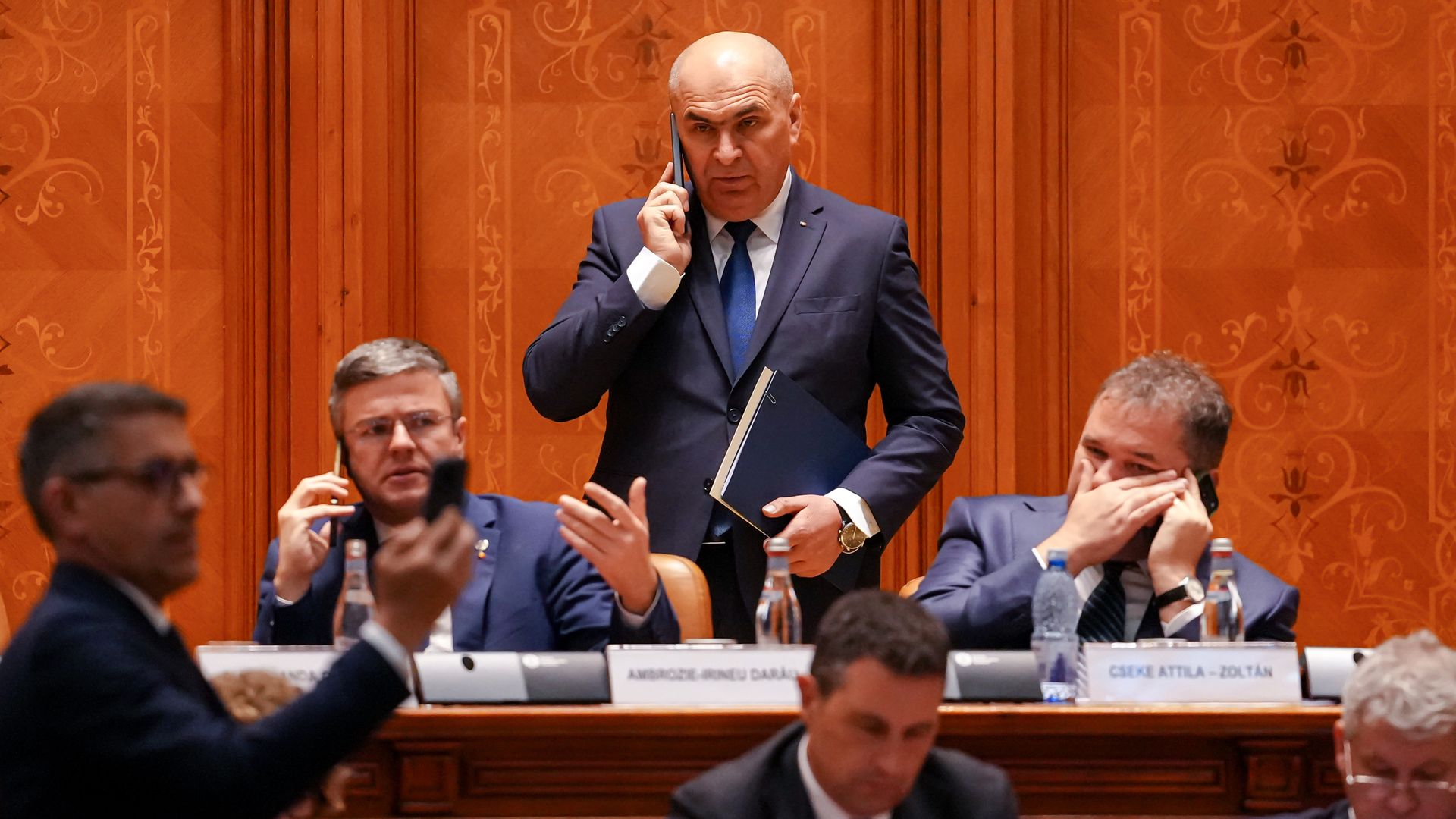
The collapse of the Romanian government following a no-confidence vote is not a sudden accident of parliamentary procedure. It is the predictable outcome of a deep-seated structural rot within the country’s political class. While international observers often frame these events as a simple tug-of-war between Moscow and Brussels, the reality on the ground in Bucharest is far more transactional and cynical. The government fell because the internal friction between reformist elements and the old-guard patronage networks became physically impossible to sustain.
The immediate trigger for the no-confidence motion was a dispute over a massive regional development fund—an 11 billion dollar pot of money intended for infrastructure but devoid of the transparency requirements that usually accompany European Union grants. When the reform-minded junior partners in the coalition demanded oversight, the Prime Minister moved to sack their ministers, effectively detonating his own administration. This was a suicide mission driven by the need to satisfy local mayors and power brokers who view the national treasury as a private checking account.
The Myth of the Pro-Europe Monolith
To understand why this matters, one must look past the "Pro-Europe" label that many Western outlets use as a shorthand for stability. In Romania, being pro-EU is often a matter of branding rather than deep ideological conviction. Most major parties claim the mantle because the alternative—alienating the source of billions in development aid—is financial madness. However, the commitment to European values like the rule of law often ends where the preservation of local influence begins.
The coalition that just disintegrated was a marriage of convenience between technocratic reformers and a traditional center-right party that has more in common with the socialist opposition than it does with modern transparency advocates. This friction created a governing body that spent more time sabotaging itself than passing legislation. The reformers wanted to digitize the state and remove political appointees from state-owned enterprises. The traditionalists saw these moves as a direct threat to the survival of their political machines.
Money as the Ultimate Political Weapon
In the Romanian political system, power flows from the ability to distribute resources to the provinces. Local mayors are the foot soldiers who deliver votes during national elections. To keep these mayors loyal, the central government must ensure a steady stream of "Anghel Saligny" funds—named after a famous engineer, but used here as a euphemism for discretionary spending.
When the Prime Minister pushed forward with this funding program without the anti-corruption safeguards requested by his partners, he was making a choice. He chose the loyalty of his party’s local barons over the survival of the national government. The no-confidence vote that followed was merely the paperwork catching up to a divorce that had already happened behind closed doors.
The Shadow of the Social Democrats
The biggest winner in this chaos is the Social Democratic Party (PSD). Despite being out of power, they have successfully navigated the collapse to position themselves as the only stable alternative. By voting to topple the government, they didn't just punish their rivals; they forced the president into a corner where he must eventually negotiate with them.
The PSD understands the rhythm of Romanian politics better than anyone. They wait for reformist coalitions to buckle under the weight of their own idealism, then they step in to "restore order." This cycle has repeated itself for three decades, ensuring that while the faces in the ministries change, the underlying bureaucratic structures remains untouched.
Inflation and the Cost of Instability
Ordinary citizens are paying the price for this political theater. Romania is currently grappling with some of the highest inflation rates in the Eastern Bloc. Energy prices are skyrocketing, and the lack of a functional government means that emergency measures are being delayed or implemented through weak interim decrees.
Investors loathe this kind of unpredictability. The Romanian Leu has faced downward pressure, and the cost of borrowing for the state is rising. When a country cannot guarantee who will be in charge of the Finance Ministry next week, the "stability premium" disappears. This isn't just about politics; it is an economic drain that hits the poorest households the hardest.
The Role of the President
President Klaus Iohannis, once seen as the ultimate guarantor of the country’s Western trajectory, now finds his legacy in jeopardy. His attempts to mediate between the warring factions have largely failed, leaving him with a diminished reputation and a fractured political landscape. Critics argue that his preference for a specific type of center-right dominance blinded him to the genuine grievances of the smaller reformist parties.
The President’s power to nominate the next Prime Minister is his last remaining leverage. However, in a parliament where no single party holds a clear majority, he is forced to choose between a minority government that will be crippled from day one or a "grand coalition" that would effectively end the reformist project for a generation.
Why Structural Reform Keeps Failing
The core problem is that the Romanian state is an employer of last resort in many regions. Thousands of jobs in local administrations and state agencies are tied to party loyalty. Any attempt to introduce merit-based hiring or digital transparency is viewed not as progress, but as an existential threat to the livelihoods of party members.
This is why judicial reforms are always the first thing to be abandoned during a crisis. A strong, independent judiciary is the only force capable of breaking the link between political power and financial gain. Yet, as soon as the heat is turned up, the political class tends to unite against the prosecutors to protect their own.
The Geopolitical Stakes
While the internal mechanics are driven by greed and local rivalry, the external consequences are significant. Romania sits on the eastern flank of NATO and the EU. It is a vital hub for regional security. Persistent instability in Bucharest invites outside influence and weakens the collective resolve of the European project.
The Kremlin does not need to actively subvert Romanian democracy when the Romanian politicians are doing such a thorough job of it themselves. Every week of gridlock is a victory for those who want to portray Western-style democracy as chaotic and ineffective. The irony is that the very politicians who wrap themselves in the EU flag are the ones providing the most ammunition to the critics of European integration.
The Path of Least Resistance
As negotiations for a new government begin, the most likely outcome is a messy compromise that favors the status quo. The reformist party that was kicked out of the coalition is unlikely to return without massive concessions that the traditionalists are unwilling to make. This leaves the door open for a "technocratic" government or a backroom deal with the socialists.
Neither of these options addresses the fundamental issues of corruption and fiscal mismanagement. A technocratic government lacks the political mandate to make tough decisions, while a deal with the socialists would likely involve a quiet agreement to stop all meaningful anti-corruption efforts.
A Fragile Future
The collapse of the government is a symptom of a country that has successfully integrated into Western institutions on paper, but has yet to reform its internal soul. The legal frameworks are in place, the buildings are there, and the flags are flying. But the actual exercise of power remains rooted in a system of patronage that dates back to the transition years of the early nineties.
Until the cost of political betrayal becomes higher than the rewards of the spoils system, Romania will continue to see these cycles of collapse. The next few months will determine if the country can finally break this pattern or if it is destined to remain the "sick man" of the European eastern flank, forever trapped between its aspirations and its reality.
Romania does not need another "pro-European" government in name only. It needs an administration that is more afraid of its voters than it is of its party barons. Without that shift, the no-confidence vote of today is just a dress rehearsal for the crisis of tomorrow.
The immediate priority for the next administration will be the implementation of the National Recovery and Resilience Plan (PNRR). This is a massive injection of EU funds tied to specific, hard reforms. If the new government fails to meet these milestones because they are too busy protecting their patronage networks, the money will stop flowing. That is the only language the current political class truly understands. The threat of an empty treasury is the only thing that might actually force a change in behavior, but betting on political maturity in Bucharest has historically been a losing wager.
The streets are quiet for now, but the frustration is simmering. The gap between the wealth of the political elite and the struggles of the working class is wider than ever. This disconnect is the fertile ground where populism grows. If the mainstream parties cannot provide a stable, honest government, the voters will eventually look toward the fringes. We have seen this play out across the continent, and Romania is not immune to the siren song of the far-right. The collapse of the coalition isn't just a change in leadership; it is a dangerous vacuum that something much darker could eventually fill.