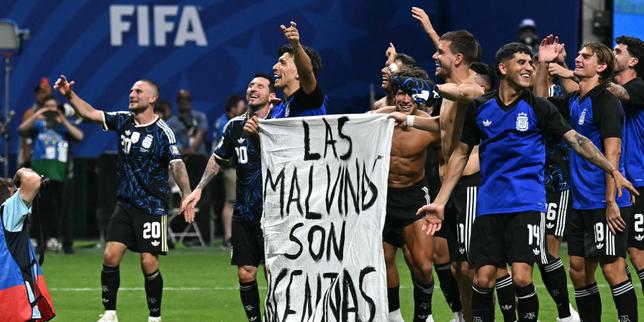
In 2014, the UK government successfully pressured FIFA to investigate and fine the Argentine Football Association after national team players displayed a banner declaring the Falkland Islands to be Argentine before a World Cup warm-up match. This incident exposed the raw, unresolved geopolitical wounds of the 1982 conflict, thrusting a bilateral territory dispute onto the global sporting stage. Yet, beneath the British outrage and FIFA's subsequent fines lies a much larger, darker reality of how the global football governing body weaponizes "neutrality" to protect its own commercial interests.
By examining the mechanics of this clash, we see that football has never been a sanctuary from global politics. It is, instead, one of its primary battlegrounds.
The Day the Pitch Turned Political
On June 7, 2014, the Estadio Unico in La Plata was filled with the usual pre-tournament euphoria. Argentina was playing Slovenia in their final warm-up match before departing for the World Cup in Brazil. Just before kickoff, the starting eleven, including global icons like Lionel Messi, Javier Mascherano, and Angel Di Maria, lined up behind a large light-blue banner.
It read simply: Las Malvinas Son Argentinas (The Falklands are Argentine).
The reaction from London was swift and fierce. The British Foreign and Commonwealth Office immediately condemned the display as a provocative political gesture. UK diplomats pressured FIFA to take immediate disciplinary action, arguing that a football pitch should never be used as a platform for nationalist territorial claims. Within weeks, FIFA complied, launching a formal investigation that eventually resulted in a fine of 30,000 Swiss francs for the Argentine Football Association (AFA).
To understand the severity of this reaction, one must look beyond the immediate diplomatic back-and-forth. The Falklands War of 1982, though brief, resulted in the deaths of hundreds of young military personnel on both sides. In Argentina, the claim over the islands is not merely a political opinion; it is a constitutional mandate. In the UK, maintaining the self-determination of the islanders is a point of national pride and defense policy. When those two realities collided on a football pitch, the illusion of sport as a unifying, non-political space shattered instantly.
The Legal Farce of Article Sixty
FIFA justified its disciplinary action by pointing to its strict rulebooks. Specifically, the governing body cited Article 60 of the FIFA Stadium Safety and Security Regulations, which prohibits the promotion of political, religious, or personal messages in stadiums. They also invoked Article 52 of the FIFA Disciplinary Code, which punishes teams for unsporting behavior and team misconduct.
On paper, the rule seems straightforward. In practice, its enforcement is entirely selective.
FIFA operates as a private, Swiss-domiciled entity that wields more diplomatic power than many sovereign states. When it suits their bottom line, they enforce these rules with draconian efficiency. When it does not, they look the other way. The definition of what constitutes a "political" message is entirely arbitrary, shaped by which governments and sponsors hold the most leverage at any given moment.
Consider the contrast. While Argentina was fined for a banner addressing a territorial claim, other politically charged displays have routinely gone unpunished or have been actively encouraged by the governing body when they align with global public opinion. This selective moral outrage reveals that FIFA is not interested in keeping politics out of sport. It is interested in keeping controversy out of its broadcast packages.
The Swiss francs extracted from the AFA did nothing to change the minds of the Argentine public, nor did they soothe British diplomatic anxieties. They merely served as a commercial toll paid by a national association to keep the tournament sponsors happy.
State Co-optation and the Argentine Football Machine
To view the Falklands banner incident as a spontaneous outburst of patriotism by the players is to ignore the structural realities of Argentine football at the time. In 2014, Argentine football was deeply entangled with the state under the administration of President Cristina Fernandez de Kirchner.
Under the state-funded program Futbol para Todos (Football for All), the Argentine government had acquired the domestic broadcasting rights to first-division matches. This was not a philanthropic endeavor to provide free sports to the masses. It was a massive, tax-funded propaganda machine. During half-time shows and commercial breaks, viewers were subjected to government ads showcasing state-sponsored infrastructure projects, attacks on political opponents, and relentless messaging regarding the sovereignty of the Malvinas.
The national team was not insulated from this environment. The AFA was highly dependent on government goodwill and financial support. When the players held up that banner in La Plata, they were operating within a system where national identity, political survival, and footballing success were completely fused.
For the players, refusing to hold the banner would have been seen domestically as an act of treason. For the government, the national team was the ultimate megaphone to project its nationalist rhetoric to a global audience on the eve of the world's most-watched sporting event. The squad was caught between the domestic demands of a populist government and the corporate demands of a global sporting monopoly.
The Ghost of Nineteen Eighty Six
The relationship between Argentine football and the Falklands War is deep, historical, and highly emotional. It is impossible to analyze the 2014 banner without acknowledging the monumental shadow of the 1986 World Cup quarter-final in Mexico.
That match, played just four years after the conclusion of the South Atlantic conflict, was treated by both the Argentine public and the players as a metaphorical continuation of the war. Diego Maradona’s two goals in that game—the infamous "Hand of God" and the spectacular solo run voted the Goal of the Century—were explicitly framed as a form of symbolic revenge.
Maradona himself wrote in his autobiography that the players felt they were defending a flag, avenging the young boys who had died in the cold of the South Atlantic. It was a classic example of how sport can absorb and transmute geopolitical trauma.
When Messi and his teammates stood behind the banner in 2014, they were tapping into this rich, historical narrative of athletic martyrdom and resistance. The British outcry was not just about a piece of fabric; it was a reaction to the realization that, despite winning the physical conflict in 1982, the UK had completely lost control of the narrative in the global cultural arena.
The Commercial Mechanics of Silence
Why does FIFA fear political banners so intensely? The answer is found in the corporate boardrooms of Zurich, not in the halls of international diplomacy.
The World Cup is not a sporting tournament that happens to have sponsors. It is a massive corporate trade show that happens to feature football matches. Companies like Coca-Cola, Adidas, and Visa pay hundreds of millions of dollars to associate their brands with the positive, clean emotions of sporting excellence.
A disputed island chain, memories of naval warfare, and diplomatic shouting matches between London and Buenos Aires are toxic to corporate brands. They introduce tension, historical grief, and polarization into an environment designed for pure consumer escapism.
By enforcing strict bans on political expressions, FIFA protects its sponsors from being associated with real-world conflicts. The "neutrality" rule is a corporate shield masquerading as a moral principle. It allows FIFA to sell a sanitized, idealized version of the world where nations compete in harmony, free from the messy realities of borders, historical atrocities, and ongoing colonial disputes.
This sanitization, however, is a lie. Football is popular precisely because it is tribal, historical, and deeply connected to local and national identities. Strip away the history, the grievances, and the politics, and you are left with a sterile product that serves only the balance sheets of multinational corporations.
The UK's insistence on a FIFA investigation and the subsequent fine did not resolve the Falklands dispute. It merely highlighted how effectively global sports governing bodies can be used to suppress uncomfortable historical realities in favor of a clean, sponsor-friendly broadcast. As long as nations have borders and histories of conflict, those conflicts will find a way onto the pitch, no matter how many fines Zurich hands down.