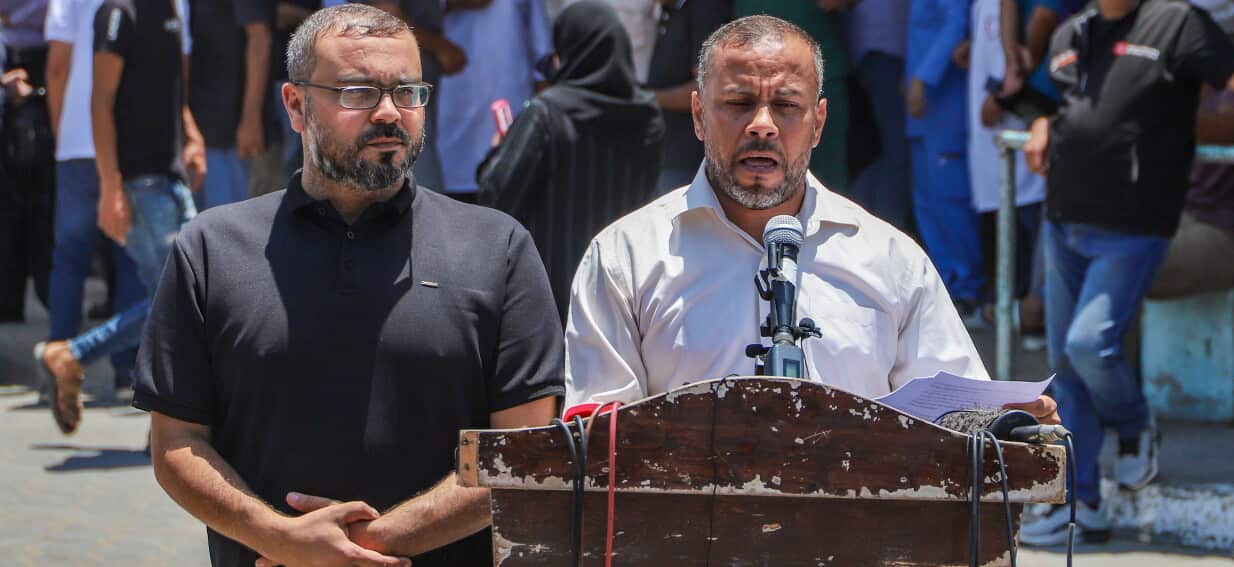
Hamas announced the dissolution of its de facto government in the Gaza Strip on Monday, a move framed as a transition of administrative power to a United Nations-backed committee of independent technocrats. The declaration ostensibly marks the end of nearly two decades of direct governance by the militant faction, aligning with the framework of a fragile, United States-brokered ceasefire agreement. Yet the announcement remains a calculated bureaucratic maneuver rather than a true abdication of power. On the ground, Hamas has no intention of surrendering its weapons or its ultimate control over the shattered enclave.
Beneath the diplomatic rhetoric lies a complex chess game involving regional actors, the international community, and a heavily blockaded population. The transition centers on transferring daily civil governance to the National Committee for the Administration of Gaza (NCAG). This temporary governing body, formed in January 2026 under the auspices of the Trump administration's Board of Peace, is chaired by Ali Shaath, a Cairo-based engineer and former Palestinian Authority official. While Hamas portrays this as a step toward full reconstruction, Israeli officials and international security analysts view it as a hollow political survival strategy designed to shift the burden of civic collapse onto foreign entities while retaining military supremacy. Meanwhile, you can read other stories here: The Real Reason Flavio Bolsonaro is Begging Trump to Delay Brazil Tariffs.
The Illusion of Bureaucratic Dissolution
By dissolving its Government Emergency Committee, Hamas is attempting to present a clean slate to international donors. Ismail al-Thawabta, the general director of the Hamas-run Government Media Office, clarified that the administrative personnel currently staffing ministries and municipalities are to be reclassified as "state employees" ready to work under the NCAG framework. This is a crucial distinction. The personnel executing day-to-day operations will not change. The police officers, tax collectors, garbage collectors, and medical workers remain the same individuals appointed or vetted by Hamas over the last nineteen years.
A true administrative vacuum would spark immediate chaos. Hamas knows this. By keeping the underlying civil service intact, the group ensures that any external governing body will remain entirely dependent on the existing local infrastructure. It is a administrative trap. If the NCAG assumes formal responsibility, it becomes financially and legally accountable for a devastated territory where more than 73,000 people have been killed since October 2023, according to local health officials, and where infrastructure damage is total. To see the bigger picture, we recommend the excellent analysis by The Washington Post.
The political leadership of Hamas is betting that international observers will accept the optics of a civilian-led committee in exchange for flowing reconstruction funds. The coastal strip is currently operating under a severe shortage of basic resources. Engine oil, cooking gas, and automotive spare parts have completely run out, grinding what remains of the local economy to a halt. By stepping back from the front line of civic management, Hamas deflects public anger over these unlivable conditions onto the incoming technocratic committee and the international community.
The Armed Core and the Cairo Bottleneck
The fundamental flaw in this transition is the complete silence on disarmament. The second phase of the October 2025 ceasefire agreement explicitly demands that Hamas dismantle its military wing, the Qassam Brigades, and surrender its arsenal to a unified authority. Monday's announcement bypassed this requirement entirely. Hamas spokesperson Hazem Qassem defended the move as a demonstration of flexibility, arguing that the group is removing any pretext for continued Israeli military action. However, flexibility in garbage collection is not flexibility in national security.
Israeli Foreign Minister Gideon Saar dismissed the announcement as an irrelevant political spin. The Israeli position remains firm. A civilian administration operating under the shadow of an armed, underground militia is not a government; it is a human shield for that militia. Israeli intelligence reports suggest that while visible military actions have decreased since the October truce, Hamas has actually fortified its positions along internal division lines in Gaza, signaling that its security apparatus remains fully operational.
Meanwhile, the NCAG itself is stuck in an administrative bottleneck in Cairo. Israeli authorities have blocked the committee's leadership from physically entering the Gaza Strip since its creation six months ago. Ali Shaath issued a statement emphasizing that for his committee to execute its mandate, there must be a single governing authority operating under one legal framework with a unified security apparatus. That reality does not exist.
The Alternate Reality of Humanitarian Cities
The timing of the Hamas announcement is not accidental. It serves as a direct counter-offensive to an alternative post-war vision being pushed by elements within the Israeli defense establishment and supported by regional partners. This competing plan involves the creation of isolated, purpose-built civilian enclaves, frequently referred to as humanitarian cities, in areas under direct Israeli military control. Under that model, aid distribution and local administration would be handled by vetted local clans completely divorced from both Hamas and the Palestinian Authority.
Hamas views these proposed enclaves as a direct threat to the territorial integrity of Gaza and its own survival. By preemptively declaring its support for the UN-backed NCAG, Hamas is forcing the international community to choose between two competing governance models. One is an internationally recognized, Palestinian-led technocratic committee that relies on existing civil servants, and the other is a fragmented network of military-administered zones.
International diplomats are caught in the middle. The Board of Peace issued a terse statement stating that its assessment of the situation would be guided by actions, not promises. The board reiterated that the core principle of the peace plan is one authority, one law, and one weapon. By refusing to address the weapons issue, Hamas has ensured that the political stalemate will continue, even as the humanitarian crisis worsens.
A Legacy of Fractured Accords
To understand why this latest announcement inspires such skepticism, one must look at the long history of failed Palestinian reconciliation efforts. Since Hamas seized control of the Gaza Strip in 2007 following a brief civil conflict with Fatah, there have been over a dozen agreements, declarations, and unity pacts signed in Cairo, Doha, Algiers, and Beijing. Every single one followed a predictable trajectory. A grand declaration of unity would be signed, a technocratic or national consensus government would be proposed, and the agreement would collapse the moment the discussion turned to security control and the integration of armed wings.
The current situation mirrors the short-lived 2014 consensus government. In that instance, Hamas formally dissolved its government to allow a cabinet of independent ministers backed by the Palestinian Authority to take over Gaza. In practice, the PA ministers were blocked from exercising actual authority, civil servant salaries became a multi-year financial dispute, and Hamas maintained absolute control over the security sector.
The primary difference today is the sheer scale of destruction. Gaza is no longer an autonomous enclave with functioning ministries; it is a field of ruins where two million people depend entirely on international aid shipments. The stakes are vastly higher for all parties involved. For Hamas, the survival of its political and military core depends on its ability to integrate into a broader international framework without surrendering its physical power.
The Ground Reality of the Ceasefire
The political maneuverings in Cairo and Washington contrast sharply with the unstable security situation on the ground. Although large-scale bombardment has subsided compared to the peak of the conflict, low-intensity warfare continues. Five Israeli soldiers have been killed in localized clashes since the ceasefire took effect, and Israeli strikes targeting suspected militant operatives occur with regular frequency.
The population of Gaza is caught in a state of suspended animation. Families living in tents amid the rubble of Khan Younis and Deir al-Balah care little about the legal distinction between a Hamas Emergency Committee and a UN-backed technocratic council. They require clean water, medical supplies, and the ability to rebuild their homes. The longer the governance dispute remains unresolved, the longer the entry of heavy machinery and construction materials will be delayed.
The international community is facing a massive financial dilemma. Donor countries are highly reluctant to pledge billions of dollars for reconstruction when there is no clear guarantee that the infrastructure will not be destroyed in a subsequent round of fighting. By offering to hand over the keys to the NCAG, Hamas is throwing the ball back into the court of the international community, daring foreign governments to refuse funding to a UN-sanctioned committee.
The reality remains that no technocratic committee, regardless of how many engineers or administrators it possesses, can govern a territory where an armed militia holds an absolute veto over public life. Until the fundamental question of security control and disarmament is resolved through direct pressure or verifiable enforcement mechanisms, the dissolution of the Hamas government will remain an exercise in administrative theater. The names on the ministerial letterheads may change, but the underlying power dynamics of the Gaza Strip remain entirely unaltered.