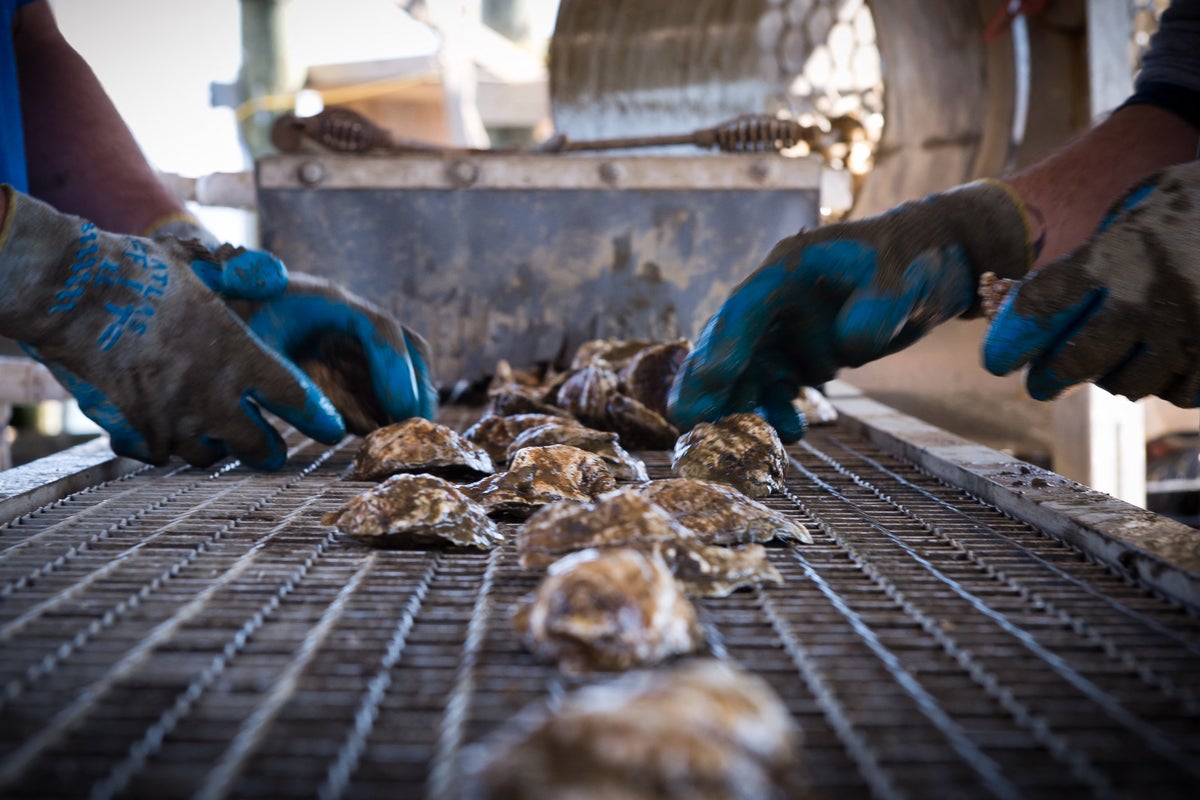
New York’s oyster industry is currently reeling from a winter that didn't just freeze the water but effectively paralyzed the supply chain. While early reports point to a $2 million loss in immediate revenue, that figure represents a shallow reading of a much deeper fiscal wound. The actual crisis isn't just about dead shellfish. It is about a fragile ecosystem of small-scale farmers, high-end distributors, and Manhattan’s elite culinary sector—all of which are now staring at an empty pipeline that will take years to refill. When you lose a harvest in this business, you aren't just losing this year's inventory. You are losing the three years of growth it took to get those oysters to market size.
The Hidden Math Of A Submerged Disaster
The reported $2 million loss is a conservative estimate based on the gate value of the oysters that didn't survive the ice. However, the business of aquaculture doesn't operate on a simple cash-and-carry basis. For a farmer in the Great South Bay or the Long Island Sound, a "harsh winter" is a compounding interest event.
Most consumers see an oyster on a half-shell and think of it as a seasonal crop, like corn or tomatoes. It isn't. An Eastern oyster (Crassostrea virginica) takes roughly two to three years to reach a three-inch market size in New York's cold waters. When a freeze kills off the current harvestable stock, it also wipes out the "seed" and the "yearlings"—the future of the farm.
Consider the replacement costs. A farmer who loses 50% of their stock doesn't just lose 50% of their paycheck. They lose the labor costs already sunk into those animals over the last 24 months, the gear damaged by shifting ice floes, and the shelf space in the city's most prestigious restaurants. In the cutthroat world of New York dining, if you can't deliver, someone else will. Once a chef strikes a local farm from the menu, getting back on that list is an uphill battle that takes more than just a fresh batch of bivalves.
Why The Ice Won This Year
It is easy to blame "weather," but that’s a lazy man’s analysis. The real culprit is the increasing volatility of the Atlantic’s "shelf water" and how it interacts with antiquated coastal infrastructure.
In decades past, consistent winter temperatures allowed oysters to enter a state of dormancy. They shut their shells and slowed their metabolism to almost nothing. They waited it out. But the modern New York winter is a series of "whiplash" events. We see 50-degree days followed by a sudden, deep freeze. These fluctuations prevent the oysters from properly acclimating. When the ice finally forms, it stays longer in the shallow bays where the majority of New York’s boutique farms are located.
The Anchor Ice Problem
One specific phenomenon that devastated the beds this year is anchor ice. Unlike the sheet ice you see on the surface, anchor ice forms at the bottom of the water column. It attaches to the cages, the bags, and the oysters themselves. When the tide comes in, the buoyant force of the ice lifts the entire apparatus—cages, gear, and heavy stone anchors—off the seabed.
The ice then drifts with the current, dragging the farm into deeper water or smashing it against piers. When the thaw happens, the oysters are often buried under feet of silt or left high and dry on a salt marsh. This isn't a loss you can insure against easily. It is mechanical destruction of an underwater factory.
The Restaurant Ripple Effect
The shockwaves from the Long Island Sound travel straight down the Long Island Expressway and into the kitchens of Midtown and the Seaport. For a top-tier New York oyster bar, the "local" tag isn't just marketing. It’s the identity.
When the New York supply dries up, these establishments have two choices: raise prices or source from the South. Neither is ideal. Southern oysters, typically from the Gulf or the Carolinas, have a completely different flavor profile. They are softer, less "briny," and lack the crisp finish that New York's cold-water minerals provide.
Supply Chain Cannibalization
We are now seeing a trend of supply chain cannibalization. Large-scale distributors, sensing the shortage, are outbidding small restaurants for the remaining local stock. This drives the per-piece price up by 30% to 40% at the wholesale level.
- The Farmer's Dilemma: Do they sell their remaining stock now to cover their losses, or hold onto it hoping the price peaks in July?
- The Chef's Choice: Do they pass the $5-per-oyster cost onto a customer already fatigued by inflation, or do they pull the item off the menu entirely?
Many are choosing the latter. When oysters disappear from the menu, the "appetizer spend" at these restaurants drops. Oysters are a high-margin "gateway" food; they lead to champagne and cocktail sales. A table that doesn't start with a dozen Blue Points is a table that spends $60 less on average.
The Policy Gap
New York likes to talk about its "Billion Oyster Project" and the environmental benefits of bivalves. They filter the water. They protect the shoreline. Yet, when it comes to the economic survival of the people actually growing them, the state's support system is remarkably thin.
Crop insurance for aquaculture is notoriously difficult to navigate. Unlike corn or soy farmers, who have a massive federal lobby and streamlined payout structures, oyster farmers are often classified as "wild harvesters" or "specialty producers." This creates a bureaucratic nightmare when trying to prove a loss caused by ice. You can't exactly walk an insurance adjuster across a frozen bay to count dead shells at the bottom of the ocean.
Furthermore, New York’s leasing laws make it difficult for farmers to move their operations. If a specific bay is prone to heavy icing, a farmer can't just relocate their cages to deeper, moving water for the winter. They are locked into a specific GPS coordinate. This lack of flexibility is a death sentence in a changing climate.
The Myth Of The Quick Recovery
There is a narrative floating around that a good spring will "fix" the industry. That is a fantasy. Because of the three-year growth cycle, the "missing" oysters of this winter will create a supply vacuum that will be felt in 2027 and 2028.
We are looking at a permanent shift in the market. Smaller "mom and pop" farms, unable to absorb a $50,000 or $100,000 loss, are already looking for buyers. This leads to consolidation. Within five years, the "New York Oyster" might be a product of three or four large corporations rather than the diverse, artisanal market that has defined the region’s culinary resurgence.
Resilience Through Engineering
If the industry is to survive, it has to move away from "hope-based" farming. Some operators are beginning to experiment with submerged long-line systems. These allow the cages to be lowered several feet below the surface, away from the crushing power of surface ice and the temperature swings of the top layer of water.
However, this gear is expensive. It requires specialized winches and larger boats. For a small farmer, the capital expenditure required to "ice-proof" a farm can exceed the annual revenue. Without state-backed low-interest loans specifically targeted at aquaculture infrastructure, the New York oyster will become a rare luxury rather than a regional staple.
The $2 million in lost sales is just the opening act. The real cost is the potential collapse of a heritage industry that was just starting to find its feet again. The city's appetite for oysters hasn't changed, but the math of producing them certainly has.
Investors and policymakers who ignore the biological timeline of the oyster do so at their own peril. You cannot fast-track a living organism. When the ice takes the crop, it takes the time. And in the New York economy, time is the one commodity nobody can afford to lose.
The farmers who are still standing are currently out on the water, assessing the wreckage of their cages and trying to salvage what they can from the mud. They aren't looking for a handout; they are looking for a regulatory framework that acknowledges they are running a business, not a hobby. If the state doesn't provide that framework, the next "harsh winter" won't just result in a $2 million loss—it will result in an empty harbor.
Move the cages deeper or watch the industry freeze out entirely.