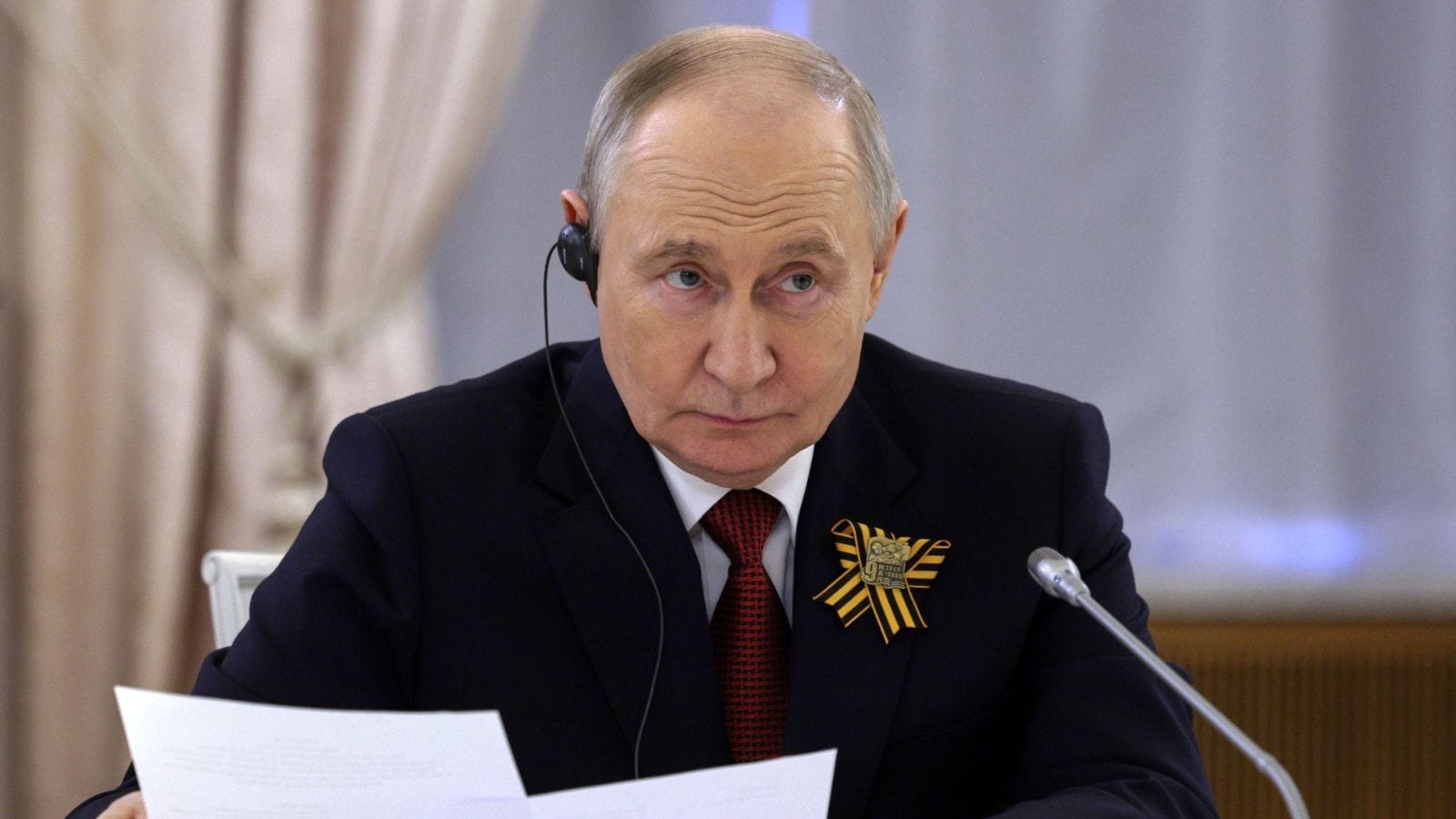
Vladimir Putin stood in a strangely quiet Red Square this weekend and told the world that the war in Ukraine is finally heading toward its conclusion. After four years of grinding attrition, a drained $3 trillion economy, and a military parade stripped of its usual armored grandeur, the Russian leader used the May 9 Victory Day stage to signal a shift in the Kremlin's narrative. This is not a sudden outbreak of pacifism. It is a calculated pivot.
The primary takeaway for those watching the front lines is that Moscow is now prioritizing a "sold" victory over a total military conquest. Putin confirmed he is open to meeting Ukrainian President Volodymyr Zelenskyy in a third country, provided a peace treaty is already finalized. This comes on the heels of a fragile, U.S.-brokered three-day ceasefire that began on Saturday, a diplomatic maneuver that has many wondering if the high-intensity phase of the conflict has truly peaked.
The Mirage of the Red Square Exit Ramp
To understand why Putin is talking about the end now, look at what was missing from the cobbles of Red Square. Instead of the typical rows of intercontinental ballistic missiles and new-generation tanks, the Kremlin displayed video footage of hardware on giant screens. It was a scaled-back celebration for a country whose military resources are spread thin across a line of Ukrainian "fortress cities" in the Donbas.
Putin's rhetoric has moved from the total "denazification" of 2022 to a more defensive, survivalist tone. He now describes the war as a just struggle against an "aggressive" NATO force, framing the current stalemate as a victory in itself because the Russian state did not collapse under Western sanctions. This narrative shift serves a dual purpose. It prepares the Russian domestic audience for a conclusion that falls far short of the original goals, while simultaneously dangling a carrot to Western leaders who are weary of the financial and political costs of the stalemate.
Internal documents leaked from the Russian Presidential Administration suggest the Kremlin’s "plausible scenario" for peace involves a neutral Ukraine serving as a "buffer zone." In this vision, the United States lifts its sanctions while European ones remain, allowing Moscow to claim it defeated the global hegemon while keeping its territorial gains. This is the "why" behind the sudden talk of endings. It is a realization that a total military victory is a demographic and economic impossibility without a general mobilization that could destabilize Putin’s own seat of power.
The Trump Factor and the Three Day Gamble
The sudden diplomatic momentum is inseparable from the intervention of Donald Trump. The three-day ceasefire and the swap of 2,000 prisoners—1,000 from each side—provided the necessary theater for Putin to speak of an ending. By validating Trump's efforts, Putin is effectively choosing his preferred negotiators. He explicitly mentioned that former German Chancellor Gerhard Schroeder would be a "preferable" figure for talks with Europe, signaling a desire to return to the era of personal, back-channel diplomacy that characterized pre-2022 relations.
However, the ceasefire is already under pressure. Reports of violations began almost as soon as the clock struck midnight on May 9. For Ukraine, the skepticism is rooted in history. Zelenskyy pointed out that Russia used its own unilateral ceasefire offers earlier in the week as cover for new strikes. The Ukrainian perspective remains firm. Any peace that merely freezes the front lines is a victory for the aggressor and a pause for future escalation.
The Buffer Zone Reality
Russia's proposed peace involves several non-negotiable pillars that Kyiv is unlikely to swallow without extreme pressure from its partners.
- Neutral Status: A permanent ban on Ukraine joining NATO or the EU.
- Territorial Freezes: Retaining the current "fortress city" lines in the Donbas.
- Sanction Relief: A staged lifting of U.S.-led economic restrictions.
The strategy here is "cognitive warfare." By appearing reasonable and ready for a "long-term historical" peace treaty, the Kremlin aims to split the Western alliance. If one side looks ready to stop and the other insists on total liberation, the narrative of who is "pro-war" begins to shift in the eyes of a frustrated global public.
Economic Exhaustion as a Catalyst
The Russian economy is the silent driver behind this new-found interest in diplomacy. While the Kremlin boasts of resilience, the reality is a $3 trillion drain that has forced the government to cannibalize its long-term future for short-term shells. The "After Victory" slides created by Kremlin planners acknowledge that a full wartime footing would cause irreversible demographic damage. Russia is losing men it cannot replace, and the technology gap is widening despite its circumvention of trade bans.
Putin is an opportunist, not a ideologue. He sees a window where Western political shifts and Russian exhaustion meet. By framing the end of the war as something within reach, he is attempting to dictate the terms of the exit before his leverage erodes further. This is not the end of Russian ambition. It is the beginning of a different kind of conflict, one fought at the negotiating table with the same ruthlessness used on the battlefield.
The coming weeks will determine if this is a genuine pivot or a tactical breather. The ceasefire expires soon, and the "fortress cities" of the Donbas remain in the crosshairs. Peace, in Putin's vocabulary, has always been a weapon used to secure what the military could not. This time is no different.